Indulgences, tulip mania, colonial charter fraud. Three scams. Three centuries. And somehow, every one of them ended up shaping the civilization we inherited.
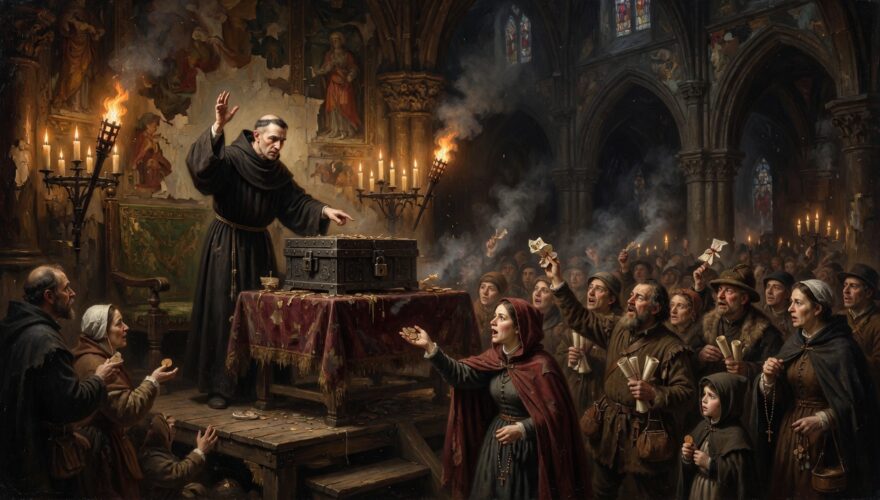
In the winter of 1517, a German monk named Johann Tetzel rode into town with a wooden box and a pitch that would have impressed a Vegas showroom. “As soon as the coin in the coffer rings,” he reportedly told the gathered crowds, “the soul from purgatory springs.” He was selling indulgences, official Catholic certificates that promised to reduce a sinner’s time in purgatory. God’s mercy, available at tiered pricing. The poor paid less. Noblemen paid more. Everyone left clutching a piece of paper, and Tetzel pocketed the proceeds for Pope Leo X’s renovation of St. Peter’s Basilica.
It was one of the most audacious fundraising operations in Western history. And the backlash it triggered burned down the religious monopoly that had governed European thought for a thousand years.
The Original Sin: Rome’s Purgatory Market
The theology was old. The commercialization was not. Since at least the twelfth century, the Church had used indulgences as a pastoral tool, a way to formally recognize acts of penance and release the penitent from temporal punishment. By the fifteenth century, however, the system had evolved into something else entirely: a revenue mechanism dressed in sacramental clothing.
Leo X needed money. St. Peter’s Basilica was under construction, its costs spiraling past anything Rome’s regular income could sustain. The solution was to authorize indulgence campaigns across Europe and take a cut of everything sold. Local bishops took their share. The Dominican friars who ran the campaigns took theirs. And Tetzel, the most gifted salesman among them, worked the German territories with the zeal of a man who believed entirely in his own product.
“The moment the money hits the chest, a soul ascends from purgatory and flies straight to heaven.”
— Attributed to Johann Tetzel, c. 1517
Martin Luther heard about Tetzel from his parishioners. People were returning from these sales events with certificates in hand and sins on their conscience, convinced they had purchased exemption from the consequences of what they had done and what they planned to do. On October 31, 1517, Luther nailed his Ninety-Five Theses to the door of the Castle Church in Wittenberg. He intended a scholarly debate. What he got was a revolution.
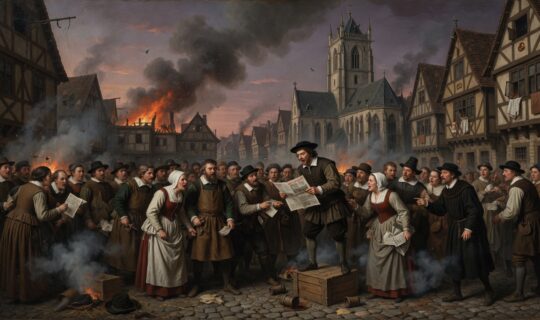
Within months, his arguments had spread across Germany by printing press, the social media of the Reformation. Within a decade, the unified Christian world of Western Europe had fractured permanently into Catholic and Protestant. Tetzel’s cash box had accidentally detonated the single biggest institutional collapse since the fall of Rome.
The Flower That Broke the Market
Move forward a century. The year is 1636 and in the Dutch Republic, grown men in wool coats are arguing over flower bulbs the way traders today argue over derivatives. A single bulb of the Semper Augustus tulip, a red-and-white striped variety prized for the flame-like streaks that ran through its petals, sold for enough guilders to buy a merchant house on an Amsterdam canal.
This was not stupidity. Or at least, not entirely. The Dutch Republic in the seventeenth century was the most financially sophisticated society on earth. They had invented the joint-stock company, the first permanent stock exchange, and the concept of futures trading. The tulip boom was, in many ways, their financial system working exactly as designed, just pointed at something gloriously absurd.
Join The Archive Briefing
Weekly dispatches. The history they didn't teach you — sourced, subverted, delivered to your inbox.

Tulip prices did not rise because people were foolish. They rose because of a fungal virus. The spectacular streaked patterns, the very feature that made a tulip rare and beautiful, were caused by a mosaic virus that made the infected bulb sterile. You could not reliably reproduce the most valuable tulips. Supply was permanently constrained. In a functioning market, that would drive prices up. And it did. The fraud was not that people valued them. The fraud was that no one knew when to stop.
By the winter of 1636-37, the tulip futures market had detached almost entirely from the underlying bulbs. Contracts changed hands in smoke-filled taverns, bought and sold by people who had never seen the actual flower. Prices had multiplied thirty-fold in a single year. Then, in February 1637, buyers in Haarlem simply stopped showing up at auction. Within days, the market had collapsed. Fortunes built over generations vanished in the time it takes a flower to wilt.
The crash was ruinous for those caught holding contracts. But the instrument they had built in pursuit of tulip profits, the futures market, the concept of trading in financial abstractions rather than physical goods… survived. It became the backbone of modern commodity trading, insurance, and eventually the entire global derivatives market. The Dutch had accidentally invented the architecture of modern finance while speculating on flowers.
The Charter, the Lie, and the Nation
The third scam is the most ambitious. It did not just reshape a market or a church. It built countries.
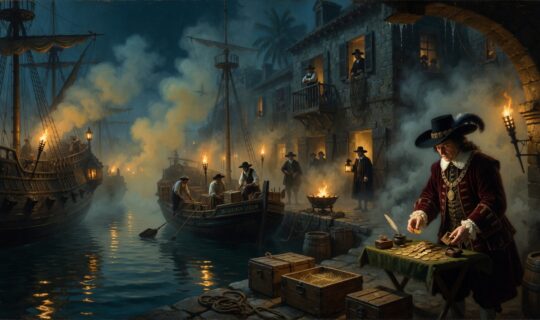
Colonial charter companies, the Virginia Company, the Dutch East India Company, the British East India Company, operated on a proposition that was, at its foundation, a legal fiction layered over a moral crime. A group of investors in London or Amsterdam would obtain a royal charter granting them exclusive rights to trade with, govern, and exploit territories that belonged to other people. They would then sell shares in this venture to the public, promising returns that bore no realistic relationship to the actual conditions awaiting settlers on the other side of the ocean.
The Virginia Company’s 1609 recruitment pamphlets described a land of extraordinary abundance. They described gold lying near the surface, indigenous peoples eager to trade, and a climate so hospitable it barely counted as hardship. Nearly 6,000 people bought in or signed up. By 1622, after a decade of starvation, disease, and violence, fewer than 1,200 remained alive in Virginia. The Company had delivered exactly none of what it promised, collected the capital of its investors, and left the survivors to improvise a colony out of catastrophe.

What survives from that failure is the United States. The legal precedents the Virginia Company established, representative assemblies, land grants, the concept of corporate governance, were absorbed into the DNA of the colonies that followed. The Virginia House of Burgesses, created in 1619 partly to appease restless colonists who had been promised self-governance by Company marketing, became the first elected legislative body in the Americas. A fraudulent prospectus gave birth to American democracy.
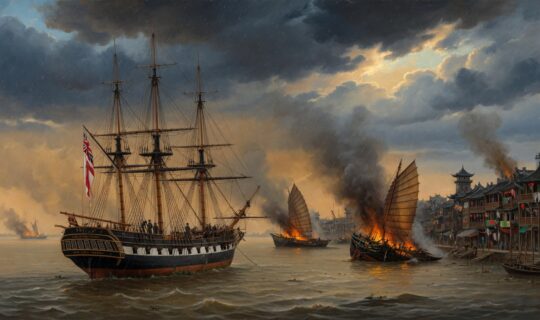
The East India Companies followed a similar arc. Investors in London and Amsterdam funded expeditions promising trade in spices and silk. What they built, inadvertently and through spectacular violence, was the institutional framework of British India and the Dutch colonial empire. The accounting systems, the legal structures, the idea that a private company could exercise sovereign power over foreign territory, all of it emerged from what was, at root, a scheme to profit from places its architects had never seen.
The Pattern in the Fraud
Three scams. Three centuries. Three very different products: salvation, flowers, futures on a distant continent. And yet the same architecture runs through all of them. A seller with a compelling story. A buyer who wants desperately to believe. A gap between what is promised and what exists. And an aftermath that reshapes the world in ways neither party anticipated or intended.
What is unsettling is not that these frauds happened. It is that the systems they built outlasted them by centuries. The Reformation that Luther triggered by attacking Tetzel’s scheme produced the intellectual framework, individual conscience over institutional authority, that underpins modern liberal democracy. The Dutch tulip market’s collapse left behind a financial architecture that runs the global economy. The charter companies’ fraudulent promises created the nation-states and legal structures most of us inhabit.
History’s lesson here is not reassuring. It does not say that honesty prevails, or that systems built on deception eventually crumble. It says something stranger. It says that sometimes, the lie is the load-bearing wall. That the structure of civilization was assembled, in part, by people who were selling something they could not deliver, and that what got built in the chaos of that broken promise turned out to be more durable than anything they intended to create.