The Aztec and Inca empires didn’t fall to swords and smallpox. They were dismantled from within. This is the brutal, overlooked truth behind the Spanish conquest. Disease is only part of the answer. The political fractures, indigenous alliances, and psychological warfare that really dismantled the Aztec and Inca empires.
The Day Their World Ended
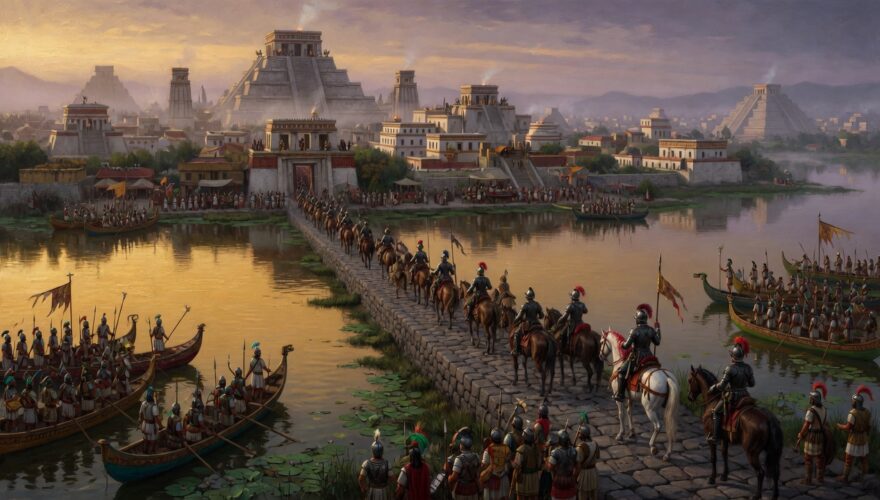
November 8, 1519. Hernán Cortés rode across a stone causeway toward Tenochtitlan, a city larger than any in Europe at the time. Around him, five hundred soldiers gripped their weapons and tried not to look afraid. Before them stretched a metropolis of two hundred thousand people, built on a lake, connected to the mainland by roads wide enough for ten men to walk abreast. Towers. Temples. Markets. The air smelled of flowers and copal smoke.
Emperor Moctezuma II came forward to greet them.
Both men understood, at that moment, that something historic and irreversible had just begun. Neither one fully understood what it would cost.
Sixteen years later, both empires, Aztec and Inca were rubble. The Aztec capital had been razed to its foundations. The Inca Emperor Atahualpa had been strangled in a public square after his subjects delivered an entire roomful of gold as his ransom, only to watch the Spanish kill him anyway.
The question that haunts historians and laypeople alike is not what happened. It’s how. How did a few hundred men badly supplied, far from home, surrounded could collapse two of the most sophisticated civilizations in the world? Disease gets most of the credit, and disease was genuinely catastrophic. But to reduce this story to germs is to misread it entirely.
The real answer is darker and more complicated. And it starts with the empires themselves.
Cracks in the Foundation
The Aztec Triple Alliance was not a beloved institution. It was an extraction machine. Tenochtitlan’s power rested on a network of conquered city-states that paid tribute in gold, grain, textiles, and human beings. Those human beings were used as sacrificial offerings, publicly, at scale. Conservative estimates suggest tens of thousands of people were sacrificed at the dedication of the Great Temple in 1487 alone, over the course of four days.
The subject peoples remembered.
Join The Archive Briefing
Weekly dispatches. The history they didn't teach you — sourced, subverted, delivered to your inbox.
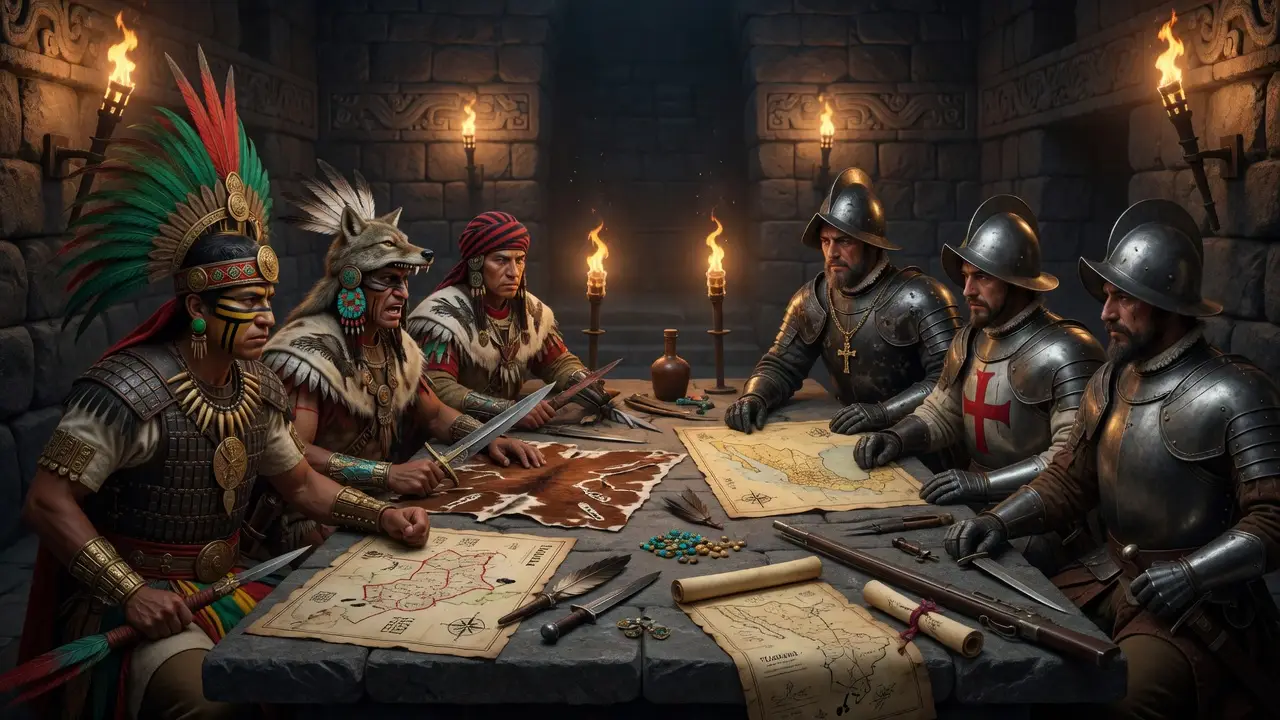
When Cortés arrived in Mexico, he didn’t land in hostile silence. He landed in an empire seething with resentment. The Totonac of Cempoala welcomed him almost immediately. The Tlaxcalans, who had never been conquered by the Aztecs, fought him ferociously at first and then made an alliance with him that would prove decisive. They provided him with tens of thousands of soldiers. Warriors who knew the terrain, knew the enemy’s tactics, knew where the supply routes were.
“This city is so great and so beautiful that I can only say I do not know how to describe its one-half.”
Hernán Cortés, in a letter to King Charles I of Spain, 1520
Cortés was not conquering Mexico. He was leading a coalition of people who had been waiting for a reason to fight back.
The Spanish brought steel swords and gunpowder and horses. The Tlaxcalans brought manpower, intelligence, and institutional rage. Neither side could have done it alone.
This is the detail that Spanish chronicles downplayed for centuries, for obvious reasons. The story of a few hundred Christians defeating a pagan empire sounded like divine providence. The story of one indigenous coalition defeating another, with European assistance, sounds like politics. Which is exactly what it was.
Francisco Pizarro and the Perfect Moment
The Inca collapse followed a different script but the same logic.
Francisco Pizarro arrived in Peru in 1532 with 168 men. The Inca Empire stretched four thousand miles along the Pacific coast, from modern Colombia to Chile. It had an estimated population of twelve million people and a professional military that had crushed every rival it had ever faced.
It was also in the middle of a civil war.
The Inca Emperor Huayna Capac had died around 1527, likely from smallpox, which had raced ahead of the Spanish like a shadow. His death triggered a succession struggle between his sons, Huascar and Atahualpa. By the time Pizarro arrived, Atahualpa had just won. He was flush with victory, camped with his army near Cajamarca, and reportedly dismissive of reports about the strange pale men with their horses and their thunder-sticks.
That dismissiveness cost him everything.
“We saw so many cities and villages built in the water and other great towns on dry land… we were amazed and said that it was like the enchantments they tell of in the legend of Amadis.”
Bernal Díaz del Castillo, The True History of the Conquest of New Spain, c. 1568
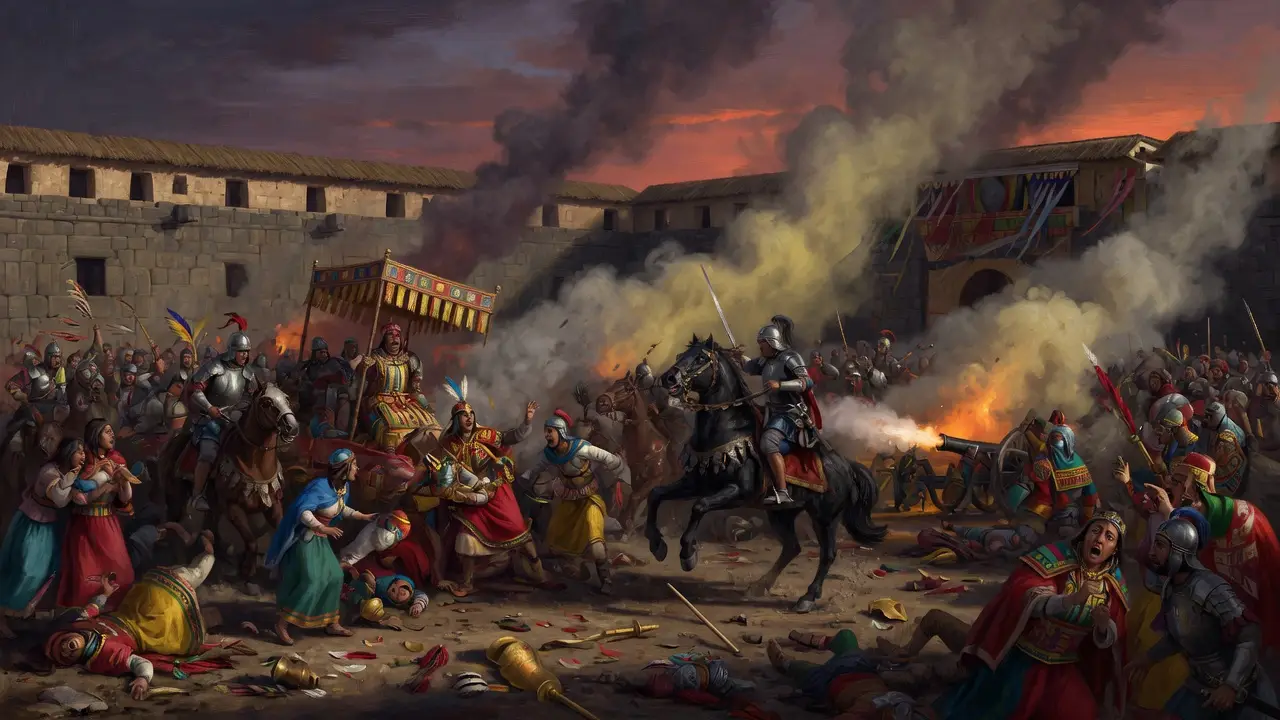
At Cajamarca on November 16, 1532, Pizarro invited Atahualpa to a meeting. The emperor arrived with thousands of attendants, ceremonially unarmed. Pizarro’s men, hidden in the buildings surrounding the square, opened fire with artillery at close range, then charged on horseback. The Inca attendants, who had never seen horses, panicked. Thousands were killed in the chaos. Atahualpa was taken alive.
It was over in two hours.
The key to understanding Cajamarca isn’t the guns or the horses. It’s that a significant faction of the Inca population had backed Huascar, and had no interest in defending Atahualpa. When the Inca administrative apparatus collapsed after the emperor’s capture, many regional lords simply waited to see what came next. Some actively collaborated with the Spanish, hoping to reclaim power from Atahualpa’s faction.
They were played for time. But they were real, and Pizarro exploited them ruthlessly.
The Horse That Rewired the Brain
There is a psychological dimension to this story that rarely gets enough attention.
The horse had been extinct in the Americas for roughly ten thousand years by the time the Spanish arrived. No living indigenous person had ever seen one. When Cortés lost a horse during an early battle, the local people found the body and were so unsettled by the creature that it temporarily stalled their response to the Spanish entirely.
During the first encounters, many indigenous warriors believed horse and rider were a single being. Early reports describe the animals as terrifying in a way that went beyond military threat, a violation of known categories, something that didn’t fit into the world as it existed. The Spanish understood this and exploited it, training their horses to charge, wheel, and rear on command specifically for psychological effect.
They take what they want from the poor Indians and no one protects them.”
Felipe Guaman Poma de Ayala, indigenous Peruvian chronicler, writing to the King of Spain, c. 1615
The guns, too, operated as much on psychology as lethality. A harquebus in 1519 was slow to load, inaccurate beyond thirty meters, and liable to misfire in rain. It was not a decisive battlefield weapon. But the sound and the smoke and the sudden death at a distance shattered something in the morale of troops who had never encountered it. Indigenous warriors who could absorb horrific casualties in conventional battle broke under artillery fire not because the casualties were necessarily worse, but because they couldn’t make sense of it.
Cortés knew this. He timed his cannon fire for dramatic effect. He staged displays. He understood that he was fighting two wars simultaneously, one with weapons and one with perception.
What Smallpox Actually Did… and What It Didn’t
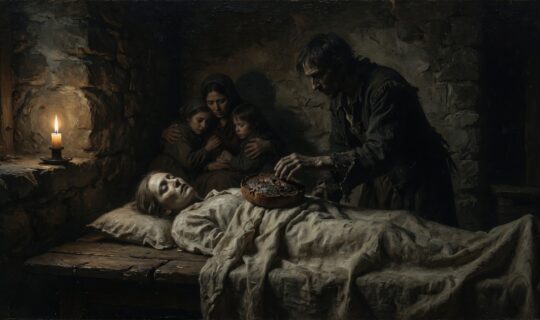
Smallpox arrived in Mexico around 1520, ahead of Cortés’s final assault on Tenochtitlan. It killed roughly half the city’s population, including Moctezuma’s successor, Cuitláhuac, who had actually managed to drive the Spanish out of the city in the Noche Triste of June 1520. That retreat was a near-catastrophic defeat for Cortés. He lost perhaps a third of his Spanish troops and most of his Tlaxcalan allies in a single night.
Disease gave him the time to recover. The epidemic that swept Tenochtitlan in the months that followed disrupted leadership, collapsed military coordination, and demoralized the population in ways that go beyond the death toll. The Aztec religious framework had no explanation for a disease that killed indiscriminately. The Spanish, who seemed largely immune, must have seemed to some like agents of something beyond ordinary warfare.
“By what authority do you tell me this? I will not leave my own faith.”
Atahualpa, upon hearing a friar’s request to accept Christianity, Cajamarca, 1532
But here is what the disease narrative misses: the Spanish won the siege of Tenochtitlan in 1521 primarily through a staggering coalition of indigenous forces. Estimates suggest between two hundred thousand and a million indigenous warriors fought alongside Cortés in the final assault. The city was systematically demolished, neighborhood by neighborhood. The canals were filled in. The causeways were held. It was a joint military operation of enormous scale, and the vast majority of the labor was done by people who had specific, personal reasons to want Tenochtitlan destroyed.
Disease created the conditions. Indigenous alliances did the work.
The Silence That Followed
After Tenochtitlan fell in August 1521, a Spanish soldier named Bernal Díaz del Castillo, who had been there for all of it, tried to describe what the silence felt like. He wrote that the city smelled of death, that the survivors walked among the rubble like ghosts, and that even the conquistadors could find no words for what they had done.
The Inca empire took another forty years to fully extinguish. A remnant state held out in the mountains of Vilcabamba until 1572. The last Inca emperor, Túpac Amaru, was captured and publicly beheaded in the main square of Cuzco while his supporters watched. Spanish accounts note that the crowd wept.
Some of those who wept had helped build what replaced him.
That is perhaps the most uncomfortable truth at the center of this story. The empires fell not simply because the Spanish were unstoppable. They fell because they had enemies within, people who made calculated decisions to align with the newcomers, who believed they could use the Spanish for their own ends and reclaim power afterward. Some did. Most didn’t. But they were rational actors, not passive victims, and their agency is part of the story whether we acknowledge it or not.
The Echo You Can Still Hear
The patterns established in the sixteenth century did not end there. The political logic of empire, the way dominant powers exploit internal fractures, the way alliances shift based on who seems to be winning, the way technology shock shapes psychological as much as physical outcomes, all of it has played out again, in different configurations, across five centuries since.
Understanding how the Aztec and Inca empires actually fell is not a lesson in European superiority. It is a lesson in how power works. How it fractures from within before it collapses from without. How the people who survive catastrophe are often the ones who made difficult choices that history will judge ambivalently forever.
Cortés entered Tenochtitlan with five hundred men. He left with a continent. But he didn’t do it alone, and the people who helped him were not simply betraying their own. They were trying to survive in a world that had just been turned upside down.
They chose wrong. Or they chose the only thing they could. Depending on your perspective, which is, in the end, how history always works.