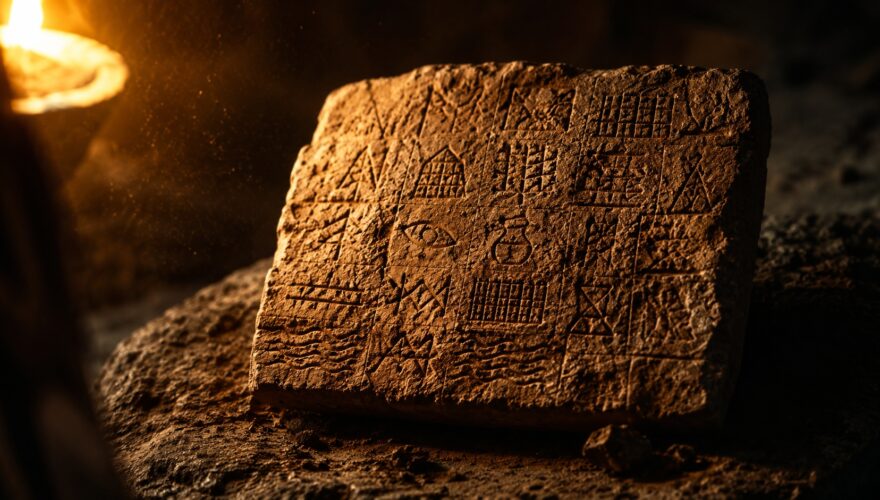
Decoding the Vinča Symbols – Everything we’ve been taught about the birth of civilization might be wrong. Long before Sumerian scribes pressed reeds into wet clay, long before a single hieroglyph was carved into an Egyptian tomb wall, a farming culture on the banks of the Danube was already scratching strange, orderly marks into pottery and bone. Three small tablets pulled from a Romanian pit in 1961 reignited a question archaeology has never fully answered: did writing begin in the fertile deserts of Mesopotamia, or on a muddy riverbank in the Balkans that history simply forgot to credit?
The Dawn of the Danube Script
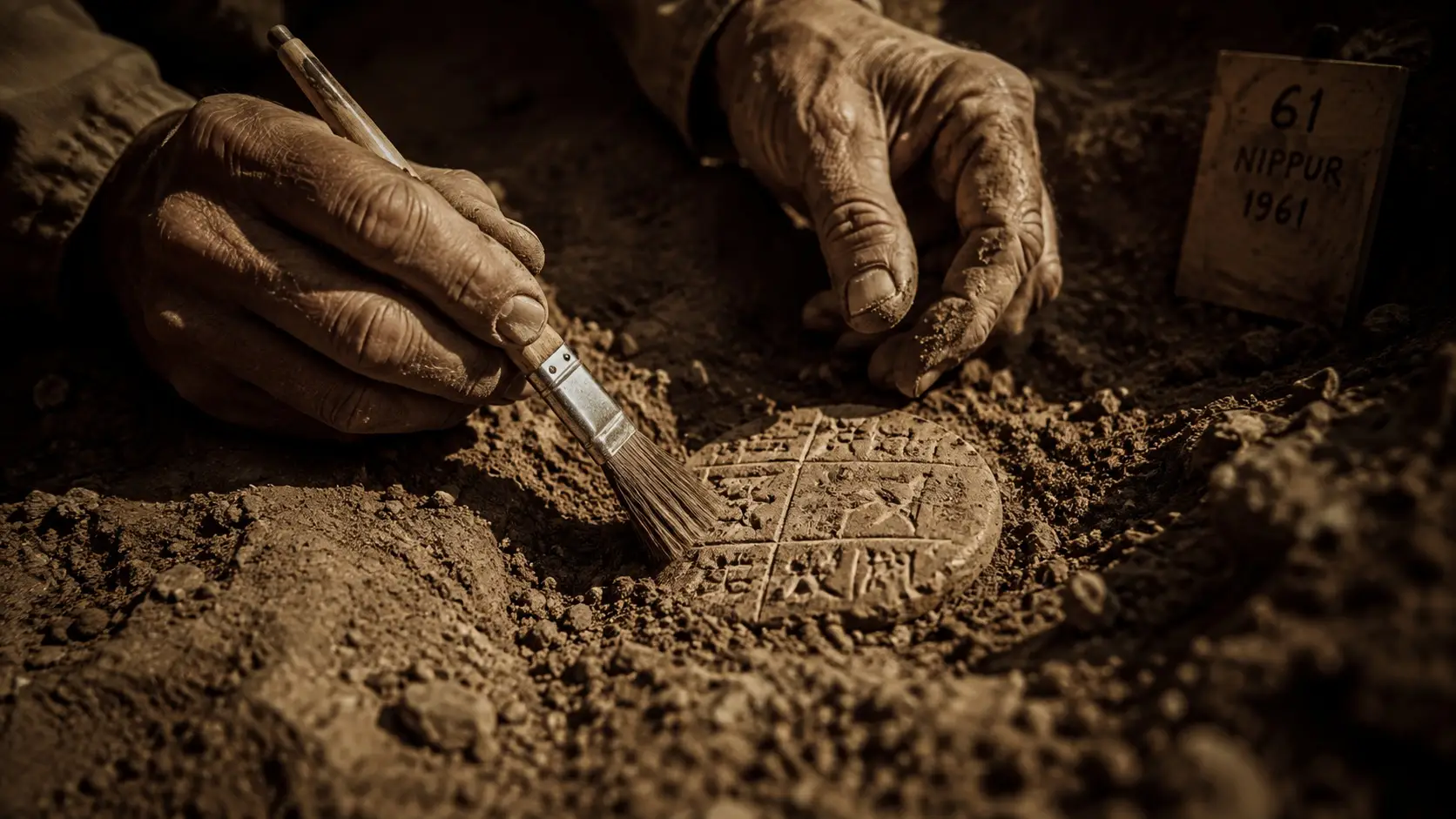
In September 1961, archaeologist Nicolae Vlassa was excavating a Neolithic site near the village of Tărtăria in Transylvania when his team uncovered something that shouldn’t have made sense. Buried alongside 26 clay and stone figurines, a shell bracelet, and the broken, burnt bones of an adult whose remains would later earn the nickname “Milady Tărtăria,” sat three small unfired clay tablets. Two were rectangular. One was a round disc barely six centimeters across. All three carried symbols scratched into their surfaces with a confidence that looked, unmistakably, like intention.
Vlassa believed one tablet showed a hunting scene, and that the other two carried something closer to writing, signs that echoed the earliest Sumerian pictographs. The trouble was timing. If the layer the tablets came from really did date to around 5300 BC, as some later estimates suggested, that would place them roughly two thousand years before Sumer’s earliest proto-cuneiform marks scratched onto clay in Uruk.
For a discipline that had spent a century treating Mesopotamia as the undisputed birthplace of the written word, that was not a small claim. It was a demotion for the cradle of civilization itself.
The people who made these tablets were not wandering bands scraping by on the margins of history. The Vinča culture, named for the riverside site of Vinča-Belo Brdo near modern Belgrade, built some of the largest settlements anywhere in Neolithic Europe. The site of Pločnik in Serbia sprawled across 120 hectares, its houses fitted with stoves and dedicated rubbish pits, its residents wrapped in wool, flax, and leather, their dead laid to rest in organized cemeteries rather than scattered graves. Nearby, at Belovode, archaeologists found evidence of copper smelting dating back roughly 7,000 years, the earliest known metallurgy on the planet. This was not a culture stumbling in the dark. This was a culture experimenting with the future.
So the question that has haunted archaeology for over sixty years refuses to go away quietly. Were these marks decoration, the Neolithic equivalent of a maker’s signature or a lucky charm? Or were the Vinča people already doing something no one else on Earth had thought to do, turning sound and meaning into something that could survive its speaker’s death?
Decoding the Sacred Geometry
Look past the Tărtăria tablets and the wider Vinča symbol corpus opens up into something stranger and richer. Archaeologists have catalogued well over 200 distinct recurring signs across more than a thousand inscribed objects, etched into pottery rims, carved into the base of anthropomorphic figurines, incised along spindle whorls used for spinning thread. Crosses, chevrons, combs, meanders, spirals. Some symbols appear alone, isolated on a single object like a stamp. Others cluster into short sequences, two or three signs deep, arranged with a rhythm that feels deliberate rather than random.
Join The Archive Briefing
Weekly dispatches. The history they didn't teach you — sourced, subverted, delivered to your inbox.
That rhythm is exactly what has drawn a new generation of researchers back to the problem. Over the past couple of years, teams have started running the Vinča corpus through computer vision models and pattern recognition software, the same broad family of tools now being used to attack other unsolved scripts, from the Indus Valley signs to fragments of oracle bone Chinese. Early findings from this computational push have flagged clusters of signs that repeat in consistent positions relative to each other, the kind of structural regularity you’d expect from a genuine notation system, not idle doodling.
None of it amounts to a decipherment. No one has produced a sentence anyone can read. But the pattern analysis has been enough to push a stubborn old question back onto serious tables: were these marks tracking something, tallying grain, marking ownership of livestock, recording which family a pot belonged to, or naming the lineage that made it?
It’s a theory that fits the moment archaeologically. Vinča communities were trading obsidian, shells, and copper across hundreds of kilometers. A growing, prosperous, interconnected society is exactly the kind of place where someone eventually needs a way to remember who owes what to whom.
Ritualized Literacy and the Goddess Cult
But there’s a complication, and it’s the detail that keeps this mystery from resolving into a tidy story about early bookkeeping. The vast majority of inscribed Vinča objects aren’t ledgers. They’re figurines. Squat, big-hipped, often faceless female forms, thousands of them, found in homes, in pits, buried beneath thresholds. Many carry symbols on the chest, the buttocks, or along the back, precisely where a mark would be seen during ritual handling rather than casual use.
Lithuanian-American archaeologist Marija Gimbutas spent decades arguing that this entire symbolic universe belonged to a coherent, goddess-centered spiritual world she called Old Europe, a culture she believed was peaceful, agrarian, and organized around reverence for a life-giving female divinity long before patriarchal Bronze Age societies swept in and buried that worldview under their own gods. Gimbutas insisted the archaeological record itself was trying to tell us something, if we were willing to listen.
“Archaeological materials are not mute. They speak their own language,” she wrote, and whatever you make of the rest of her theory, that line captures exactly why this mystery refuses to die. Every incised spiral and chevron on a Vinča figurine reads less like an invoice and more like a prayer, or a name spoken to something unseen.
That tension sits at the heart of the whole debate. If writing began here, it may not have begun as bureaucracy at all. It may have begun as liturgy, a way of marking objects as sacred, of binding a symbol to a spirit rather than a number to a sack of barley. Which raises an uncomfortable possibility for anyone attached to the tidy textbook version of history: maybe literacy’s first job wasn’t commerce. Maybe it was worship, and Mesopotamia only got there first because its priests happened to also be its accountants.

The Great Chronology Conflict
Here is where the story stops being a clean underdog narrative and turns into a genuine academic brawl, one that’s been running since the tablets first left the ground.
The chronology fight has two separate layers, and it’s worth untangling them. The first is about the tablets themselves. Because they were made of unfired clay, they cannot be carbon-dated directly. Their age depends entirely on the layer they were found in and the organic material recovered alongside them, and critics have spent decades arguing the site’s stratigraphy was disturbed, that the tablets may have slipped down from a much later layer during the original dig, or been deposited during a burial that cut through older soil. If that’s true, the tablets could be centuries younger than the dramatic 5300 BC estimate, close enough in time to Mesopotamian writing that the “Europe got there first” claim collapses entirely.
The second layer is broader and more ideological. Twentieth-century radiocarbon dating on Neolithic Balkan sites kept returning dates uncomfortably early for a scholarly establishment that had built its entire framework around the Near East as the engine room of human progress. For years, those early dates were treated as anomalies, glitches, results to be quietly set aside rather than reckoned with. It’s only in the last couple of decades, helped along by better excavation standards, ancient DNA studies, and now computational symbol analysis, that the European early-dating evidence has forced its way back into mainstream conversation rather than being waved off as fringe enthusiasm.
Nobody serious is declaring the debate settled. The honest scholarly position today remains cautious, genuinely undecided between calling this proto-writing, a ritual notation system, or something that never crossed the threshold into language at all. But cautious is not the same as closed. And the fact that this argument is still alive, still capable of making trained archaeologists raise their voices at conferences, tells you how much is actually at stake. Move the birthplace of writing from the Tigris and Euphrates to the Danube, and you don’t just redraw a map. You rewrite who gets to be called the ancestor of the written word.
Legacy of a Forgotten Revolution
Whatever the Vinča symbols were, they didn’t last. Around 4500 BC, the great Vinča settlements began to empty out. Sites like Vinča-Belo Brdo and Divostin, which had once housed thousands, were abandoned or transformed beyond recognition. Archaeologists still argue over why, pointing to shifting climate, changing farming pressures, and later waves of migration from the Pontic steppe that reshaped Europe’s population and its languages. Gimbutas famously blamed an invasion of horse-riding, patriarchal newcomers for extinguishing Old Europe’s goddess culture outright, a claim modern archaeology treats with real skepticism even as ancient DNA studies confirm that steppe migrations genuinely did reshape the Balkans in this period.
Whatever caused it, the symbol system went quiet with the culture that made it. It never evolved into the alphabet we use today. That lineage runs through the Phoenicians more than a thousand years later, an entirely separate invention with no demonstrated connection to the marks scratched onto Vinča pottery. If this was writing, it was a false start, a door that opened and then shut again for two thousand years before anyone in Europe tried to write anything down once more.
Related tablets keep surfacing across the region, the Gradeshnitsa tablets in Bulgaria, the Dispilio tablet pulled from a lakebed in northern Greece, each one a reminder that whatever happened at Tărtăria wasn’t an isolated fluke but part of a shared symbolic culture stretching across the wider Balkans. Some researchers have pushed the comparisons much further afield, drawing lines all the way to the Indus Valley script thousands of kilometers away. That claim sits well outside the mainstream and deserves real skepticism, but it shows how hungry this field still is for a bigger picture, a sense that Old Europe wasn’t as isolated as the old textbooks assumed.
Maybe that’s the real reason this story keeps resurfacing every few years, in a new journal paper, a new documentary, a new AI model trained to hunt for patterns human eyes missed. It isn’t really about whether one culture beat another to an invention by a couple of millennia. It’s about what we assume when we decide a people were “primitive.” The Vinča built cities before the word existed. They smelted copper before the Bronze Age had a name. And they may have looked at a symbol, scratched into wet clay by firelight, and understood it the way we understand a word on a page, as something that could outlive the hand that made it.
We still can’t read what they wrote. But we’re no longer sure they weren’t writing.