The ancient Greeks built temples to gods they were quietly dismantling in philosophy, theater, and history. From Xenophanes to Euripides to Socrates, classical Greece’s greatest minds treated the myths as metaphor, not gospel. Here’s the truth behind a mythology we often praise without fully understanding.
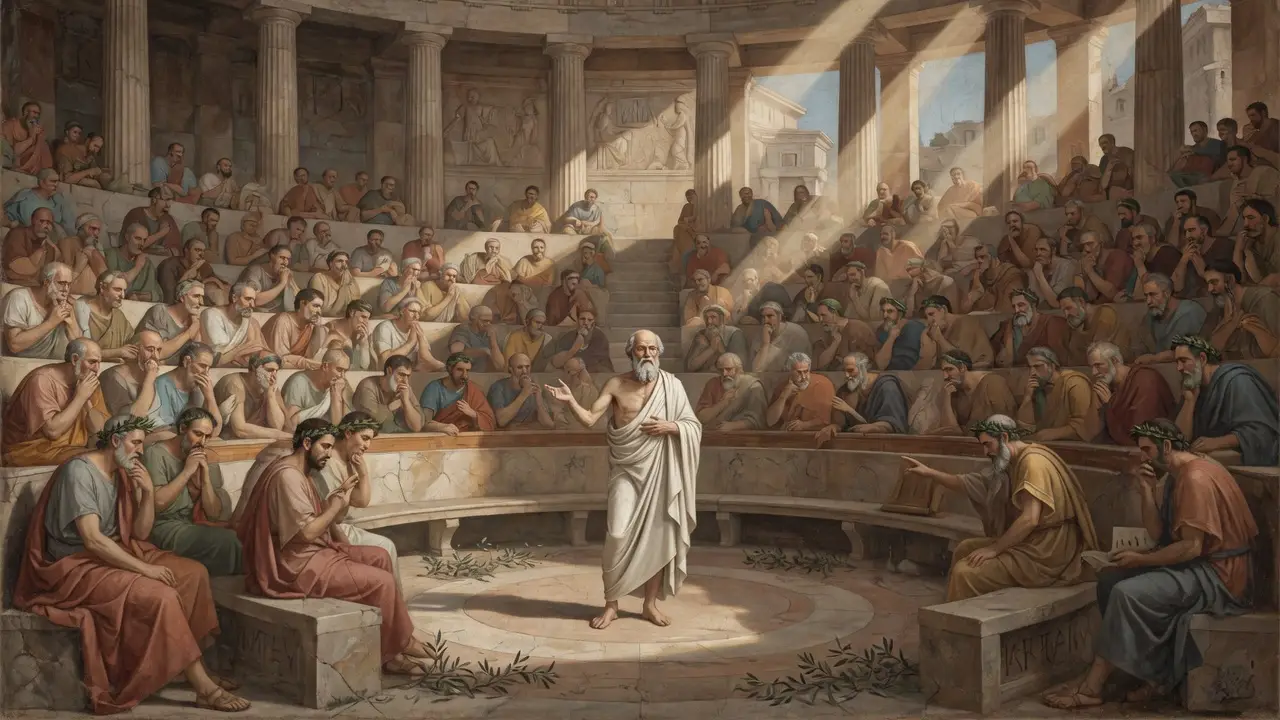
In 399 BC, a seventy-year-old man stood before five hundred of his fellow Athenians and was sentenced to death. His crime, officially, was impiety. He had corrupted the youth. He had failed to honor the gods of the city.
Socrates drank the hemlock. The gods of Athens were avenged.
Except Socrates wasn’t an isolated eccentric. He was the product of a culture that had been quietly, systematically doubting its own gods for over a century. The trial wasn’t Athens defending a faith. It was a city having a nervous breakdown over the fact that its most educated citizens had long since moved past the gods, and couldn’t stop saying so out loud.
The mythology we’ve inherited, the one that fills our museums and blockbuster films and children’s books, the gods hurling thunderbolts, Odysseus cursed across a wine-dark sea, the Minotaur waiting in the dark, was not, for the Greeks who created it, a religion in any sense we’d recognize. For many of them, it was something closer to literature. Useful. Powerful. Not necessarily true.
The Religion We Think We Know
There’s a version of ancient Greece that lives in the popular imagination: a world soaked in divine belief, where priests read the entrails of animals to find the will of Zeus, where every storm was Poseidon’s mood and every plague was Apollo’s punishment, where the gods were real and everyone knew it.
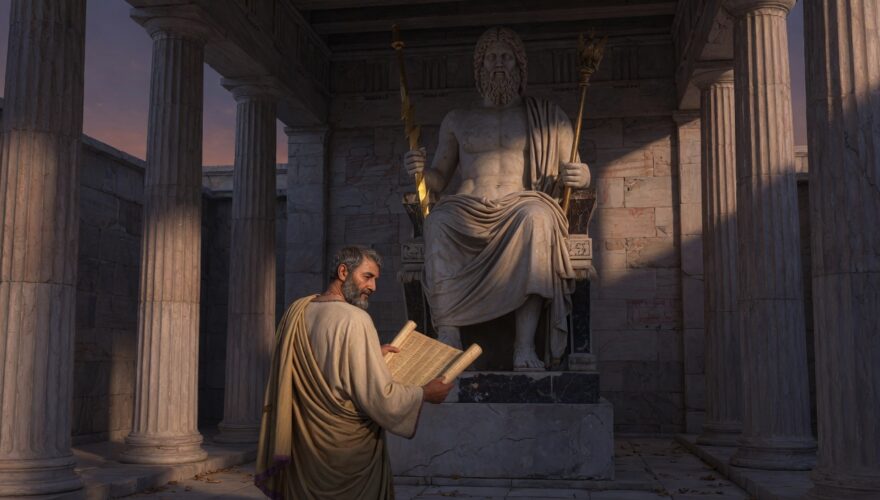
Parts of that are true. Temples were built. Sacrifices were made. The Oracle at Delphi drew visitors from across the Mediterranean world. Public religion was very much alive.
But there’s a critical difference between performing religious rituals, which was a civic duty, a form of social belonging, a mark of being a proper Greek citizen, and actually believing that Zeus sat on a gold throne on Olympus and personally intervened in human affairs. And for the philosophers, the playwrights, and the historians who defined Greek intellectual culture, the gap between those two things was enormous.
Join The Archive Briefing
Weekly dispatches. The history they didn't teach you — sourced, subverted, delivered to your inbox.
They participated in the religion. They just didn’t believe the stories.
The Philosophers Who Lit the First Match
It started early, well before Socrates made it famous.
Around 570 BC, a philosopher named Xenophanes of Colophon noticed something that nobody around him seemed to want to say. The gods looked suspiciously like whoever was describing them. “The Ethiopians say their gods are flat-nosed and black,” he wrote. “The Thracians say theirs have blue eyes and red hair.” His conclusion was devastating in its simplicity: if horses and oxen could draw pictures, they’d draw gods that looked like horses and oxen.
LESSER-KNOWN DETAILS
Anaxagoras, a close friend of Pericles (the most powerful man in Athens during its golden age), was exiled from Athens for saying the sun was not a god but a burning rock larger than the Peloponnese. This happened in approximately 434 BC, decades before Socrates. The charge was the same: impiety.
Xenophanes wasn’t an atheist. He believed in some kind of divine principle. But he was openly contemptuous of Homer and Hesiod, the two poets whose works were the closest thing Greece had to a sacred scripture, for filling their stories with gods who lied, committed adultery, and stole from each other. “Homer and Hesiod,” he wrote, “have attributed to the gods everything that is shameful and disgraceful among men: theft, adultery, and deception.”
He said this in public. He kept his head.
Xenophanes was the opening shot. What followed was a sustained, centuries-long intellectual assault on the literal content of Greek mythology, carried out not by heretics on the fringes but by the most celebrated minds in the Greek world.
Heraclitus, the brooding philosopher from Ephesus, called Homer a fraud who deserved to be expelled from public competitions. Plato, who wrote some of the most beautiful prose in the ancient world and whose influence on Western civilization is almost impossible to overstate, dedicated large sections of the Republic to arguing that the poets were dangerous. The myths were lies, he said. They depicted gods behaving badly, and the young would imitate what they admired. He wanted the stories censored.
The man who wanted to censor Homer didn’t believe Homer’s gods were real. He was worried about the stories as fiction, as cultural narrative, as the kind of thing that shapes character. That’s a thoroughly modern concern. It has nothing to do with faith.
What the Playwrights Actually Did
The theater of Athens is where the myths lived in their most vivid, most emotionally potent form. Sophocles, Euripides, Aeschylus: these men put Oedipus and Medea and Orestes on stage and broke audiences open with them. If any group of people should have been true believers, it was the tragedians.
Euripides wasn’t.
He was the most subversive playwright of the classical age, and the most popular. In his hands, the gods became something uncomfortable. They weren’t majestic. They were petty, vindictive, arbitrary. Hecuba, the Trojan queen destroyed by a war the gods engineered, gets no divine consolation, no cosmic justice. There isn’t any. Hippolytus is destroyed because Aphrodite is irritated. Not punished for a transgression. Destroyed because a goddess was in a bad mood.
Euripides kept letting his characters say, quietly but unmistakably, that the gods of the myths couldn’t be what they were claimed to be. “If gods do evil,” one character asks, “then they are not gods.” The line lands like a stone dropped into still water. The audience would have felt it.
LESSER-KNOWN DETAILS
Theodorus of Cyrene, sometimes called the first explicit atheist in the ancient world, reportedly said “what is considered just or shameful is a matter not of nature but of convention.” He survived without punishment.
He was criticized for it constantly. Aristophanes mocked him in comedy after comedy. But Euripides was also the playwright whose works were most requested by Macedonian and Sicilian courts, whose lines prisoners of war quoted to earn their freedom, whose influence outlasted every other tragedian. The Greeks who loved him most weren’t disturbed by his theological skepticism. They recognized something true in it.
The Historians Who Treated Myth as Source Material, Not Gospel
Thucydides, writing his account of the Peloponnesian War in the late fifth century BC, sets out his methodology in the opening pages with a clarity that still reads as startlingly modern. He is writing about what actually happened, he explains, and this is difficult, because people don’t always remember correctly, and they have self-serving reasons to misremember. The mythological past, the age of heroes, is even harder to verify. He treats the Trojan War not as divine history but as a historical event that has been heavily embellished.
He never calls the gods false. He just treats them the way a serious journalist treats unverified sources: with careful distance.
Herodotus, often called the father of history and frequently criticized by later writers for being too credulous, is more complex. He records myths and religious traditions from dozens of cultures, Greek and foreign alike. But he records them as traditions, as things people believe, not as accounts he’s endorsing. He notes, with what feels like deliberate dryness, that divine explanations and human explanations often exist side by side, and he declines to arbitrate between them.
This wasn’t agnosticism from cowardice. It was a sophisticated intellectual position: the stories matter because people believe them and act on them. Whether they are literally true is a different, possibly unanswerable question.
The Quiet Heresy That Was Hiding in Plain Sight
Here’s what makes all of this remarkable: it wasn’t hidden.
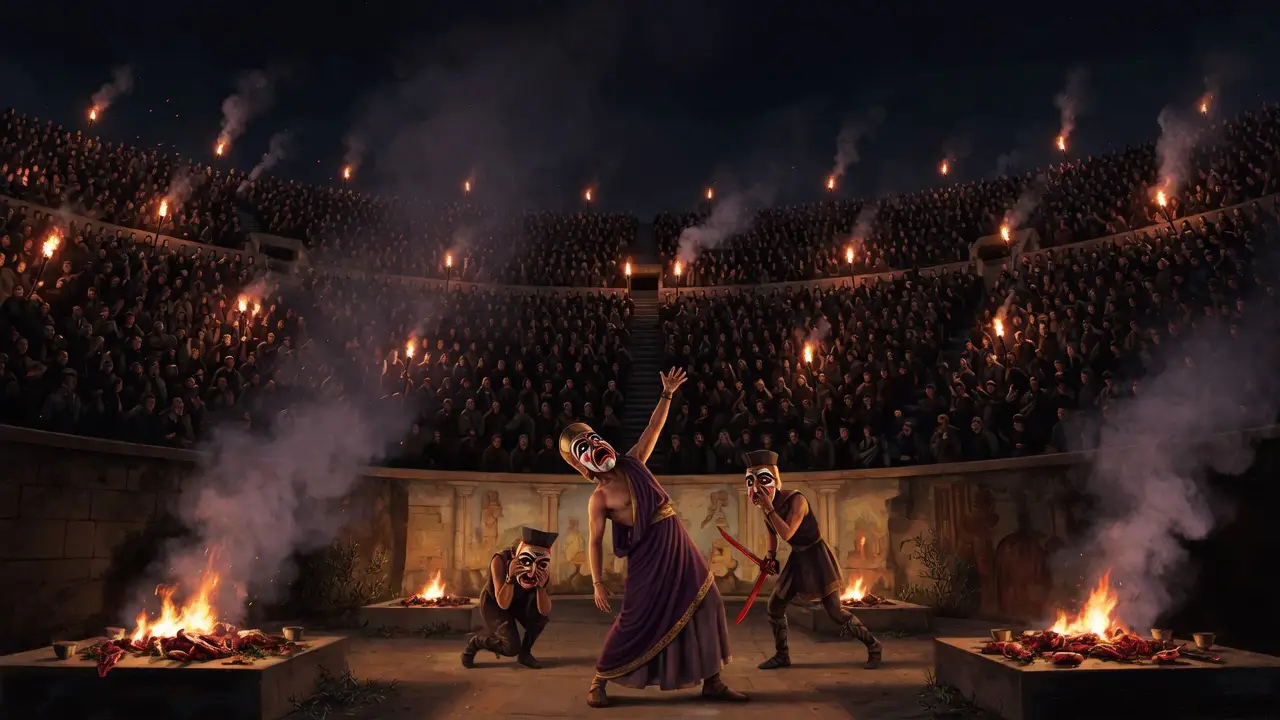
These weren’t whispered heresies passed between trusted friends in private homes. Euripides performed his skeptical plays at the Festival of Dionysus, in front of tens of thousands of Athenians, as part of a state religious celebration. Plato published his critiques of mythology and let them circulate. Xenophanes performed his philosophical poems at symposia, the social gatherings that were the intellectual heart of Greek civic life.
LESSER-KNOWN DETAILS
The Greek word for actor, hypokrites, is where we get “hypocrite.” It originally just meant someone who answers, or a performer. The Greeks were deeply aware of the performance dimension of public religion.
The Greeks had a concept they called allegoresis, reading the myths as allegories for deeper truths. The gods weren’t literally beings who interfered in human affairs; they were symbols. Zeus was reason, or the sky, or the principle of cosmic order. Aphrodite was the force of desire. Ares was the spirit of conflict. This allowed educated Greeks to participate in public religion while maintaining private skepticism. You could sacrifice to Aphrodite at her temple and simultaneously believe that what Aphrodite “really” represented was the irrational pull of human longing.
This is not belief. This is something more sophisticated, and more modern, than belief.
The One Man They Actually Killed
So why did they execute Socrates?
Because he pushed too far, too publicly, in a city traumatized by defeat. Athens had just lost the Peloponnesian War. It had suffered a plague that killed perhaps a quarter of its population. It had endured the catastrophic Sicilian Expedition, a military disaster of almost incomprehensible scale. The city was raw and frightened and looking for explanations.
Socrates had spent decades doing what the philosophers and playwrights had done, questioning received wisdom, poking at the assumptions underneath public piety, exposing the gap between what people professed to believe and what they actually knew. But he did it face to face, in the markets and gymnasiums, with real people who went home and told their fathers what he’d said.
The trial of Socrates wasn’t really about theology. It was about political anxiety expressed through a religious charge. His execution was the exception that proves the rule: for most of Greek history, in most of its cities, a remarkable degree of philosophical freedom was not just tolerated but celebrated.
The irony is almost too neat. The city that killed him for impiety had been producing impious philosophers for over a century without anyone losing their head.
Why the Myth of the Myths Persists
We romanticize Greek religion because we encounter it aesthetically. The gods are beautiful. The stories are gripping. The temples are architectural marvels that still stop people in their tracks. We approach the mythology the way we’d approach a great novel, suspended in willing belief, and we assume the Greeks did too.
LESSER-KNOWN DETAILS
Prodicus of Ceos argued, around 400 BC, that the gods were originally just names humans gave to useful things: bread was called Demeter, wine was called Dionysus. This theory, that gods are deified human inventions, is called Euhemerism. It was controversial. It was also widely discussed and not suppressed.
But the Greeks who built the Parthenon and staged the tragedies and wrote the philosophical dialogues were doing something harder and stranger than believing. They were living inside a cultural framework that everyone maintained publicly and many questioned privately, using the myths as shared language, as artistic material, as civic glue, while the intellectual class picked the theology apart with the systematic enthusiasm that characterizes every great period of human inquiry.
They were, in short, people. Complicated, contradictory, performing one thing and thinking another. Exactly like us.
The gods of Olympus didn’t fall when Christianity arrived. They had been quietly vacating the premises for centuries before that, replaced not by another faith but by philosophy, by drama, by history, by the stubborn human habit of asking what is actually, demonstrably, undeniably true.
The Greeks gave us that habit. It may be the most honest thing they ever did.