Before the telegraph, before the telephone, before anything we call modern, ancient empires solved the same problem every civilization faces: how do you rule what you cannot see? From the Persian Royal Road to Inca mountain runners, these forgotten courier networks were the original internet, and they changed the world.
- 1 Ancient Empires Moved Information Faster Than Armies
- 2 Before the Wire, There Was the Road
- 3 The Royal Road: Darius and the World’s First Postal Highway
- 4 Cursus Publicus: Rome’s State-Run Postal Machine
- 5 The Yam: Mongol Speed and the Terror of Connectivity
- 6 The Chasqui: Runners in the Sky
- 7 The Intelligence Hidden in the System
- 8 When the Lines Go Down
- 9 What the Runners Left Behind
Ancient Empires Moved Information Faster Than Armies
The message left Persepolis before dawn.
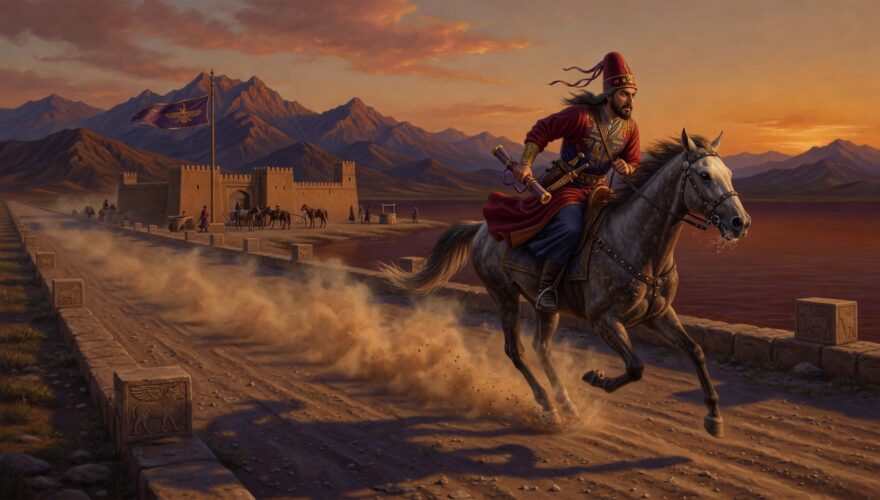
A rider on a fresh horse, carrying a clay-sealed dispatch from Darius the Great himself, thundered out of the capital and into the dark. He would ride hard for roughly fifteen miles before pulling up at a stone relay station on the Royal Road. Another horse waited. Another rider stood ready. The original messenger handed off the dispatch, barely slowing down, and within seconds the second rider was gone, swallowed by dust and distance.
By the time most of Persia’s citizens had finished breakfast, that message was already two hundred miles away.
This was not magic. It was engineering, discipline, and an understanding that power without communication is just geography. Every great empire in history faced the same brutal problem: how do you rule territory you cannot physically stand in? The answer, across cultures separated by oceans and centuries, was almost identical. You build a nervous system. You create a courier network so reliable, so fast, and so ruthlessly organized that information moves faster than armies.
They called it different things. The Persians called it the Angarium. The Romans had the cursus publicus. The Mongols built the Yam. The Inca had chasqui runners who covered Andean mountain passes at a sprint. But every empire arrived at the same truth: the one who controls the flow of information controls everything.
Before the Wire, There Was the Road
It’s easy to romanticize ancient empires as collections of monuments and battles. What actually held them together was logistics, specifically the unglamorous, thankless, daily grind of moving information across hostile terrain before anyone had invented anything faster than a horse.
Consider the scale of the problem. The Persian Empire under Darius stretched from the Aegean coast of modern Turkey to the borderlands of India. The Roman Empire at its height wrapped around the entire Mediterranean and pushed deep into Britain and the Middle East. The Mongol Empire was the largest contiguous land empire in history. The Inca controlled a thin, vertical strip of South America running more than two thousand miles along some of the most punishing mountain terrain on earth.
Join The Archive Briefing
Weekly dispatches. The history they didn't teach you — sourced, subverted, delivered to your inbox.
Without fast, reliable communication, none of these empires could function. Tax records go uncollected. Rebellions go unanswered. Armies march on outdated orders and get slaughtered. The center cannot hold. So every civilization, independently, built systems to move words across space at the fastest speed their technology allowed.
What they built was extraordinary.
The Royal Road: Darius and the World’s First Postal Highway
Around 500 BCE, Darius I of Persia ordered the construction of a road stretching approximately 1,700 miles from Susa to Sardis. The Royal Road was not simply a trade route. It was a command-and-control infrastructure, built specifically so that the Persian king could govern his empire in something approaching real time.
Every fifteen to twenty miles along the Royal Road, the Persians installed a relay station, called a chapar-khaneh. Each station held fresh horses, fresh riders, and supplies. A message could be handed from one courier to the next, around the clock, without the information ever stopping to rest. The road also featured inns for slower official travelers, guard posts, and bridges at river crossings.
“Neither snow nor rain nor heat nor gloom of night stays these couriers from the swift completion of their appointed rounds.”
Herodotus on the Persian couriers (c. 440 BCE)
The Greek historian Herodotus clocked the result. A journey that took an ordinary traveler ninety days by foot or cart could be covered by the royal courier system in a week. He wrote, with undisguised admiration, that neither snow nor rain nor heat nor gloom of night stays these couriers from the swift completion of their appointed rounds. You may recognize that line. The United States Postal Service borrowed it for their unofficial motto roughly 2,400 years later.
But the Royal Road was not purely about speed. It was about surveillance. Every dispatch passing along the road was theoretically readable by Persian officials at any relay station. The empire’s governors, called satraps, received their orders via the road and sent their reports back the same way. The road was the empire’s bloodstream and its listening device simultaneously.
“Cyrus first established the postal system, having calculated how far a horse can travel in a day without tiring, and placed stations at each such interval, with men and horses always ready.”
Xenophon on Persian road communications (c. 370 BCE)
Persian relay riders were among the most respected government employees in the empire. They carried a document called a halmi, essentially a royal passport, which gave them the right to commandeer horses, food, lodging, and assistance from any citizen they encountered along the road. Refusing a halmi-bearing courier was a crime. The courier was, in a very literal sense, the voice of the king moving through the landscape.
Cursus Publicus: Rome’s State-Run Postal Machine
The Romans studied the Persians, admired what they built, and then, in the Roman way, made it larger, more bureaucratic, and more indispensable to the functioning of the state.
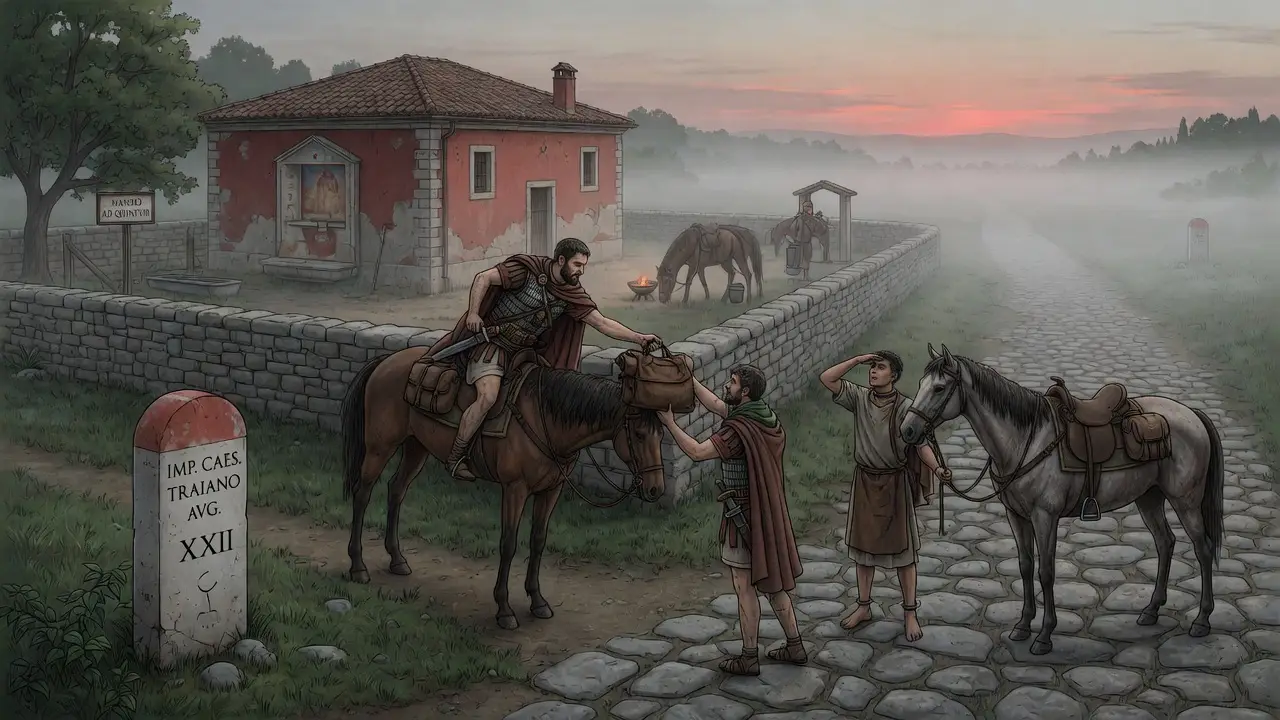
Emperor Augustus formalized the cursus publicus, the “public course,” sometime around 20 BCE. It was the largest organized communication network the ancient Western world had ever seen, stretching across forty thousand miles of paved Roman road. Augustus initially designed it to move his personal dispatches. Within a generation, it had become the operating system of the entire empire.
The cursus publicus ran on two speeds. The cursus velox, the fast course, used mounted riders changing horses at relay stations called mutationes, spaced roughly seven to twelve miles apart. A fast dispatch could cover fifty miles a day, sometimes more in emergencies. The cursus clabularis, the slow course, used ox-drawn wagons to haul heavier cargo, official documents in bulk, and government officials traveling on state business.
Stations along the road were not crude shelters. Major stopping points, called mansiones, were full guesthouses with stables, kitchens, baths, and veterinary facilities for the horses. The Roman government maintained these at enormous expense because they understood something most rulers forget: a communication network is only as reliable as its infrastructure on the worst day of the year, not the best.
“By this means the emperor received news of a defeat on the frontiers before the sound of the engagement had died away.”
Procopius on the cursus publicus under Justinian (c. 550 CE)
Access to the cursus publicus was strictly controlled by a document called the diploma or evectio, issued personally by the emperor or a high official. Forging one was a capital offense. The emperor Hadrian once executed a provincial official discovered using a counterfeit evectio to move personal goods on the state relay system. The network existed for the empire, not for private enrichment, and Rome enforced that distinction violently.
The courier system’s reach created a peculiar intimacy across enormous distance. A letter sent from Rome to Roman Britain would take roughly a month under normal conditions. A military emergency dispatch could cut that significantly. The Emperor Marcus Aurelius reportedly dictated his philosophical notes, the collection we now call the Meditations, during military campaigns in the field, and those dispatches reached Rome in weeks. The man who wrote “you have power over your mind, not outside events” ran an empire partly through a courier system sophisticated enough to carry his private thoughts across a continent.
The Yam: Mongol Speed and the Terror of Connectivity
When the Mongols arrived, they brought conquest and destruction that still echoes through history. What they also brought, paradoxically, was a communication network of such sophistication that the Chinese, Persian, and Russian bureaucracies they absorbed were immediately made more functional, not less.
Genghis Khan established the core of what would become the Yam system during the early decades of the thirteenth century. His grandson Kublai Khan expanded it into something genuinely astonishing: a relay network stretching across the entire Mongol Empire, from the Pacific coast of China to the steppes of Eastern Europe, a distance of roughly five thousand miles.
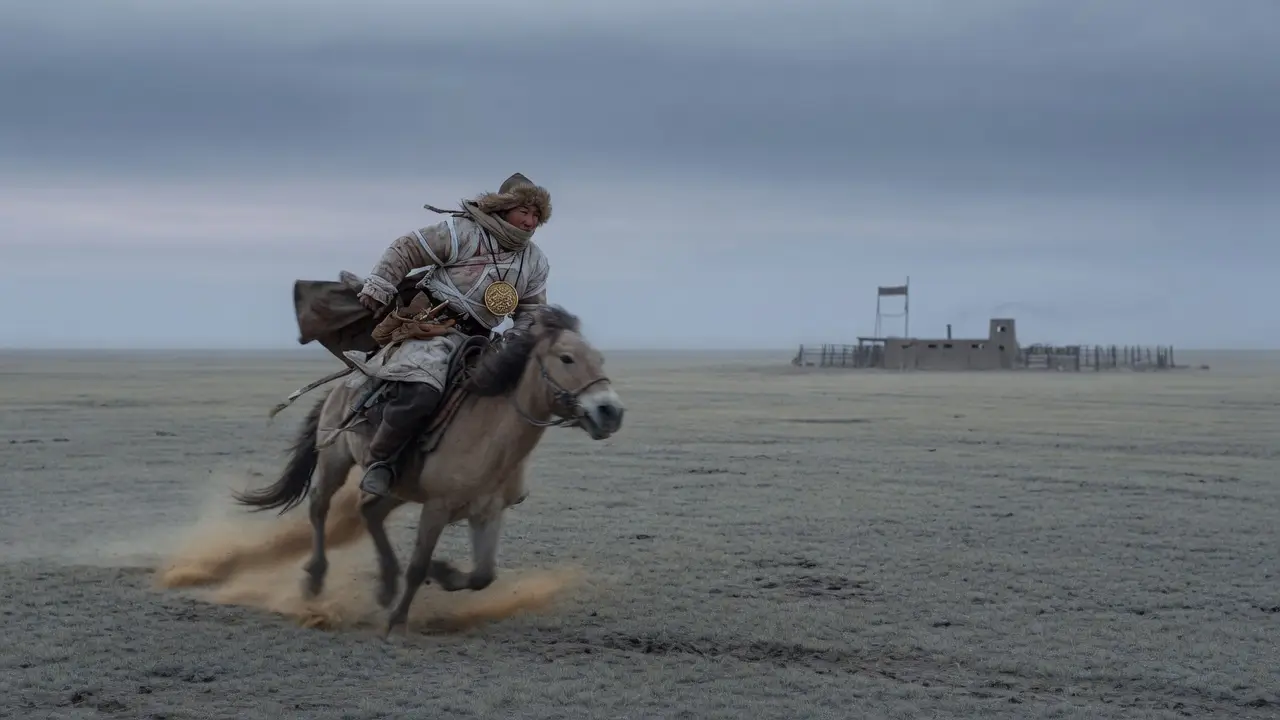
The Yam worked on the same relay principle as the Persian and Roman systems, but the Mongols executed it with their characteristic intensity. Relay stations were placed every twenty-five to thirty miles. Each station maintained a minimum of four hundred horses at all times, along with food, shelter, and replacement riders. Mongol couriers wore a special medallion called a paiza, which functioned like the Persian halmi: it granted unlimited authority to commandeer any resource from any subject of the Khan. A courier arriving at a village could take the headman’s own horse if the station animals were exhausted.
“Through the province there are many roads leading to different quarters, and on each of these roads, every twenty-five miles… there is a station… in which are kept three or four hundred horses… I do not believe there is a finer establishment in the world.”
Marco Polo on the Yam system (c. 1300 CE)
The speeds achieved by Yam riders are almost unbelievable. The Venetian merchant Marco Polo, who traveled through the Mongol Empire in the 1270s, reported that riders covered two hundred miles in a single day during emergencies, cycling through horses at a gallop. He described the courier stations as magnificent establishments, and he had seen much of the known world by that point, so the praise carries weight.
Mongol couriers wore tight bandages wrapped around their torsos and heads before long rides. The bandages reduced vibration damage to internal organs during the sustained full-gallop stretches between stations. The riders were not just fast, they were physically conditioned specifically for the work, and the bandaging technique had been developed over generations of steppe riding culture. It was sports medicine before sports medicine existed.
The Yam had a second function beyond speed. Because every piece of official information moving through the empire passed through Mongol-controlled relay stations, the Khan had an extraordinary intelligence capability. Messages could be read, copied, or delayed. The system was both a highway and a surveillance apparatus, a pattern that reappears with striking consistency across every major courier network in history.
The Chasqui: Runners in the Sky
The Inca courier network, called the chasqui system, solved a different problem than its Eurasian counterparts. The Mongols had horses. The Romans had roads. The Inca had neither horses nor wheeled vehicles, and their empire ran through the Andes, one of the most vertical and brutal terrains on earth.
Their solution was pure human engineering.
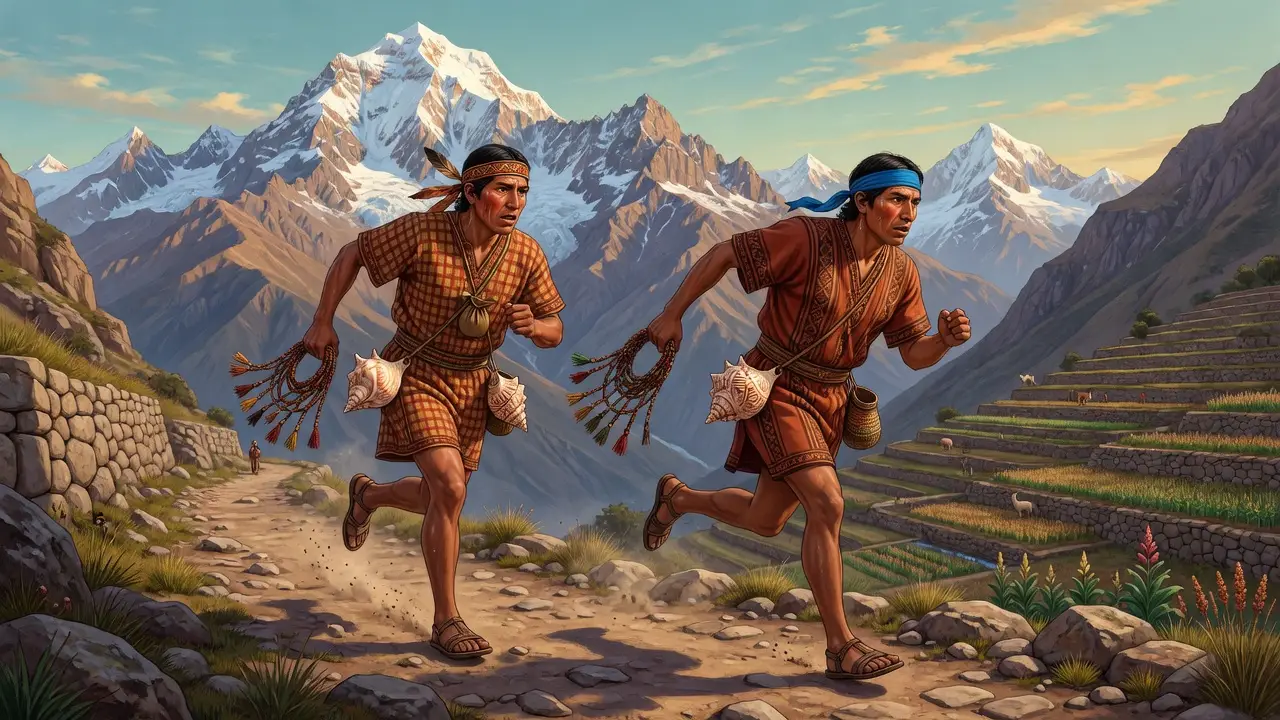
The Inca built two parallel road systems running the length of their empire, one along the coast and one through the mountains. The mountain road alone stretched roughly three thousand miles and crossed passes at elevations above fifteen thousand feet, where the air is thin enough to make casual walking feel like punishment. Along these roads, every two to four kilometers, the Inca maintained a small hut called a tambo, staffed at all times by two chasqui runners.
A chasqui would spot an approaching runner, begin jogging to match speed, receive the verbal message and physical items (knotted record strings called quipu, small packages, fresh fish from the coast destined for the Sapa Inca’s table in the highlands), and then sprint the next two-kilometer leg at full speed. Day and night, in any weather, at altitude, in relay.
“The posts were so swift, and they ran so fast… that in a short time, news was known more than five hundred leagues away.”
Pedro de Cieza de León, Spanish chronicler, on the chasqui (c. 1550 CE)
The result was breathtaking. Fresh fish from the Pacific coast reached Cusco, the Inca capital high in the mountains, within two days. A message could cover 150 miles in a single day across the Andes. Spanish conquistadors, arriving in the sixteenth century with their horses and European arrogance, were genuinely stunned. They had horses and the Inca runners still moved information faster over mountain terrain.
The chasqui were selected in childhood, trained specifically for the role, and held a position of significant prestige and honor in Inca society. They were exempt from the mit’a labor tax that all other subjects owed the state. They wore distinctive dress including a feathered headdress and carried a conch shell horn called a pututu, which they blew to announce their approach so the waiting runner could begin moving before arrival. The handoff itself was a practiced athletic technique, refined over generations.
Spanish colonial records describe watching a chasqui relay in action and comparing it to watching a single smooth courier mechanism, not a series of separate runners, because the transitions were so fluid and rapid.
The Intelligence Hidden in the System
These networks shared something deeper than technology: they were instruments of political control as much as communication.
The Persian Royal Road gave Darius visibility into every province. The cursus publicus gave Roman emperors the ability to issue orders faster than provincial governors could formulate independent responses. The Yam gave the Mongol Khan eyes across a continent. The chasqui gave the Sapa Inca a nervous system that connected the body of the empire to its brain in real time.
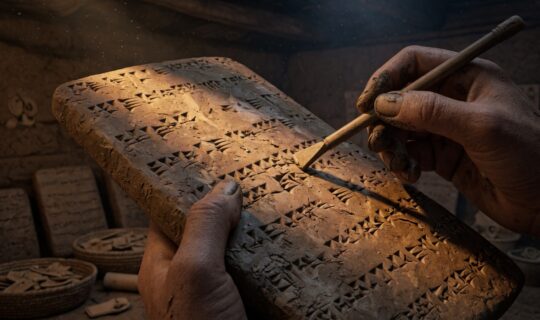
Every one of these systems also created a record of itself. Clay tablets, papyrus scrolls, knotted quipu strings, bamboo documents, all moving through physical networks, all leaving traces. Empires that built reliable courier networks also became, almost accidentally, literate administrative states. The need to move information created the need to record it, and the recording created bureaucracy, and bureaucracy, for all its tedium, is what separates a kingdom from an empire.
The courier networks were not just communication systems. They were cognitive infrastructure. They extended the mind of the ruler across geography in a way that nothing before them had managed.
When the Lines Go Down
Every network in history eventually broke, and the breakdowns are as instructive as the systems themselves.
The cursus publicus began degrading in the third century CE as the Roman Empire entered its long crisis. Maintaining forty thousand miles of roads and thousands of relay stations required tax revenue, political stability, and central authority. As all three eroded, the stations fell into disrepair, the horses went unmaintained, and the messages slowed. By the time the Western Empire collapsed in 476 CE, the cursus publicus had essentially ceased to function in most of Europe. What followed was not merely political fragmentation but an information blackout. Medieval Europe, without a functioning relay system, took centuries to rebuild the administrative sophistication Rome had made routine.
The Yam collapsed with the Mongol Empire itself. When Kublai Khan’s successors fractured the empire into competing khanates, the relay stations that required central coordination and funding were abandoned. The steppe roads that had once carried messages from Beijing to Budapest within weeks reverted to disconnected local tracks.
The Inca chasqui system was not defeated by internal collapse. It was cut off surgically by the Spanish conquest. The conquistadors understood, with the instincts of experienced conquerors, that the runner network was the Inca state’s central nervous system. Disrupting it was not simply a military tactic. It was a decapitation. Without the chasqui relaying orders and information from Cusco, the regional governors lost coherence, and an empire of millions became suddenly manageable for a force of hundreds.
Control the message. Control the empire. The Spanish had learned that lesson from people who had been practicing it for centuries.
What the Runners Left Behind
The modern world built the telegraph, the telephone, the internet, and satellite communication. We move information at the speed of light across a global network of unimaginable complexity. It is easy to look at these ancient courier systems as crude precursors, interesting footnotes in a story that was always heading somewhere better.
That misses the point entirely.
The Persian, Roman, Mongol, and Inca networks did not simply move messages. They solved, for their time and their technology, the same fundamental problem that every subsequent communication system has tried to solve: the problem of scale. How do you govern what you cannot see? How do you hold together something larger than any single person can physically manage? How do you make a decision in the center that arrives in the periphery before the situation has already changed?
Every answer to those questions, from relay riders on the Royal Road to fiber optic cables under the Atlantic, is built on the same principle. You break the distance into manageable segments. You maintain the infrastructure between segments regardless of the cost. You standardize the format of the information so it survives handoffs without distortion. You protect the couriers.
The runners and riders of the ancient world figured this out without computers, without electrical engineering, without anything we would recognize as modern technology. They used horses, human legs, roads, stone huts, and the understanding that information delayed is power diminished.
The internet did not invent the idea. It just made the relay stations invisible.