
Before treaties, before embassies, empires secured peace by taking children. From Rome to the Ottomans, hostage diplomacy shaped history’s greatest powers and the boys raised in enemy courts often became their captors’ greatest weapons.
- 1 The Boy at the Roman Table
- 2 Not Prisoners. Not Guests. Something Worse.
- 3 Rome’s Finishing School for Foreign Kings
- 4 Persia’s Long Game
- 5 The Ottoman Machine
- 6 The Mongol Variant
- 7 Medieval Courts and the Children of the Treaty Table
- 8 When the Hostage Became the Threat
- 9 The Weight of That Childhood
- 10 The Long Echo
The Boy at the Roman Table
He was maybe eight years old when they took him. His name was Demetrius, son of the Macedonian king Philip V, and one morning he was placed on a ship bound for Rome, not as a prisoner in chains, but as a “guest.” He would eat Roman food, learn Latin, wear a toga, and grow up inside the city that had just crushed his father’s army at Cynoscephalae. Rome would be polite about it. Rome was always polite about it.
They called it obsidum, the giving of hostages. And for centuries, it was the most sophisticated, most quietly brutal instrument of statecraft the ancient world ever produced.
Not Prisoners. Not Guests. Something Worse.
The word “hostage” carries a modern flavor of masked men and ransom notes. What empires actually practiced was something far more patient and far more psychologically sophisticated.
A hostage in the ancient and medieval world was a living contract. He was proof that a treaty had teeth. If his father the king kept faith, the boy lived well, received an education, attended banquets, and was treated, at least on the surface, with honor. If the father broke faith, the boy died. Simple arithmetic. Terrible arithmetic, when you are eight years old and don’t yet understand it.
What made hostage diplomacy genuinely insidious was the secondary function that empires quietly discovered: if you raise a foreign prince in your court long enough, he stops being foreign. He learns your language, absorbs your values, admires your gods, and when the day comes for him to return home and rule his own people, he rules them with your interests already baked into his thinking. You have not just secured a peace. You have manufactured an ally from the inside out.
Rome’s Finishing School for Foreign Kings
Rome turned this into an art form. Over three centuries, the city received princes from Numidia, Macedonia, Syria, Parthia, and a dozen other kingdoms, boys ripped from their homes under diplomatic language and installed in aristocratic Roman households where they learned rhetoric, law, and the particular Roman conviction that Rome was the natural order of the world.
“He who controls the education of children controls the future.”
Plato
Jugurtha of Numidia arrived as a young man in 134 BC to serve under Scipio Aemilianus during the siege of Numantia. He watched Roman legions work. He drank with Roman officers. He studied how Rome won. When he returned home, he used everything he had learned to wage one of the most damaging guerrilla wars Rome ever faced, bribing senators, outmaneuvering commanders, playing factions against each other with a Roman’s understanding of Roman weakness. The Roman historian Sallust recorded that as Jugurtha rode out of Rome after a visit, he reportedly turned and said, “A city for sale, and doomed to quick destruction, if it finds a buyer.”
Join The Archive Briefing
Weekly dispatches. The history they didn't teach you — sourced, subverted, delivered to your inbox.
It was the observation of a man who had been educated, housed, and welcomed, and had paid very close attention.
Demetrius of Macedon had a different fate. Seventeen years in Rome made him more Roman than Macedonian. When he finally returned to his brother Perseus’s court, he seemed foreign, suspect, dangerously pro-Roman. Perseus had him poisoned. The hostage had been so thoroughly remade that his own family no longer recognized him as one of their own.
Persia’s Long Game
The Achaemenid Persians understood the same logic, refined it, and added a layer of bureaucratic precision. When Darius I and his successors received princes from vassal states, from Lydia, from Egypt, from the fractious Greek city-states after their various defeats, they didn’t merely house them. They placed them in the royal court at Persepolis, educated them alongside Persian nobles, and immersed them in the ideology of Persian kingship: that the Great King was the axis around which the civilized world turned.
A lesser-known detail: Persian royal hostages were sometimes given Persian wives and Persian estates. The chains were invisible. The dependency was not. By the time a vassal prince returned home to rule, he often owed his social identity, his alliances, and in some cases his children, born to Persian women, to Persia itself.
The Greek writer Herodotus noted the practice with a mixture of admiration and unease. Persia was not merely securing borders. It was colonizing minds.
The Ottoman Machine
No empire systematized hostage diplomacy as thoroughly, or as coldly efficiently, as the Ottomans. But they added a twist that made the whole institution genuinely strange: they did it to their own subjects.
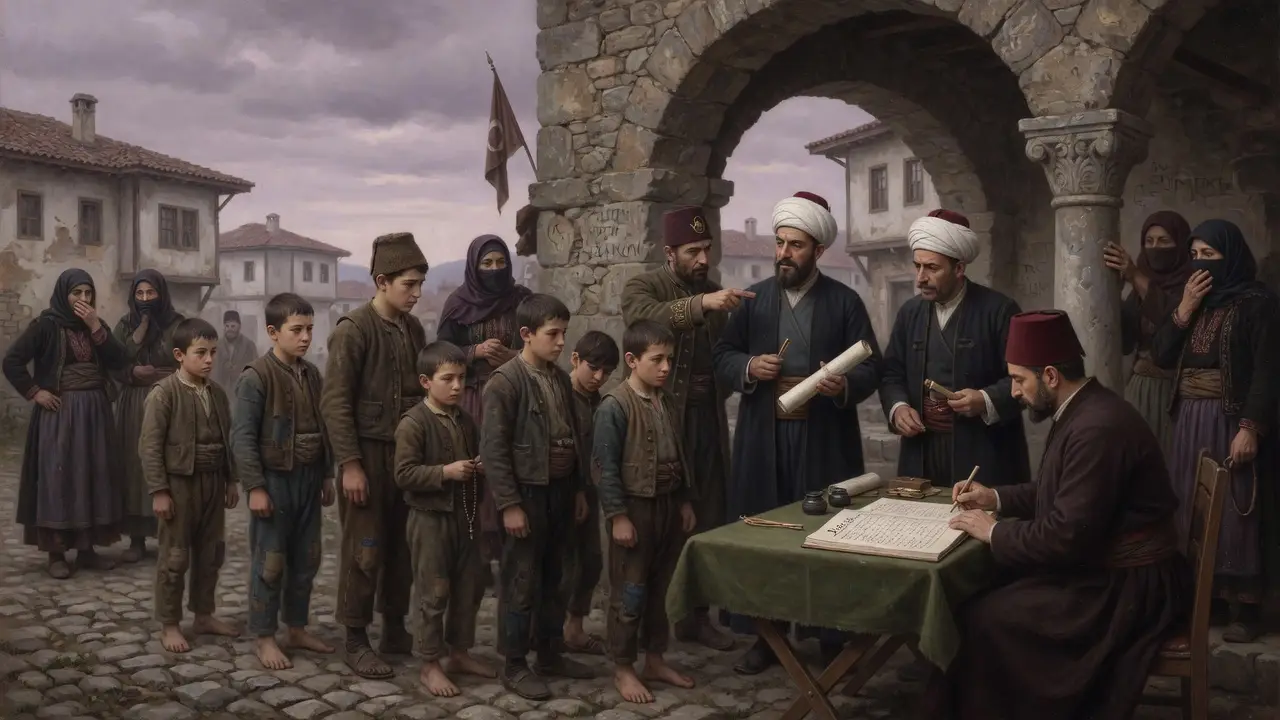
The devshirme system, which ran from roughly the 14th through the 17th centuries, was a periodic levy of Christian boys from the Balkans, Anatolia, and the Caucasus. Ottoman officials would arrive in a village, assess the boys between the ages of eight and eighteen, select the most promising, strong, intelligent, physically imposing and take them.
The boys were converted to Islam, given new names, and funneled into one of history’s most demanding educational pipelines. The best went to the Enderun, the palace school inside Topkapi. There, over years of rigorous training in theology, languages, horsemanship, military tactics, and administration, they were forged into what the empire needed most: absolutely loyal servants with no family ties to protect and no feudal loyalties to honor.
“We took their sons so that their fathers would remain our friends.”
Ottoman bureaucratic rationale documented in 15th-century administrative records
They became grand viziers. Generals. Admirals. The architect Sinan, who designed the Suleymaniye Mosque, came through this system. So did Ibrahim Pasha, Suleiman the Magnificent’s closest friend and grand vizier, until Suleiman had him strangled.
LESSER-KNOWN DETAILS
By the late 16th century, the Ottomans stopped sending princes to the provinces to gain military experience and instead began keeping all potential heirs confined in a section of the Topkapi Palace called the kafes (cage). Princes could reign for decades in isolation, with no administrative or military training, before inheriting an empire they had never governed or seen. Hostage logic, turned inward.
The paradox was profound. These men held enormous power. They could command armies, reshape the empire’s architecture, determine foreign policy. And yet they were, in the most technical sense, the Sultan’s property. They had been taken as boys, unmade, and rebuilt in the empire’s image. Their loyalty was not a choice. It was the only identity they had ever been given.
The Mongol Variant
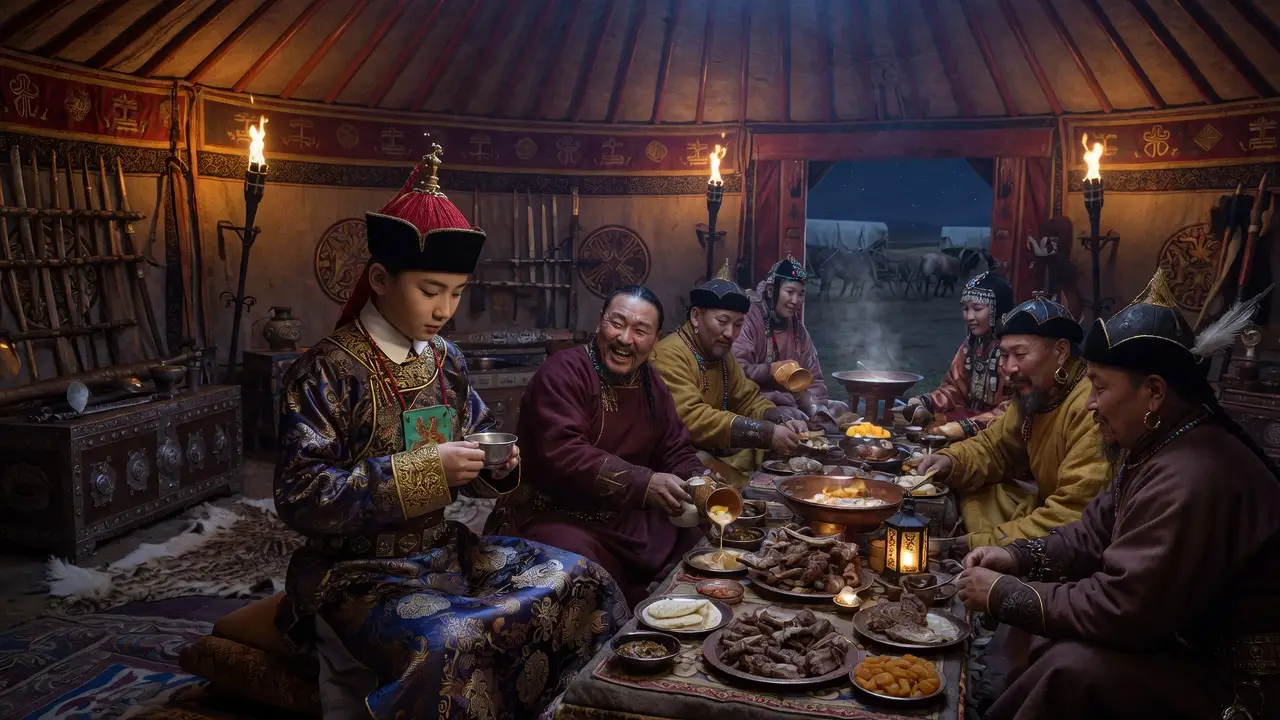
Where Rome seduced and Persia absorbed, the Mongols kept things direct. Hostage-giving in the Mongol system, called il in some sources, was explicitly transactional and backed by an unambiguous threat. When a kingdom submitted to Mongol authority, its ruler sent sons or brothers to the Great Khan’s court, and they stayed there as living collateral while the subject ruler paid tribute and supplied troops.
LESSER-KNOWN DETAILS
After the disastrous Mongol incursions into Poland in 1241, several Polish noble families sent children to Mongol-adjacent courts as diplomatic insurance. The records are fragmentary, but some of those children appear decades later as interpreters and intermediaries, neither fully Polish nor fully anything else.
What surprised outside observers was that the Mongol court was not cruel to these hostages. Genghis Khan and his successors understood that a dead or mistreated hostage cost them leverage. Hostages were fed, trained in Mongol cavalry tactics, exposed to the extraordinary cosmopolitanism of a court that pulled scholars, merchants, and artists from across Eurasia. A Korean or Persian or Chinese prince who spent years at Karakorum emerged with a Mongol-inflected worldview and, crucially, with relationships inside the Mongol ruling structure that could serve him later.
One lesser-known case: Prince Nayan, a Nestorian Christian, had lived within the Mongol sphere long enough to command Mongol troops, before eventually rebelling against Kublai Khan. His execution was itself Mongol in character: he was wrapped in felt so that no blood touched the earth, a form of death reserved for those of high status. Even in killing him, they honored the protocol.
Medieval Courts and the Children of the Treaty Table
In medieval Europe, the practice wore a softer face but lost none of its edge. When English and French kings concluded peace treaties, sons were exchanged. When powerful lords submitted to a king, they sent a son to the royal court, officially as a ward, learning the arts of knighthood. Unofficially, as an anchor.
The young Thomas Becket spent time at the court of Theobald of Bec before rising through ecclesiastical ranks. Edward the Black Prince grew up surrounded by the sons of men his father had just defeated. The medieval court was a permanent, rotating hostage exchange dressed up in the language of chivalric education.
Wales produced one of the era’s most telling examples. After the conquest of 1282-83, the English crown methodically took Welsh noble children, particularly the heirs of houses that might one day anchor a rebellion, and raised them in English households. Some were treated well. Some were imprisoned. The point was the same: the next generation of Welsh leadership would owe their formation to England.
Geoffrey of Monmouth, writing in the 12th century, embedded hostage exchange so deeply into his legendary history of Britain that it appears as simply the normal grammar of power. Because, by then, it was.
When the Hostage Became the Threat
Hostage diplomacy contained its own contradiction. The empires that practiced it wanted a hostage who was cultured enough to be a useful ally when he returned home, educated, sophisticated, capable of ruling. But the more capable and sophisticated you made someone, the more capable and sophisticated his potential resistance became.
Antiochus IV of Syria had spent years in Rome as a hostage. He returned to the Seleucid throne as a man who understood Roman power intimately, and who, perhaps because of that intimacy, spent his reign trying to outrun Rome’s shadow through aggressive Hellenization, which culminated in the desecration of the Jerusalem Temple and the Maccabean revolt. Rome had shaped him. His response to that shaping convulsed an entire region.
LESSER-KNOWN DETAILS
The Parthian king Phraates IV sent four of his sons to Rome voluntarily around 10 BC as a diplomatic gesture that also conveniently removed potential rivals to his throne. Augustus displayed them at public games. Rome got its propaganda. Phraates got rid of four problems at once.
The Ottoman princes who didn’t make it through the devshirme pipeline but watched it operate from their palace windows understood something quietly terrifying: the empire was more efficient at creating loyalty than their own families were. That knowledge was not comfortable.

The Weight of That Childhood
What the historical sources rarely dwell on — and what stays with you once you notice it, is what it meant for the boys themselves. Not the kings they became or the wars they triggered, but the specific texture of that experience: leaving home young, arriving in a foreign city where everyone spoke differently, where the food was strange, where your status was simultaneously honored and suspended, where you were always aware, at some level, that your life was collateral.
Some adapted completely. Some never did. Some went home and found themselves strangers. The Roman writer Polybius, who was himself taken as a Greek hostage to Rome in 167 BC and eventually became one of Rome’s greatest historians, left behind a body of work that is simultaneously a tribute to Rome and a complex negotiation with what it meant to admire the power that had taken you.
“The giving of hostages is a form of faith made flesh.”
From Polybius, Histories
He called Rome magnificent. He also never stopped being Greek.
The Long Echo
Hostage diplomacy as a formal institution faded with the rise of professional diplomacy, permanent embassies, and international law. But its logic did not disappear. It became subtler. Colonial boarding schools that took indigenous children and returned them fluent in European languages, estranged from their own. Cold War student exchange programs designed to build sympathetic elites. The scholarship pipelines that bring promising students from developing nations to American and European universities, not through coercion, but through incentive so powerful that coercion is no longer necessary.
I have lived among them so long that I can no longer tell whether I rule my people or merely translate for their conquerors.”
Polybius’s autobiographical passage in the Histories
The mechanism changed. The ambition, shape the next generation of foreign leadership before they lead, remained exactly what it had always been.
Empires have always known that the most durable conquest is not of territory. It is of the people who will govern territory. And the most efficient moment to achieve that conquest is childhood, when identity is still soft.
The boy at the Roman table grew up. He learned Latin, wore a toga, absorbed Roman law and Roman ambition. And then, one day, he went home.
What he carried with him was the point.