From Peter the Wild Boy at the court of George I to the mysterious Kaspar Hauser, Europe’s “feral children” weren’t just curiosities, they were experiments. Discover the real, dark history of the wild children the Enlightenment used to answer its most dangerous questions about human nature.
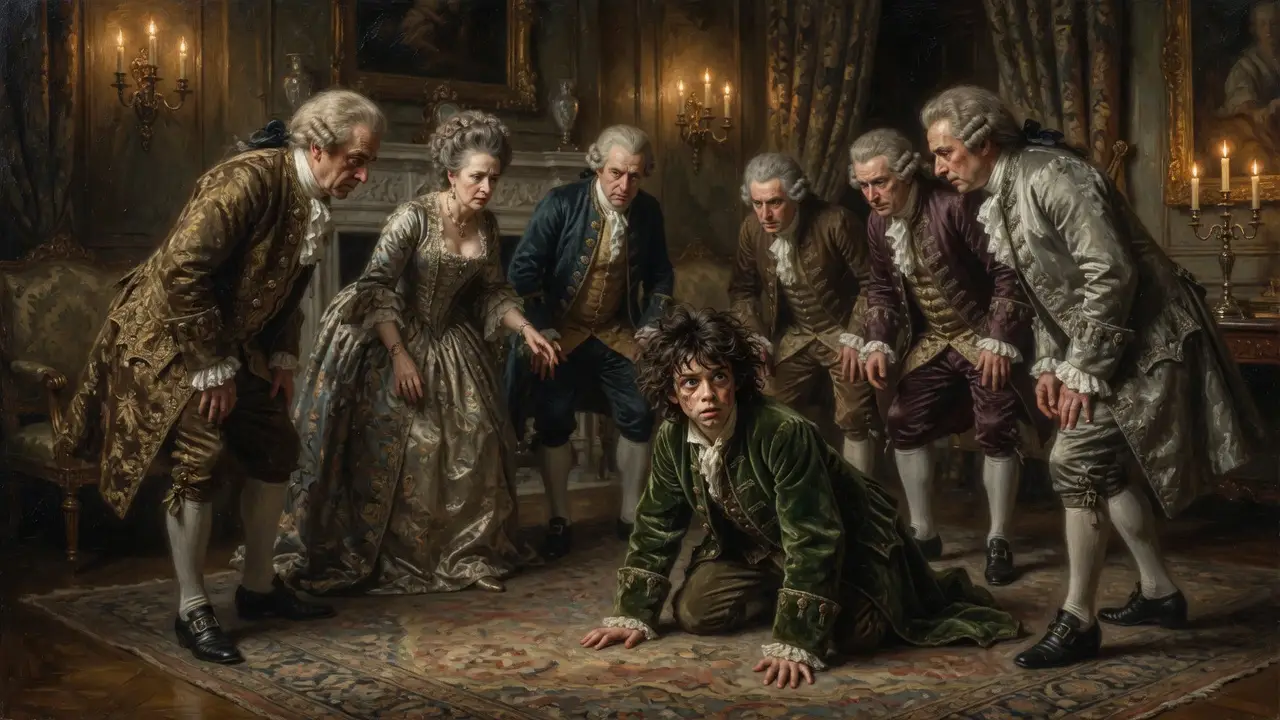
On the evening of April 7, 1726, the courtiers of George I packed themselves into the drawing room at St. James’s Palace, chattering about balls and masquerades as they usually did. Then the doors opened, and two footmen carried in a grinning, bushy-haired boy. He wore a coat of green velvet someone had wrestled him into. He scurried across the floor on all fours, lapped water from a bowl like a dog, and showed not a flicker of recognition that he was standing in one of the most powerful courts in Europe.
The Age That Could Not Stop Watching
The 18th century believed in reason. It believed in progress, in the perfectibility of man, in the Enlightenment’s great promise that human beings, given the right conditions, could reach toward the divine. And then Europe kept stumbling across children who had grown up outside all of that: in forests, in isolation, in darkness. Children who didn’t speak. Who ate raw meat. Who seemed to belong to no recognizable category of person.
“If a lion could speak, we could not understand him.”
Ludwig Wittgenstein
These children didn’t just fascinate the public. They became experiments. Living arguments for theories that philosophers were trying to win. Tests for questions that had no clean answers: What makes us human? Is language something we’re born with or something that has to be taught? If a child is raised without civilization, what is left?
The answers, across a century of cases, were disturbing in ways the experimenters had not expected.
Peter of the Hertswold Forest
In 1725, a boy of unknown parentage was found living wild in the woods near Hamelin, Germany. He had been surviving entirely on nuts and acorns. He walked on all fours, could not be taught to speak, and exhibited what witnesses called uncivilized behavior.
News of the boy reached King George I, who was visiting his Hanover homeland. Peter was housed at Kensington Palace and treated more as a curiosity than a conventional ward. He slept on the floor in a corner, or on straw in stables. Attendants wrestled him daily into a green velvet coat to present him at court. His diet favored raw vegetables, grass, and nuts over cooked meals. He ate using his hands directly from dishes, scampered on all fours, climbed over furniture, and lapped water from bowls.
Writers hailed Peter as the most wonderful wonder, and London was fascinated. Peter fanned the flames of a debate raging around science and philosophy, nature versus nurture, and the delicate line between humans and wild animals. Daniel Defoe wrote a pamphlet about him. Jonathan Swift, never one to miss an opportunity for cruelty, satirized the craze. Carl Linnaeus, the great taxonomist, created an entirely new category of human in his Systema Naturae just for Peter, calling him Juvenis Hanoveranus.
Philosophers debated the very definition of a human being, and whether people had souls. If Peter possessed no speech, did he therefore possess no soul? Was he really just an animal?
Nobody asked what Peter thought about any of this.
Join The Archive Briefing
Weekly dispatches. The history they didn't teach you — sourced, subverted, delivered to your inbox.
Man is born free, and everywhere he is in chains.”
Jean-Jacques Rousseau, The Social Contract (1762)
The scientific mystery of why he failed to cast off his feral ways remained unsolved until 2011, when analysis of a Kensington Palace portrait suggested Peter had a rare genetic condition known as Pitt-Hopkins Syndrome, identified only in 1978, which causes severe neurological effects, developmental difficulties, and an inability to speak. In other words, he was not a blank slate. He was a child with a disability, abandoned by his family, hunted down in a forest, paraded before kings, and studied by the greatest minds of his age. None of them ever came close to understanding him.
LESSER-KNOWN DETAIL
When a fire broke out in Norwich in 1751, a jail burned down, releasing inmates into the streets. Peter, who had gone missing for months, walked out of the smoke, having been locked up as a vagrant. His own caretakers had placed newspaper advertisements offering a reward for his return.
He spent his later decades as a farmhand in Hertfordshire, fitted with a leather collar reading: “Peter, the Wild Man of Hanover. Whoever will bring him to Mr. Fenn at Berkhamsted, Hertfordshire, shall be paid for their trouble.” He died in 1785, aged around seventy-two. His grave is in the churchyard of St. Mary’s, Northchurch, directly outside the main door. He is buried there still.

The Wild Girl Who Fought Back
Most histories of feral children focus on Peter and Victor. Few remember Memmie Le Blanc, which is a strange omission, because her story is wilder than either of theirs.
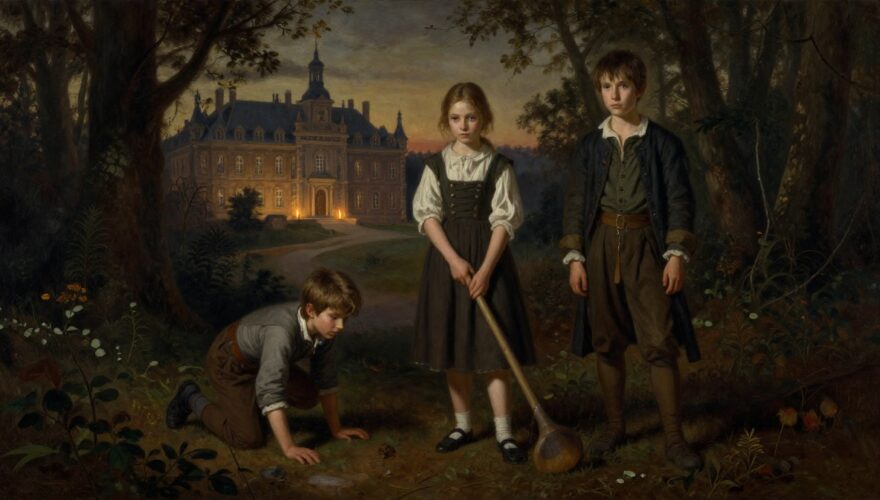
For ten years, she walked thousands of miles alone through the forests of France. She ate birds, frogs, fish, leaves, branches, and roots. Armed with a club, she fought off wild animals. When she was finally captured in 1731, she was black-skinned, hairy, and had claws. When she knelt to drink water, she made repeated sideways glances, the habit of someone in a permanent state of alert.
The villagers of Songy first spotted her raiding an apple orchard. They sent a bulldog to retrieve her. She killed the dog with a blow to the head, climbed a tree, leaped between branches, and disappeared. They sent hunters. When they finally caught her, she could not speak French or any formal language. They offered her a rabbit, which she skinned and ate raw.
Her origins were as tangled as her story. Modern research suggests Le Blanc was likely of Meskwaki origin, from the Great Lakes region, enslaved as a young girl after surviving a French massacre. She had arrived in Marseilles in 1720 before eventually escaping into the French forests. She had been trafficked across an ocean. The wilderness was the first freedom she’d had.
When doctors attempted to change her diet from raw meat to cooked food and wine, she became extremely sick and her teeth fell out. The Enlightenment’s version of care was essentially forcing her to become someone else. When she was placed in the care of a convent, her raw food diet was denied her, and her wild outings ceased. She nearly died, becoming a shell of herself, losing weight and growing weak and depressed.
“Everything is good as it leaves the hands of the Author of things; everything degenerates in the hands of man.”
Jean-Jacques Rousseau, Emile (1762)
But Memmie Le Blanc refused to become a case study. Her recovery was remarkable. She learned to read, write, and speak French fluently. She is the only documented feral child known to have learned to read and write as an adult, making her unique in the historical record. Enlightenment intellectuals saw her as a living witness to the species’ first era of lawless barbarism. She became the object of fascination for Rousseau, Condillac, and others who saw what they wanted to see in her, a philosophical argument in human form. She was something else: a survivor who had outlasted every attempt to either kill her or define her.
LESSER-KNOWN DETAIL
In 1737, the Queen of Poland, mother of the French queen, took Memmie Le Blanc hunting with her on a visit to France, where Memmie was still fast enough to outrun and kill rabbits.
She died financially comfortable in Paris in 1775, aged sixty-three.
Victor, and the Man Who Would Not Stop
On a cold January morning in 1800, a naked boy emerged from the woods near Saint-Sernin-sur-Rance in southern France. He could not speak, only made strange, unintelligible sounds. He was seen to run on all fours at times. He was completely uninitiated in cultural mores and appeared little more than an animal to those who found him.
The specialists took one look at him and gave up. Then a young physician named Jean-Marc Gaspard Itard stepped in. Itard believed two things separated humans from animals: empathy and language. He named the boy Victor and brought him to live in his home, wanting to civilize him with the objectives of teaching him to speak and to communicate human emotion.
Itard began a six-year effort to see what the boy was capable of learning. He was assisted by a widow named Madame Guérin, who became something close to a mother to Victor. The methods Itard used were systematic and relentless: sensory stimulation, physical exercises, language drills. Victor eventually learned to read and write very simple noun-verb sentences. Itard taught him to recognize letters using metal cutouts arranged on a reading board. When scrambled, Victor could match the correct card with the appropriate item.
LESSER-KNOWN DETAIL
Itard, the physician who worked so hard to “civilize” Victor, conducted separate experiments at the Institution Nationale des Sourds-Muets that included delivering electrical shocks, leech therapy, and ear surgeries on deaf students in attempts to restore their hearing. The man shaping the education of a wild child was simultaneously torturing the deaf in another wing.
But Victor would never speak. He was blemished by a thick scar slashed across his larynx, evidence of violence done to him before Itard ever found him. Someone had tried to kill this child, possibly for being different. For Victor, the call of the wild remained strong. He could spend hours looking out of the window and loved the snow. When Itard took him to the countryside, Victor was agitated and tried to escape continuously. The windows of Paris were the only nature left to him.
Criticism of Itard’s methods has focused on a fatal flaw: the twin errors of isolating Victor from other children and the imposition of speech on the mute boy. He was trying to fix something that wasn’t broken, according to one paradigm, while refusing to meet Victor inside the world Victor understood.
Itard’s experiment came to an unsuccessful end. Victor remained living with Madame Guérin until his death from pneumonia in 1828. He was forty years old, roughly. He never said a word. And Itard, for all his frustration, considered his work with Victor one of the most significant failures of his career, while the field of special education considers it one of its founding documents.

The Boy Who Appeared From Nowhere
Around four o’clock in the afternoon of May 26, 1828, a cobbler named George Weichmann was standing outside his house in Unschlitt Square in Nuremberg when he saw a teenage boy, limping and dressed in tattered clothes and ill-fitting boots.
The boy could say almost nothing beyond his name and the phrase “I want to be a horseman like my father was.” His feet were soft as the palm of a hand, as though he had never worn shoes before he had traveled to Nuremberg. He could not tolerate sunlight. He was repulsed by all food except bread and water.
Kaspar Hauser claimed he had spent his entire life in a small darkened cell, fed through a slot, with only two wooden horses to play with. He had been hastily taught to read and write when he was freed on the streets of the Bavarian city. He carried two letters detailing part of his history and the address to which he should be delivered. One of those letters, many later noted, appeared to have been written by the same hand as the other… which was to say, possibly by Hauser himself.
Speculation about his identity spread across Europe. Some believed he was the rightful heir to the Grand Duchy of Baden, switched at birth to prevent his legitimate claim to the throne. Rumors swirled that Hauser was actually a lost prince, perhaps the son of Grand Duke Carl von Baden and his wife Stephanie de Beauharnais, who had been adopted by Napoleon.
Kaspar was taken in by a local schoolmaster, Georg Friedrich Daumer, who attempted to educate him. Under Daumer’s care, Kaspar displayed unusual sensitivity to his environment, with a seemingly heightened sense of taste, smell, and hearing. He showed a natural talent for drawing and music. He flourished, slowly, in ways that Peter and Victor never had.
The first person to seriously pursue Kaspar Hauser’s story was Anselm von Feuerbach, Bavaria’s top criminologist. For him, Kaspar Hauser was a two-year-old in a teenager’s body.
Then, on December 14, 1833, Kaspar returned home with a serious chest wound. He said that a stranger had given him a bag, stabbed him in the chest, and fled. The bag contained a note written in mirror writing, partially identifying the attacker’s supposed hometown. But when a policeman searched the gardens where Hauser said he was attacked, there was no second set of footprints in the snow.
The note in the purse contained a spelling error and a grammatical error, both typical for Hauser. The note itself was folded into a specific triangular form in the way Hauser typically folded his letters. Forensic examiners agreed that the chest wound might have been self-inflicted.
LESSER-KNOWN DETAIL
he note found with Kaspar Hauser’s fatal wound was written in mirror writing and contained a partial name and incomplete location, almost as if designed to tantalize without revealing. It has never been decoded.
He died three days later. He was twenty-one years old.
His tombstone in Ansbach reads: “Here lies Kaspar Hauser, riddle of his time. His birth was unknown, his death mysterious.” In the spot in the Court Garden where he was stabbed, a monument reads in Latin: “Here a mysterious man was killed in a mysterious way.”
Whether he was a prince, a fraud, a tortured child, or something in between, Kaspar Hauser left a wound in the European imagination that never fully closed. In 2024, DNA analysis confirmed he was not of the Baden royal line. But that only answers one question. All the others remain open.
What Europe Was Really Looking For
Across a century and across four countries, these children were treated as riddles to be solved rather than people to be helped. The Enlightenment needed them. Philosophers were trying to settle the nature-versus-nurture debate, and here were perfect subjects: human beings who had developed outside society, untouched by language and civilization. At the time when Rousseau was arguing that man was born inherently good, Victor presented an ideal test case for what might happen if children were left to their own devices without the corrupting or humanizing influence of society.
But the children kept refusing to confirm the theories. Peter couldn’t speak because of a genetic condition nobody understood. Memmie had been enslaved and trafficked and had crossed an ocean before she ever set foot in a French forest. Victor had a scar on his throat that suggested someone had tried to murder him in childhood. Kaspar Hauser’s origins remain genuinely unknown.
These were not blank slates. They were human beings with histories the Enlightenment wasn’t equipped to read.
In the early 19th century, Peter’s case was classified as a foundational example in European discussions of human development and socialization. Scholars noted his limited responsiveness to language as evidence of the challenges in reversing prolonged isolation, which informed Itard’s systematic approach to teaching Victor. The cases built on each other, each generation of scientists learning from the failure of the last, but the children themselves bore the cost of those lessons.
What they show us now, with the distance of centuries, is not a debate about human nature. It’s a record of what happens when vulnerable people become useful to those with power. When a child’s suffering is interesting enough that it gets written down, theorized about, published. When the question of what makes someone human is answered by treating them as less than one.
Peter walked on all fours through the corridors of Kensington Palace. Memmie ate raw birds in the forests of France for a decade. Victor watched the snow from a window in Paris, unable to go back and unable to fully arrive. Kaspar Hauser died in a German garden with a wound that may or may not have been his own.
None of them ever got to tell their own story. That’s the part that still stings.