In the summer of 1858, a heatwave turned the River Thames into a fermenting open sewer so toxic it drove Parliament from its own chambers. Discover how the Great Stink exposed London’s deadly sanitation crisis, the deadly myths that masked its real cause, and the underground engineering marvel that saved a city, and still runs beneath it today.
The summer of 1858 arrived in London like a slow-moving execution. The sun climbed past 90 degrees Fahrenheit (~33°C) day after day, baking the cobblestones, drying out gutters, and pulling something monstrous up from the bed of the River Thames. By late June, the smell had become a living thing — thick enough to taste, strong enough to curl the wallpaper in riverside houses. Members of Parliament, the men who governed a quarter of the planet, were holding handkerchiefs soaked in chloride of lime to their faces just to walk through their own building. The empire that ran the world couldn’t survive its own bathroom.
This wasn’t a bad smell that people complained about over tea. This was a public health catastrophe disguised as an odor problem, and it took a literal stink to finally force the most powerful government on earth to admit that London was killing its own people.
A City Built on Top of Its Own Waste
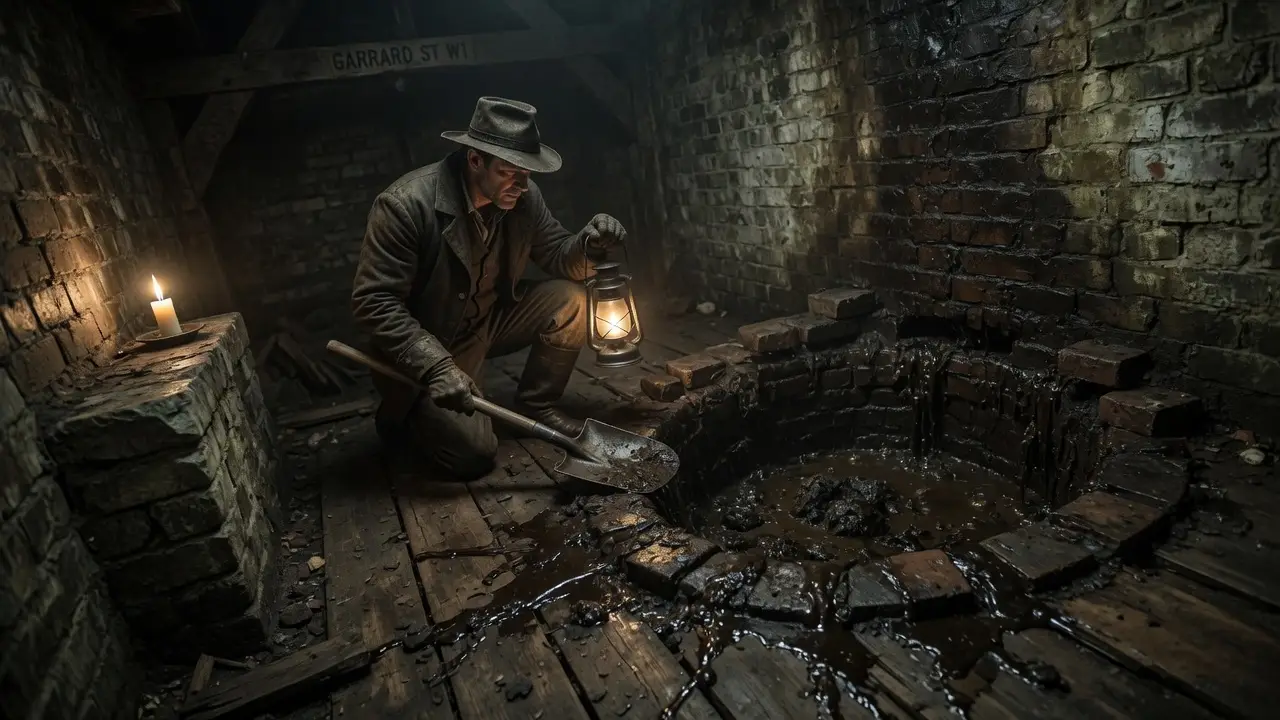
To understand how bad 1858 got, you have to understand what London had become by the mid-1800s. The population had exploded past two million people, crammed into a city whose sanitation system had barely changed since medieval times. Most homes relied on cesspools, pits dug beneath houses or in back courtyards, meant to hold human waste until it could be carted away by “night soil men” and sold as fertilizer.
It was a system that barely worked for a city of two hundred thousand. For a city of two million, it was a slow-motion disaster.
Then came the water closet, the flush toilet, marketed as the great hygienic breakthrough of the Victorian age. Wealthy households installed them by the thousands, proud symbols of modern living. Nobody stopped to ask the obvious question: where does all that water go?
The answer was straight into the existing cesspools, which had never been designed to handle a constant flood of water. The pits overflowed. Sewage backed up into basements, seeped through floorboards, and pooled in streets. So London did what seemed logical at the time, it connected the overflowing cesspools directly to the storm drains, which all emptied into one place… the Thames.
The same river that supplied much of the city’s drinking water became, quite literally, an open sewer. By the 1850s, an estimated 250 million gallons of raw sewage were entering the Thames every single day. Add to that the waste from slaughterhouses, tanneries, and chemical factories lining the banks, and you had a river that was less water and more a slow-moving chemical soup with a population’s worth of human waste mixed in.
Join The Archive Briefing
Weekly dispatches. The history they didn't teach you — sourced, subverted, delivered to your inbox.
The Smell That Was Supposed to Kill You
Here’s where the story gets darker, and stranger. The dominant medical theory of the time (miasma theory) held that disease was spread through “bad air.” Foul smells weren’t just unpleasant; they were believed to be the disease itself, an invisible poison that could seep into your lungs and rot you from the inside.
So when cholera tore through London in repeated waves throughout the 1840s and 50s, killing tens of thousands, the prevailing wisdom was that the smell of the Thames and the slums was the killer. Authorities respond accordingly, they tried to mask and disinfect the smell rather than clean the water itself.
A physician named John Snow had already made the radical argument, back in 1854, that cholera was spreading through contaminated water, not bad air, famously tracing an outbreak in Soho to a single contaminated water pump. But his theory was largely dismissed by the scientific establishment. The men in charge kept fighting the smell, not the source.
It’s a chilling irony: the very thing Londoners feared, the stench was mostly harmless. The thing they ignored, the water itself was the actual killer.
Four years before the Great Stink, the scientist Michael Faraday had taken a boat trip down the Thames and dropped small pieces of white paper into the water to test how far they’d sink before disappearing into the murk. They vanished almost instantly. He wrote a letter describing the river as a uniform, opaque, pale brown liquid — and warned that if nothing changed, the consequences in hot weather would be horrific.
Nobody listened. Then 1858 arrived.
The Summer London’s Government Couldn’t Escape
When the heatwave hit in June 1858, the Thames essentially began to ferment. The heat accelerated the decomposition of everything sitting in the riverbed, decades of sludge, sewage, and industrial runoff — turning the water into a bubbling, gas-releasing mess. Witnesses described the surface of the river as visibly fermenting, with clouds of foul gas rising off it in the heat.
The Houses of Parliament sat right on the riverbank, and the smell didn’t politely wait outside. It came through windows, curtains, walls. Members of the House of Commons reportedly abandoned committee rooms overlooking the river entirely. Some accounts describe MPs fleeing the library mid-session, handkerchiefs pressed to their faces, unable to continue working.
Desperate officials tried to fight back. Workers dumped enormous quantities of lime, chloride of lime, and carbolic acid into the river and along the banks, hoping to neutralize the smell chemically. They soaked curtains in disinfectant. They considered, seriously, relocating Parliament entirely, moving the seat of government away from the river, away from the city, to escape a smell that money and power couldn’t buy their way out of.
The Times, July 1858, reported that the intense heat had driven members of the legislature from the riverside portions of their own buildings, with those who ventured toward the library being driven back almost immediately, handkerchiefs pressed to their faces.
For perhaps the first time, the wealthy and powerful were forced to confront the fact that the river didn’t care about class. The poor had been drinking, bathing in, and dying from this water for years. Now the smell had crawled into the chambers where laws were made, and suddenly the problem became urgent.
What followed was one of the fastest legislative turnarounds in British parliamentary history. A bill granting the Metropolitan Board of Works the authority and funding to overhaul London’s entire sewage system was introduced, debated, and passed in roughly two weeks, an almost unheard-of pace for Victorian bureaucracy. Politicians who had ignored years of warnings, petitions, and cholera death tolls suddenly found their courage the moment the smell reached their own noses.
Bazalgette’s Underground Cathedral
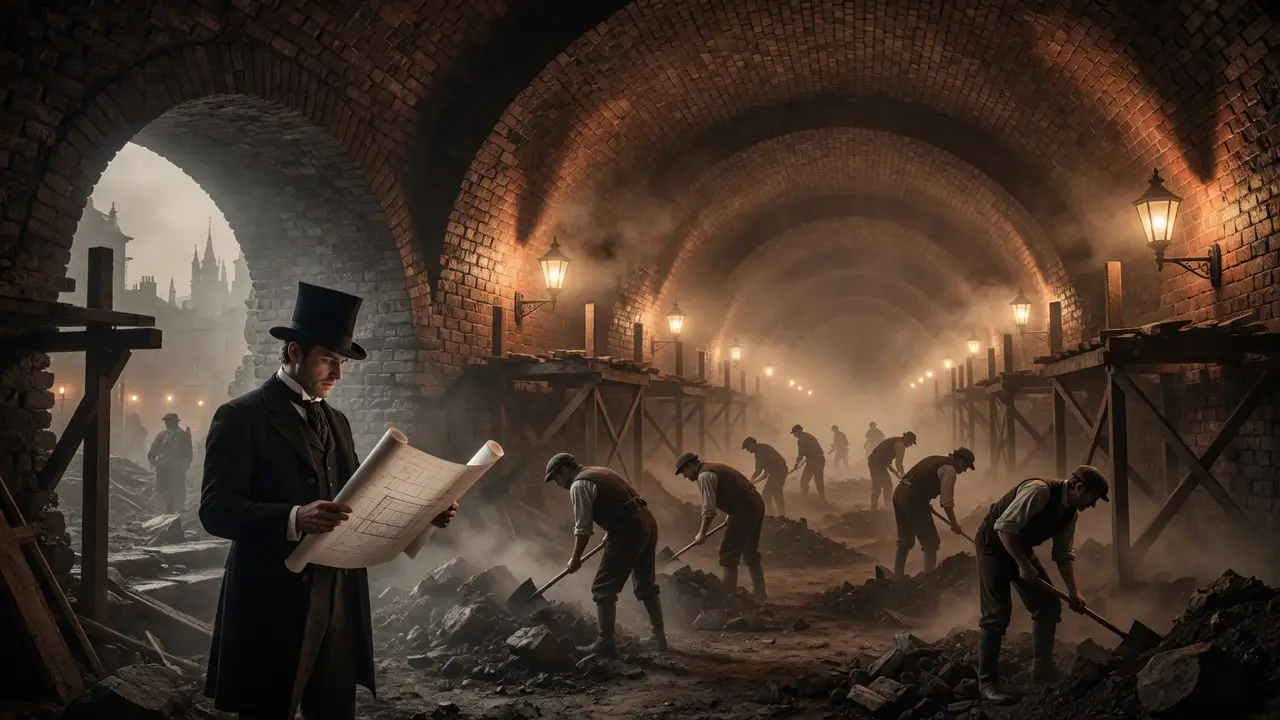
The man handed this monumental task was Joseph Bazalgette, chief engineer of the Metropolitan Board of Works. He had actually proposed a comprehensive sewer plan years earlier, only to watch it get buried under competing proposals, committee infighting, and government indecision. The Great Stink didn’t give him a new idea, it gave him the political will to finally execute the one he already had.
Bazalgette’s plan was staggering in scope. He designed a network of enormous intercepting sewers that would run roughly parallel to the Thames, capturing waste before it could reach the river and carrying it miles downstream, away from the densely populated city center, where it would be released into the tidal estuary instead.
The numbers involved are almost cartoonish in scale. Around 82 miles of main interceptor sewers. Over a thousand miles of smaller street sewers feeding into them. More than 300 million bricks. The construction required building entirely new embankments along the Thames: the Victoria, Albert, and Chelsea Embankments, essentially reclaiming land from the river to house the new sewer tunnels beneath wide new roads.
Benjamin Disraeli, addressing the House of Commons in 1858, reportedly described the Thames as “a Stygian pool, reeking with ineffable and unbearable horror”, delivered while reportedly holding papers to his nose as he crossed the terrace overlooking the river.
It took roughly a decade and a half to complete, employing thousands of workers using methods that, by modern standards, look almost insanely dangerous, men working with hand tools and basic explosives in tunnels deep beneath one of the busiest cities on earth. The brickwork was done to a standard so precise that much of Bazalgette’s original system is still in active use today, more than 160 years later, quietly handling a city population many times larger than the one it was designed for.
Here’s the detail that tends to get lost: Bazalgette built the system based on miasma theory. He thought he was solving a smell problem. What he actually did, by removing sewage from the water supply entirely, was solve the cholera problem almost as a side effect. London’s cholera epidemics essentially stopped after the system came online, not because anyone fully understood why, but because the engineering accidentally addressed the real cause while everyone was arguing about the wrong one.
The Stink That Never Really Left
It would be comforting to say the Great Stink is a relic or a grim curiosity from a less sophisticated time. But… it isn’t.
London’s Victorian sewer system, brilliant as it was, was built for a city of roughly four million people. Greater London today holds close to nine million. During heavy rainfall, the system still overflows by design, a safety mechanism Bazalgette built in, dumping untreated sewage directly into the Thames dozens of times a year, exactly as it was engineered to do, just far more often than originally intended because the population has nearly doubled what the system was designed for.
That’s the reason London has been building the Thames Tideway Tunnel (nicknamed the “Super Sewer”) a new 25-kilometer tunnel running deep beneath the existing Victorian system, designed specifically to capture the overflow that Bazalgette’s network can no longer handle. It is, in almost every meaningful sense, a sequel to 1858. The same city, the same river, the same basic problem of human waste outgrowing the infrastructure meant to handle it, just with better technology and a much bigger budget.
Michael Faraday, in his 1855 letter to The Times describing his boat trip down the Thames, noted that the entire river appeared as an opaque, pale brown fluid, and warned that the consequences of the existing conditions, if allowed to continue into hot weather, would be dreadful to contemplate.
The uncomfortable lesson of the Great Stink isn’t really about Victorian sewage. It’s about the gap between when a problem becomes real and when the people in power decide to act on it. London knew about cholera for decades. It knew the river was poisoned for years. Nothing changed until the smell became personally, physically unbearable for the people who held the purse strings.
It’s worth sitting with that for a moment. Every era has its own version of an overflowing cesspool, slowly worsening, well-documented, affecting the poor first and worst, ignored by those with the power to fix it until the consequences become impossible to avoid smelling from the comfort of their own offices.
The Thames eventually ran clear again. The question worth asking is what’s quietly fermenting beneath our own feet right now, waiting for its own unbearable summer.