
Long before the KGB or the Stasi, ancient empires built the first surveillance states. Discover how Assyria, Persia, Qin China, and Rome mastered the art of control through fear.
The secret police state did not begin in the twentieth century. From the Assyrian Empire’s royal letter networks to the Qin dynasty’s neighbor-informer system, ancient rulers discovered the most powerful weapon of all: making people afraid of each other. This is where it started.
- 1 Someone Was Always Watching
- 2 What Makes a State a Surveillance State
- 3 Assyria: The Empire That Ran on Reports
- 4 Persia: The Eye That Traveled
- 5 Qin China: When Neighbors Became the Police
- 6 Rome: Messengers Who Stayed Too Long
- 7 The Machinery Underneath
- 8 Uncertainty Is the Weapon
- 9 The Inheritance
Someone Was Always Watching
The letter arrived before dawn. The provincial governor read it twice, then burned it. Somewhere in his household, he suspected, someone was already writing a report about him.
This scene could have unfolded in Nazi Germany, Stalinist Russia, or East Berlin. But it happened three thousand years ago, in the provinces of the Neo-Assyrian Empire, where kings built something the ancient world had never quite seen before: a system designed to make every powerful man feel watched, every subordinate uncertain, and every act of disloyalty difficult to hide. Not through walls or armies alone, but through information. Through whispers. Through people whose real job was not what it appeared to be.
The secret police state did not begin in the twentieth century. It began whenever rulers realized that armies could hold borders but only fear could hold power.
What Makes a State a Surveillance State
Before we follow the informers through history, it helps to understand what we are actually looking for. A state tips into secret-police territory when it deploys informers to report on private behavior, when central officials quietly monitor local governors, when disloyal speech becomes punishable, when secret reports flow directly to the ruler bypassing normal channels, and when ordinary people begin to wonder whether the man next to them at dinner works for the palace.
The critical ingredient is not the informer himself. It is the uncertainty he creates. A man who knows he might be watched behaves differently from a man who is certain he is not. Rulers across the ancient world understood this, even if none of them had a word for it.
What is remarkable, looking back across four civilizations, is not how different these systems were. It is how similar. The tools were almost always the same: a trusted messenger who saw too much, a tax inspector who asked the wrong questions, a neighbor encouraged by law to report on other neighbors. The machinery of control is surprisingly consistent across time, geography, and culture.

Join The Archive Briefing
Weekly dispatches. The history they didn't teach you — sourced, subverted, delivered to your inbox.
Assyria: The Empire That Ran on Reports
The Neo-Assyrian Empire, which dominated the ancient Near East from roughly the ninth to seventh centuries BCE, was one of the most militarily aggressive states the ancient world ever produced. It was also, in ways historians are still mapping, one of the most administratively sophisticated.
Under Sargon II and his successors, the empire stretched across more than seventy provinces, from the eastern Mediterranean to the Persian Gulf. Governing that kind of territory without telecommunications, without printing, without any of the infrastructure we associate with modern administration, required something unusual: a culture of systematic reporting that bordered on obsession.
LESSER-KNOWN DETAILS
The royal correspondence system used a relay of mounted couriers capable of moving messages roughly fifty kilometers per day, making it possible for the king in Nineveh to receive a provincial report and send a response within a week. This speed, by ancient standards, was itself a form of power projection.
Thousands of letters from Assyrian kings and officials have survived, giving historians a window into the machinery of empire that is almost embarrassingly intimate. Governors wrote to the king about harvests, about troop movements, about the behavior of neighboring officials. Royal emissaries traveled the provinces and sent back assessments. Trusted agents reported on men the king did not fully trust. The reports were often short, formulaic, the ancient equivalent of a memorandum. But their sheer volume tells a story about how the empire understood control.
The king was, in theory, the eye at the center of an information web. But the system created something its architects probably did not entirely intend: a culture of lateral surveillance, where officials watched each other and reported upward, where the most dangerous thing a governor could do was become too powerful, too popular, or too quiet.
Assyrian letters reveal officials openly accusing each other of disloyalty, incompetence, or corruption. Some of these accusations were probably true. Many were almost certainly strategic. The king benefited either way. When everyone is reporting on everyone else, the ruler at the center is the only person who sees the whole board.
“The king, my lord, knows the land and its people better than they know themselves.” This formula, repeated across countless letters to the Assyrian throne, was not mere flattery. It was an acknowledgment of the system. The king was supposed to know. And knowing, the letters implied, he was watching.
Persia: The Eye That Traveled
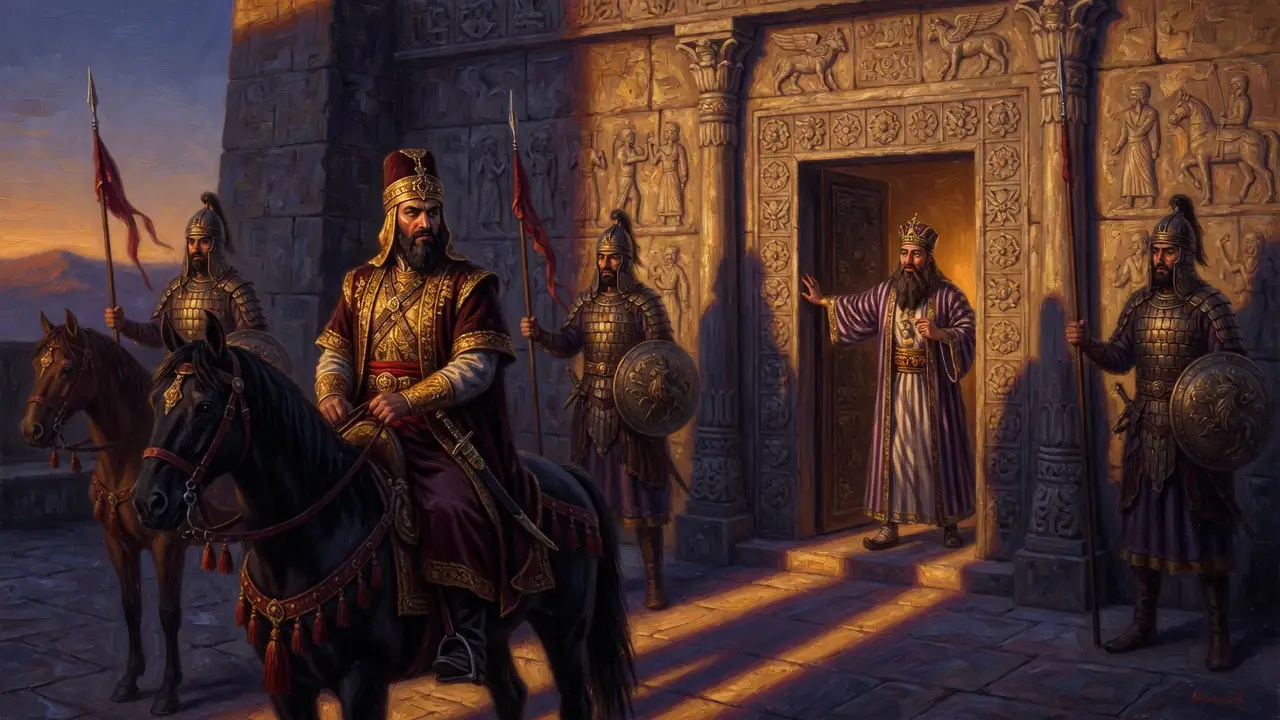
The Achaemenid Persian Empire inherited a vast administrative problem and solved it with elegant brutality. Darius I divided his empire into satrapies, large provinces governed by satraps who were often relatives of the king or members of the Persian nobility. They had real authority. Tax collection, local justice, military levies: the satraps ran the day-to-day machinery of empire.
The king did not trust them.
This was not paranoia, exactly. It was history. Governors with armies and tax revenues had a habit, across every civilization, of becoming something more than governors. The Persian solution was to build a second layer of authority directly inside the satrap’s administration.
The royal secretary, assigned to each satrapy, answered to the king, not the governor. So did the military commander. So, most conspicuously, did the official known in Greek sources as the “Eye of the King,” a royal inspector who traveled the empire, arrived without warning, investigated the satrapy, and reported directly to the court at Persepolis or Susa.
LESSER-KNOWN DETAILS
The Persian road system, the Royal Road, was explicitly designed in part to enable rapid communication between the king and the satraps. Herodotus marveled at its speed and noted that nothing traveled faster than these royal messengers, a line later adapted (loosely) for the U.S. Postal Service motto.
The “Eye” is mentioned by Herodotus and Xenophon, and while Greek sources sometimes distorted Persian administration for their own narrative purposes, the essential structure is confirmed by Persian administrative records. The point of the system was not merely to catch corrupt governors, though it did that. The point was that the satraps knew the Eye might arrive at any moment. They could never be entirely certain which officials in their own court reported to the palace instead of to them.
Herodotus records a telling detail: Xerxes was kept informed about Greek affairs by observers whose identities the Greeks could not determine. The intelligence network ran outside visible channels. That is, by most definitions, the architecture of secret policing.
“The King’s Eye sees all that is done in his realm, and his ear hears what is spoken in darkness.” This formulation, preserved in fragments of Persian court literature, was not a metaphor. It was a policy statement.
Qin China: When Neighbors Became the Police
The Qin state, which eventually unified China in 221 BCE under the First Emperor, ran a surveillance system that makes the Assyrian and Persian examples look almost restrained.
The architect was Shang Yang, the minister who transformed Qin from a mid-tier warring state into a military and administrative machine in the fourth century BCE. His reforms are preserved in the Book of Lord Shang, one of the more unsettling political texts in world history, written with a clarity about power that most rulers prefer not to commit to writing.
Shang Yang’s system divided the population into groups of five to ten households, bound together by collective responsibility. If one household committed a crime and the others failed to report it, all were punished. If you reported the crime yourself, you were rewarded. If you concealed it, you could be executed. The result was a society in which the state did not need an extensive secret police force, because it had successfully conscripted the population itself into mutual surveillance.
LESSER-KNOWN DETAILS
The collective responsibility system meant that entire villages were sometimes punished for crimes committed by one person. The records from Shuihudi, a cache of Qin legal documents discovered in a tomb in 1975, reveal just how granular the state’s interest in individual behavior had become. Officials recorded disputes, debts, and accusations in remarkable detail.
This was the innovation. Earlier surveillance systems required the ruler to deploy agents outward, into the population. Shang Yang reversed the architecture. He built the surveillance into the social fabric itself. Every neighbor was a potential informer, not because they were loyal to the state but because the consequences of failing to inform were worse than the discomfort of turning someone in.
The psychological effect was precisely what the state intended. Trust between neighbors became a liability. Privacy became dangerous. The man who kept to himself became suspicious by definition. In a society organized around collective punishment, silence looked like complicity.
“When the people fear the law more than they fear their enemies, the state is strong.” The philosophy is attributed to Shang Yang himself, and it captures something important about the logic of these systems: they were not designed to punish everyone. They were designed to make punishment feel possible for everyone.
The First Emperor, Qin Shi Huang, inherited and intensified this machinery. Burning books was the visible part of his censorship. The invisible part was a bureaucracy trained to report, categorize, and surveil. Scholars estimate that the Qin state produced a volume of administrative records so vast that the emperor reportedly weighed rather than counted the documents that required his daily attention.
Rome: Messengers Who Stayed Too Long
Rome’s surveillance apparatus developed later and more gradually, which makes it a useful case study in how these systems emerge from ordinary institutions.
The frumentarii began as military grain collectors. Supply logistics in an empire spanning three continents required men who traveled widely, knew local conditions, and reported what they saw. Over time, by the late second and early third centuries CE, they had acquired a darker reputation. They were accused of acting as informers, gathering intelligence on provincial governors and private citizens, and reporting to the imperial court.
Their successors, the agentes in rebus, first appear in records around 319 CE. They were, officially, imperial couriers and inspectors. In practice, contemporary critics described them as something considerably less neutral. The historian Ammianus Marcellinus, writing in the fourth century, was scathing about their methods and their reach. They were, in his account, men whose official function was communication but whose actual function was surveillance, and who had learned to convert information into personal advantage.
What made the Roman case notable was the scale of accusation that followed in their wake. Roman emperors, particularly during periods of political instability, came to rely on a broader culture of denunciation known through the delatores, professional accusers who made careers informing on citizens for treason and other political crimes. The delatores were not a secret police in any formal sense. But the culture they inhabited, and which the agentes in rebus later amplified, produced the same psychological effect: in the wrong political climate, any conversation could become evidence.
LESSER-KNOWN DETAILS
The frumentarii were so universally despised that Diocletian officially abolished them in the late third century CE. The agentes in rebus, who replaced them, quickly became equally despised. The same institutional function, rechristened, continued under a new name. The pattern repeats throughout history with notable regularity.
Tacitus, writing about the Tiberian period, described a Rome where men were afraid to speak openly even at dinner, where letters were sometimes read before they reached their destination, where the most dangerous thing you could say was something that could be interpreted as criticism of the emperor.
“In the reign of Tiberius,” Tacitus wrote, “even silence was not safe.” The remark is one of the sharpest observations about political fear in ancient literature, and it applies, with modifications, to every system in this article.

The Machinery Underneath
What these four civilizations built looks different on the surface. Assyrian letter networks, Persian royal inspectors, Qin collective punishment registers, Roman imperial couriers: the institutional forms vary enormously. But the underlying logic is identical.
Control through information. Loyalty enforced through uncertainty. Power maintained not just by what the state can do to you, but by what you fear it might already know.
The tools are also consistently humble in origin. The Assyrian system grew out of the ordinary administrative need to govern distant provinces. The Persian Eye of the King was, formally, an inspector of accounts. The Qin mutual surveillance network was built on the existing structure of village organization. The Roman agentes in rebus started as couriers. None of these systems was designed in a single moment as a surveillance apparatus. All of them evolved toward that function because surveillance turned out to be an extremely effective tool for keeping power concentrated at the center.
This is perhaps the most uncomfortable finding in the history of early surveillance states. You do not need to build secret police from scratch. You need a mail system, a tax administration, a legal framework that criminalizes disloyalty, and an incentive structure that rewards reporting. The rest follows.
Uncertainty Is the Weapon
The scariest thing about these systems was not always the punishment itself. It was the impossibility of knowing how much the state already knew.
An Assyrian governor facing a royal inspection could not be certain which of his own scribes had been writing to the palace. A Persian satrap entertaining a visiting official could not be certain the man was only a guest. A Qin farmer who had not reported his neighbor’s small transgression could not know whether someone else had already done it, making his silence newly criminal. A Roman senator being careful about what he said in public could not know whether the agent who delivered his letters had read them first.
This is why historians of totalitarianism often note that actual surveillance does not need to be comprehensive to be effective. It needs to be believable. The state that watches everyone all the time is expensive and logistically impossible. The state that convinces people it might be watching is something you can build with letters, legal codes, and a few hundred well-placed informers.
The ancient world discovered this principle independently across multiple continents. It has never gone out of fashion.
The Inheritance
Every modern surveillance state has ancestors in these ancient systems, not because there is a direct institutional line from Sargon II to the Stasi, but because the logic is embedded in the structure of centralized power itself. Whenever a ruler accumulates enough authority to punish disloyalty, and enough administrative capacity to detect it, the infrastructure of a surveillance state exists in potential. Whether it activates depends on political pressure, on how threatened the ruler feels, on how much the existing legal and social framework can be adapted to serve intelligence functions.
The Assyrians, Persians, Qin Chinese, and Romans were not anomalies. They were early practitioners of a technique that human civilization has returned to, in different forms and with escalating sophistication, ever since.
The province is quiet. The reports keep coming. Somewhere in the capital, a man reads them carefully and decides what to do.
That man has always existed. We are still figuring out how to stop him.