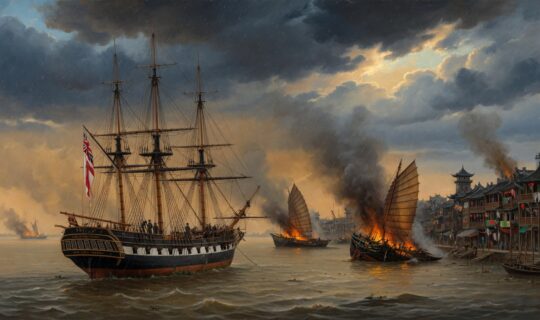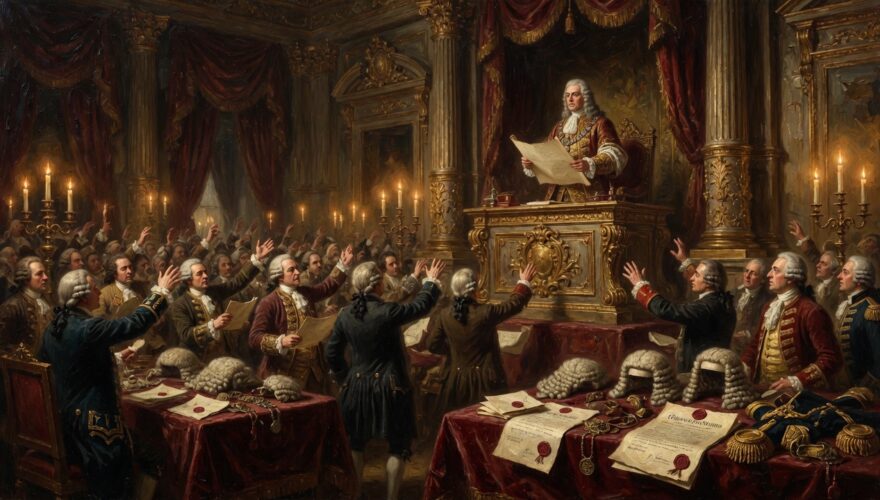
For most of recorded history, governments didn’t simply wield power… they auctioned it off. Tax collection rights, judicial posts, noble titles, military commissions, and trading monopolies were all commodities available to the highest bidder. This is the story of how states sold their own authority, who bought it, and what it cost everyone else.
- 1 The State as an Auction House
- 2 Tax Farming: Buying the Right to Bleed the People
- 3 Selling Government Offices: Justice for Purchase
- 4 Titles, Nobility, and the Monetization of Rank
- 5 Chartered Companies: Corporations with Armies
- 6 Mercenaries and Privatized Violence
- 7 Monopolies: Selling the Right to Control Markets
- 8 Why Rulers Did It: The Logic of Selling Power
- 9 The Price of the Auction
- 10 Echoes of the Auction Block
The State as an Auction House
In 193 AD, the Roman Empire went up for sale.
The Praetorian Guard had just murdered Emperor Pertinax, a man who had lasted barely three months on the throne. Rather than backing a candidate on the basis of competence, loyalty, or even ambition, the guard did something that would have horrified Augustus: they held an auction. Whoever offered the most money to each soldier would wear the purple. A wealthy senator named Didius Julianus outbid his rivals, paid up, and became emperor for sixty-six days before being executed.
The story is outrageous. It is also not as exceptional as it sounds.
LESSER-KNOWN DETAIL
In its early decades, the Dutch East India Company sometimes paid shareholder dividends in physical pepper, nutmeg, and cloves rather than money, because the company held more spice than currency. Shareholders in Amsterdam had to then sell the spice themselves to realize their returns.
For most of recorded history, the line between public authority and private transaction was thinner than we like to admit. Governments did not simply exercise power. They sold it. Tax collection, judicial office, military command, noble rank, territorial control, all of it could be, and was, converted into a commodity. The state was not always an institution. Often, it was a marketplace.
Understanding how that marketplace worked reveals something uncomfortable: the corruption was not a bug in the system. Frequently, it was the system.
Tax Farming: Buying the Right to Bleed the People
In the ancient world, governments faced a problem that has never entirely gone away. They needed money from distant places, but they lacked the bureaucratic machinery to collect it efficiently. The solution they reached for was elegant, profitable for some, and brutal for many: sell the right to collect taxes to private contractors, and let them worry about the logistics.
Rome institutionalized this through the publicani, private companies that bid at auction for the right to collect provincial taxes. The model was simple. The government named a sum it expected from a given province. Contractors paid that sum upfront. Then they went to the province and collected as much as they could, keeping everything above the agreed figure. The margin was their profit, and the incentive to maximize it was absolute.
For Roman provincials, especially in the Greek east, the publicani were a source of generalized dread. The Greek historian Polybius noted that the companies employed vast networks of clerks, collectors, and enforcers. Their reach was intimate and their methods were not always gentle. Legal redress was slow. The contractors had cash, connections, and Rome’s implicit backing.
Join The Archive Briefing
Weekly dispatches. The history they didn't teach you — sourced, subverted, delivered to your inbox.
The tax-gatherers have stripped the provinces bare; they are not collectors of revenue but devourers of fortunes.”
Cicero, Against Verres, 70 BC
The Ottoman Empire ran a similar architecture under the name iltizam. Tax collection rights were sold to mültezims, private revenue farmers who paid the treasury in advance and then extracted what they could from peasants and merchants in their assigned districts. The system funded the empire’s vast military operations for centuries. It also generated chronic rural misery, particularly as collection rights began passing through multiple hands, each layer adding its own cut before anything reached the actual taxpayer.
France refined the practice to a baroque extreme. By the eighteenth century, the Ferme générale (the General Farm) was a private consortium of forty financial partners who had purchased, for approximately eighty million livres, the exclusive right to collect all of France’s indirect taxes: customs duties, the gabelle on salt, the tobacco excise, and more. The farmers-general lived in extraordinary splendor. Their offices occupied a building that stretched across several city blocks in Paris. Some hired lavish private guards. One of them, Claude Baujon, reputedly spent more on his dinner table each year than the average French town spent on everything.
When the Revolution came, the farmers-general were among its earliest targets. Twenty-eight of them were guillotined in 1794, including the chemist Antoine Lavoisier, who had joined the company three decades earlier as an investment. The Revolutionary tribunal reportedly dismissed Lavoisier’s scientific accomplishments with a phrase that may be apocryphal but captures the mood precisely: “The Republic has no need of scientists.”
What the publicani, the mültezims, and the farmers-general shared was not simply greed. They were rational actors operating within a system that governments had designed, because governments found it useful. The contractor assumed the collection risk. The treasury received a predictable advance. The political cost like resentment, revolt, collapse of rural economies, was paid by someone else, somewhere distant, usually several years later.

Selling Government Offices: Justice for Purchase
Medieval and early modern states discovered a related convenience: if you needed revenue without raising taxes, you could simply sell the offices that administered the state itself.
France developed this practice into a machine of extraordinary sophistication. By the sixteenth century, the French crown was selling judicial positions, administrative posts, financial offices, and municipal magistracies as routinely as a modern government might issue bonds. The offices came with salaries, fees, and certain legal privileges. They could be inherited. They could be resold, often at a profit, when the holder died or wished to retire.
The venality of office, as historians call it, was not mere corruption in the modern sense. It was policy. Henry III formalized the process with an edict in 1581. By the time of Louis XIV, the French state was generating enormous sums through the creation and sale of new offices, many of them invented specifically to be sold. The historian William Doyle has estimated that by the late seventeenth century, France had somewhere in the range of forty-six thousand venal offices, their holders forming a kind of fixed capital investment in the royal administration.
The consequences were predictable. Judges who had paid for their positions expected to recover the investment. Justice, inevitably, followed the money. Reformers complained throughout the seventeenth and eighteenth centuries that courts were slow, partial, and expensive precisely because the men who staffed them were financial stakeholders rather than public servants. The parlements, France’s high courts, became hereditary preserves of wealthy families who had bought their way in and intended to stay.
“An office is a piece of property; the holder owns it as fully as his house or his fields, and he will part with it under no less compulsion.”
Henri de Boulainvilliers, Mémoires, c. 1710.
Spain sold administrative offices in its American colonies on a massive scale throughout the seventeenth and eighteenth centuries. The positions of corregidor and alcalde mayor, local governors with broad judicial and economic authority over indigenous communities, were auctioned off to bidders who then deployed to remote provinces with one objective: extract enough from the local population to recover the purchase price, pay off debts incurred during the journey, and generate a profit. The indigenous communities of Peru and Mexico thus found themselves governed by men who were, in effect, creditors trying to collect a debt, and the population was the collateral.
England was not immune. Army commissions were purchased in Britain until 1871. The practice meant that military promotion often had less to do with battlefield competence than with the size of a family’s banking account. A colonelcy cost several thousand pounds in the early nineteenth century. Wellington himself purchased his early commissions, though he later condemned the system, having presumably extracted its benefits already.
Titles, Nobility, and the Monetization of Rank
Power, in the early modern world, was not only administrative or military. It was also social, and social rank was something governments quickly realized they could sell.
France, again, was the master of this art. The state created a category of offices that carried not just administrative functions but the legal status of nobility itself, the so-called noblesse de robe, nobility of the robe, as distinct from the older noblesse d’épée, nobility of the sword. A wealthy merchant or lawyer who purchased a high judicial or financial office could, over the course of a generation or two, acquire noble status. His children would be gentlemen. His grandchildren might forget the counting house entirely.
This was good for the buyer, who acquired social elevation, tax exemptions, and legal privileges. It was good for the crown, which received cash. It was infuriating to the old nobility, who found their ranks diluted by men whose grandfathers had been in trade. The tension between old and new nobility became one of the structural fault lines of French society in the century before the Revolution.
LESSER-KNOWN DETAIL
France created offices purely to sell them. When the treasury was under pressure, the crown would invent entirely new administrative positions, sometimes with genuinely fanciful functions, and sell them.
Spain created a formal tariff for noble titles. The price of a marquisate or county varied by period and by the negotiating skill of the buyer, but the transaction was open and understood. James I of England sold baronetcies outright from 1611, initially at £1,095 each, a price explicitly set to fund military operations in Ireland. His successor Charles I sold peerages in ways that scandalized even contemporaries accustomed to court corruption.
The Ottoman Empire sold honorary titles, tax exemptions, and administrative appointments with what one contemporary European observer described as remarkable efficiency. The price was known. The process was direct. There was almost none of the elaborate fiction of voluntary gift-giving that European courts preferred.
What these systems shared was an understanding that legitimacy itself could be manufactured and sold. Rank was not simply inherited or earned. It was produced by the state on demand, with a price attached.
Chartered Companies: Corporations with Armies
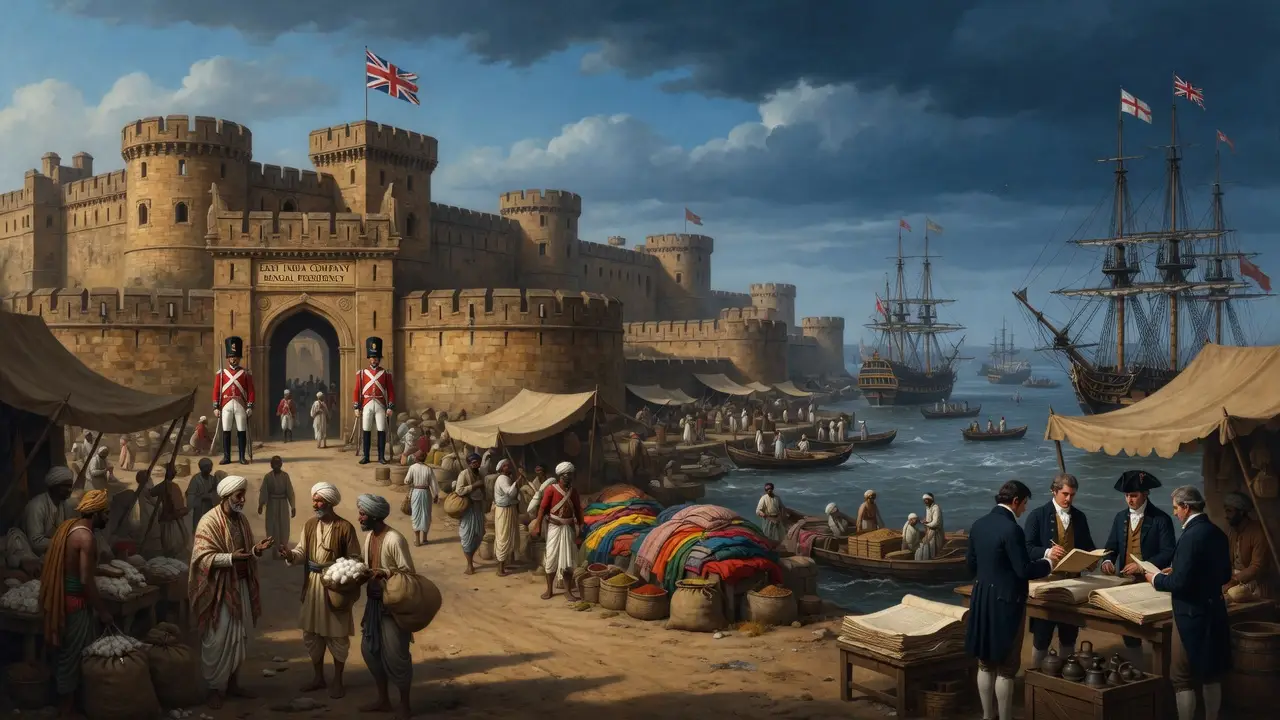
Perhaps the most consequential form of privatized power was the chartered company: a commercial enterprise to which the state granted governmental authority, including the right to make war, impose taxes, administer justice, and govern territory.
The Dutch East India Company, founded in 1602, was given a monopoly over all Dutch trade east of the Cape of Good Hope and west of the Straits of Magellan, effectively, most of the world’s most lucrative trade routes. More than that, it was authorized to negotiate treaties with foreign rulers, build fortresses, raise armies, and wage war in its shareholders’ interests. It did all of these things, systematically and with extraordinary violence, across a century and a half of operations in Asia.
The company’s headquarters in Batavia, modern Jakarta, was a city-state unto itself. Its governors-general held powers that would not have looked out of place in European royal courts. At its height, the VOC employed nearly thirty-five thousand soldiers and operated a fleet of armed merchantmen that dwarfed the navies of many European states. Its balance sheets were examined by stockholders in Amsterdam who had no particular interest in what happened to the people of Java or the Spice Islands, only in the dividends.
“The peasant who is found carrying six pounds of smuggled salt loses everything he owns, and if he owns nothing, goes to the galleys.”
Sebastien le Prestre de Vauban, Projet d’une dîme royale, 1707
The British East India Company followed a similar arc, but longer and more consequential. Founded in 1600 as a trading venture, it spent its first century acquiring footholds in Indian ports through commercial negotiation. Then, after the collapse of Mughal central authority in the mid-eighteenth century, it began fighting. By 1803, the company controlled a territory larger than Western Europe and commanded an army of over 150,000 men, roughly twice the size of the British Army at home.
The company’s courts administered law for tens of millions of people. Its currency circulated across the subcontinent. Its famines, particularly in Bengal in 1770, where as many as ten million people may have died, resulted directly from its revenue policies, which prioritized tax collection above all other considerations during the same years that its shareholders in London were receiving handsome returns.
The company was not simply corrupt in the ordinary sense. It was a state within a state, and it was operating on behalf of private shareholders whose interest was profit. When those two obligations conflicted, shareholders won.

Mercenaries and Privatized Violence
War, too, was a commodity.
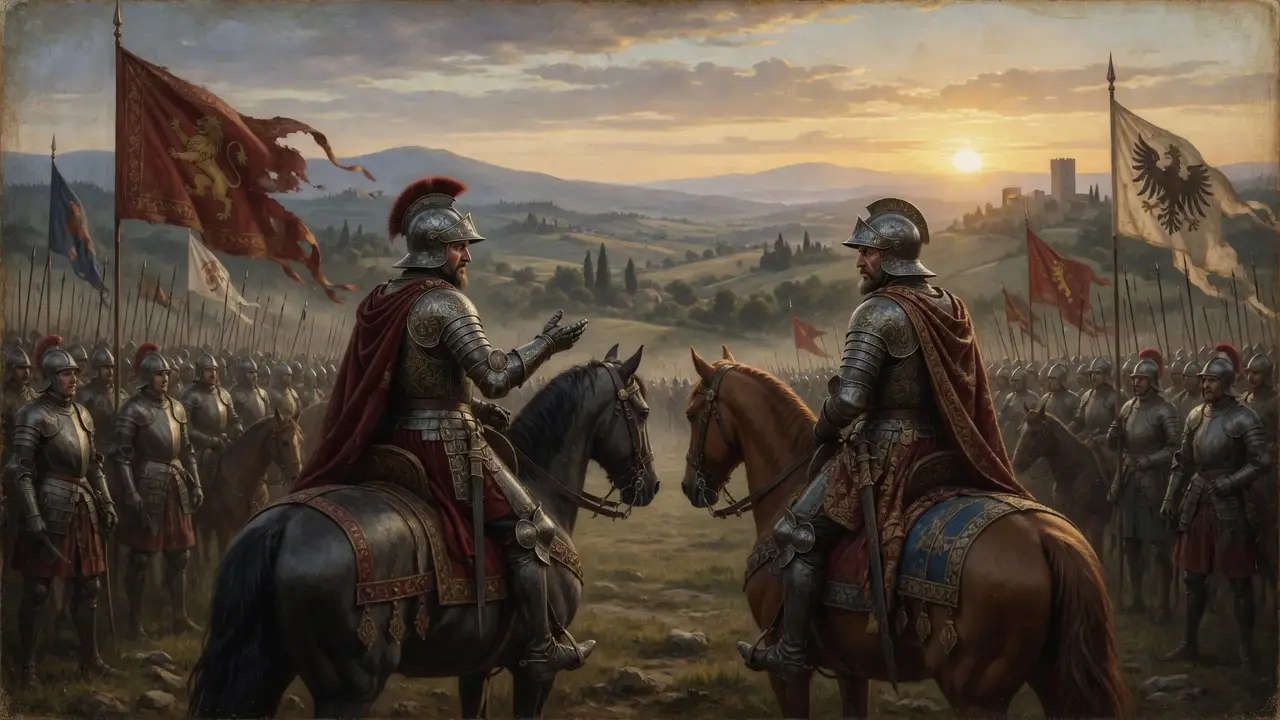
Medieval and early modern rulers rarely commanded armies of loyal national subjects in the modern sense. They hired, contracted, and borrowed military force from a range of private providers whose loyalty was professional rather than patriotic, and whose willingness to fight depended on whether the money arrived on schedule.
The condottieri of Renaissance Italy were the most celebrated practitioners of this trade. Men like Sir John Hawkwood, an English adventurer who fought for Florence, Milan, the papacy, and almost anyone else who would pay him, organized and sold military capability as a business. Hawkwood’s White Company at its peak numbered in the thousands and operated across the Italian peninsula with a professionalism that impressed contemporaries. When Florence hired him, they got results. When a rival offered more money, the results might go in a different direction.
The practice generated its own perverse incentives. A condottiere who destroyed an enemy army destroyed the market for his services. Better to win a battle decisively, capture a few nobles for ransom, and leave the enemy weakened but intact, ready to fight and lose again next season. The wars of fourteenth-century Italy have been criticized by historians as elaborate and expensive performances, plenty of maneuvering, relatively little killing, because killing too efficiently was bad for business.
“Mercenary captains are either very competent men or they are not. If they are, you cannot trust them, because they will always be striving for their own greatness… if they are not capable, they ruin you in the normal way.”
Niccolò Machiavelli, The Prince, 1532
Britain rented soldiers in the modern sense when it hired approximately thirty thousand German troops from several small principalities for service in North America during the American Revolutionary War. The majority came from Hesse-Kassel, which is why Americans called them all Hessians. The Landgrave of Hesse-Kassel received a substantial payment per soldier, plus additional fees for casualties, which created a financial incentive that critics at the time found deeply strange. Frederick the Great of Prussia, not a man easily shocked by political cynicism, compared the arrangement to a farmer selling cattle to a slaughterhouse.
States also sold violence outward, in the form of privateers. Governments issued letters of marque, legal licenses to attack enemy shipping and keep a share of what was taken. The pirate and the privateer operated on the same ocean, often in the same ships, distinguished mainly by paperwork and the current diplomatic situation. Sir Francis Drake was a privateer when he raided Spanish ports with Elizabeth I’s tacit approval, and would have been a pirate if the relationship between England and Spain had been different. The line was contractual, not moral.
Monopolies: Selling the Right to Control Markets
Governments discovered early that they did not need to tax transactions directly if they could simply sell exclusive rights to conduct them.
Salt was the most common target. In France, the gabelle was not merely a tax on salt, it was a system under which the crown controlled the supply, fixed the price, and in much of the country required households to purchase a minimum quantity annually from government-licensed sellers, whether they needed it or not. Smuggling salt was punishable by galley service. Enforcement was sufficiently aggressive that historians estimate thousands of people were prosecuted annually in the eighteenth century for the crime of buying their salt from the wrong person.
Tobacco monopolies operated across much of Europe and its colonies. Spain controlled tobacco production in its American territories and sold distribution rights to licensed merchants. Portugal established a crown tobacco monopoly that eventually became one of its primary revenue sources. France folded tobacco into the Ferme générale, which meant that the same private consortium that collected customs duties also controlled what you smoked and how much you paid for it.
“Every rupee of profit made by an Englishman is lost forever to India.”
Edmund Burke, speech to Parliament, 1783
The colonial trade monopolies of the seventeenth and eighteenth centuries were perhaps the most economically consequential. Spain’s Casa de Contratación held exclusive authority over all trade between Spain and its American empire. The English Navigation Acts required that goods moving through English colonies travel in English ships. The French exclusif restricted colonial trade to French merchants exclusively. These monopolies transferred enormous wealth to licensed traders and their governments, and generated equally enormous resentment in the colonies, where merchants and consumers paid artificially elevated prices for everything.
The monopoly was, in this sense, a tax dressed in commercial clothing. It achieved the same result, transferring wealth from the many to the few, while allowing the crown to claim it was simply regulating trade, not taxing it. The fiction was rarely convincing to those paying the elevated prices, but it was politically useful to those collecting them.
Why Rulers Did It: The Logic of Selling Power
It is tempting to interpret the sale of power as a symptom of moral failure: rulers who were greedy, shortsighted, or indifferent to the populations they governed. Some certainly were. But most of them were operating under pressures that made the sale of authority look, from where they stood, like the only practical option.
War was the fundamental driver. Early modern wars were ruinously expensive. Armies needed to be paid weekly or they dissolved into mutiny and looting. Navies required constant maintenance. Siege warfare consumed resources at rates that no premodern taxation system could easily sustain. The rulers who built the largest and most durable states were almost always also the ones who found the most creative ways to convert future revenue into present cash… and selling offices, monopolies, and tax rights was essentially doing exactly that.
LESSER-KNOWN DETAIL
The Roman publicani had shareholders. The tax farming companies of Rome were among the earliest known joint-stock enterprises in history.
State capacity was another constraint. Building a professional bureaucracy is expensive and slow. Training tax collectors, establishing courts, and paying administrators required revenue that the state did not yet have. Selling offices to men who would finance their own positions was a way of offloading the cost of administration onto the people doing the administering. The French crown could not easily afford to staff every provincial court with paid judges. But wealthy families could afford to buy the positions, and the crown received a lump sum it needed now, rather than a salary stream it would need to sustain indefinitely.
Debt management shaped everything. Rulers borrowed from bankers, merchants, and nobles, and the interest rates on those loans could be crippling. Selling a monopoly or a block of offices generated immediate cash to service existing debt. Chartered companies offered a variation on this theme: they provided capital and military capability the state could not otherwise afford, in exchange for commercial privileges that had real economic value.
The need to maintain the loyalty of powerful elites was equally pressing. A king who wanted the support of the great noble families could reward them with offices, titles, and tax exemptions, converting potential rivals into stakeholders in the existing order. It was cheaper than fighting them, and it worked, at least until the system accumulated so many privileged exceptions that the burden of sustaining it collapsed onto the people who had no privileges at all.
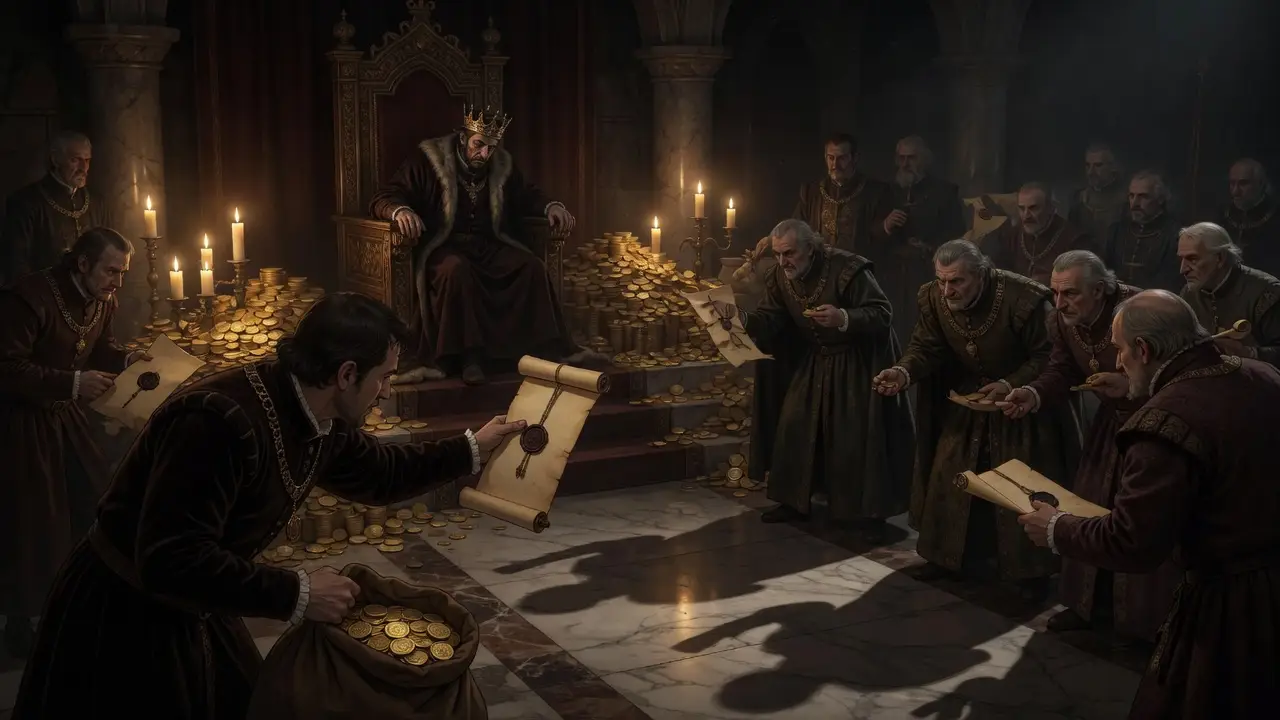
The Price of the Auction
Systems built on the sale of power share a particular failure mode. They work, until they don’t, and when they stop working, they tend to stop catastrophically.
The French Ferme générale funded the monarchy for generations. It also concentrated resentment against a visible, named group of profiteers, created a class of tax officials whose interests were explicitly opposed to those of the people they taxed, and made reform nearly impossible because the men who would need to give up their purchased positions had paid good money for them and were not inclined to surrender them voluntarily. When the Revolution came, it did not simply reform the tax system. It abolished the purchasers.
The British East India Company governed South Asia for long enough to reshape it permanently, and the costs of its governance, the famines, the forced deindustrialization, the systematic extraction of capital, remained as grievances long after the company itself was dissolved in 1858 and replaced by direct Crown rule. The dissolution did not undo what had been extracted.
The purchase of military commissions in the British Army produced, among other things, the catastrophic confusion of the Charge of the Light Brigade in 1854, where cavalry officers who had purchased their commands led six hundred men into a valley of Russian artillery through a combination of miscommunication and the assumption that bravery could substitute for competence. It was not the only disaster attributable to purchased rank, merely the most famous.
None of these systems survived indefinitely. What ended them, usually, was some combination of the following: a crisis expensive enough that existing revenue mechanisms were visibly inadequate, a population whose resentment had accumulated past the point of management, a reforming administration willing to buy out or dissolve vested interests, or a revolution that eliminated the interests entirely.
What did not end them, in any case on record, was the gradual recognition by those who benefited that the system was unjust. Systems built on purchased power do not reform themselves from the inside. The people with power bought it. They intend to keep it.
Echoes of the Auction Block
The selling of power did not end with the French Revolution, or with the dissolution of the East India Company, or with the abolition of purchased commissions in 1871. It transformed.
Private military contractors operate in active war zones today under government contract, the condottieri with better equipment and less ornate armor. Tax farming resurfaces in the form of privatized toll roads, private prison systems paid per inmate, and debt collection operations licensed by governments that lack the will or the capacity to pursue collections themselves. The granting of monopoly rights to pharmaceutical companies, telecommunications firms, and infrastructure operators replicates the logic of the royal charter in a modern regulatory wrapper. The sale of donor perquisites, naming rights, and access to officials operates in the grey zone between patronage and transaction that the early modern state would have recognized instantly.
The specific mechanisms change. The underlying logic that the state possesses authority, that authority can be packaged, and that someone will pay to acquire a piece of it, has proven remarkably durable.
Didius Julianus bought the Roman Empire for sixty-six days before being executed. It turned out the empire was not actually for sale; it had merely been sold. That distinction is the one that tends to become clear only after the transaction has completed, when the people who were not party to the deal begin asking questions that the auction house cannot answer.