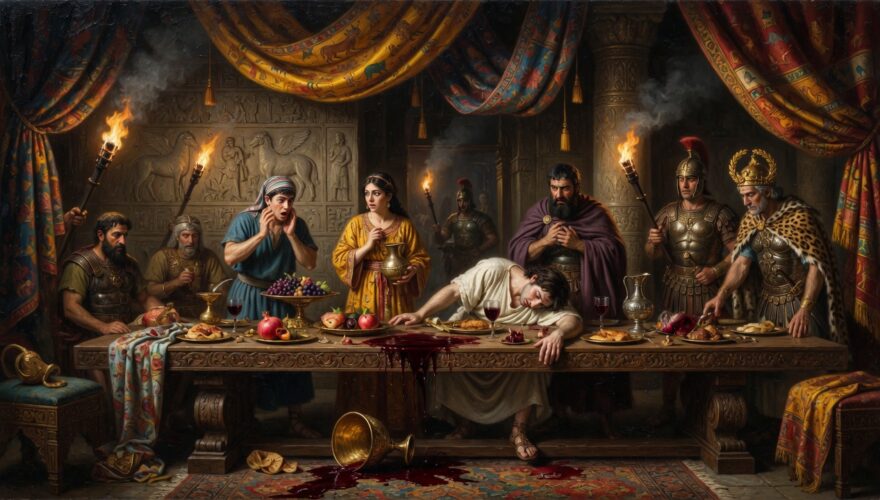
He had conquered most of the known world. Then he went to a dinner party and never came back.
In June of 323 BC, Alexander III of Macedon attended a feast at the palace of Nebuchadnezzar II in Babylon. He drank heavily, as he often did. He laughed, as he often did. And then, over the following twelve days, he deteriorated in ways that no court physician could explain or stop. First a fever. Then progressive paralysis. Then silence.
He was thirty-two years old.
What happened in those twelve days has been argued over, reinvestigated, and theorized about for more than two thousand years. Poison. Typhoid. Alcoholic liver failure. Grief. Guillain-Barré syndrome. The list keeps growing because the answer keeps slipping away. But here’s what makes this more than a historical whodunit: the uncertainty itself is the story. In the ancient world, powerful men didn’t just die. They were helped along, covered up, or rewritten. The fog around Alexander’s death isn’t accidental. It’s a signature.
A Body Already Running on Empty
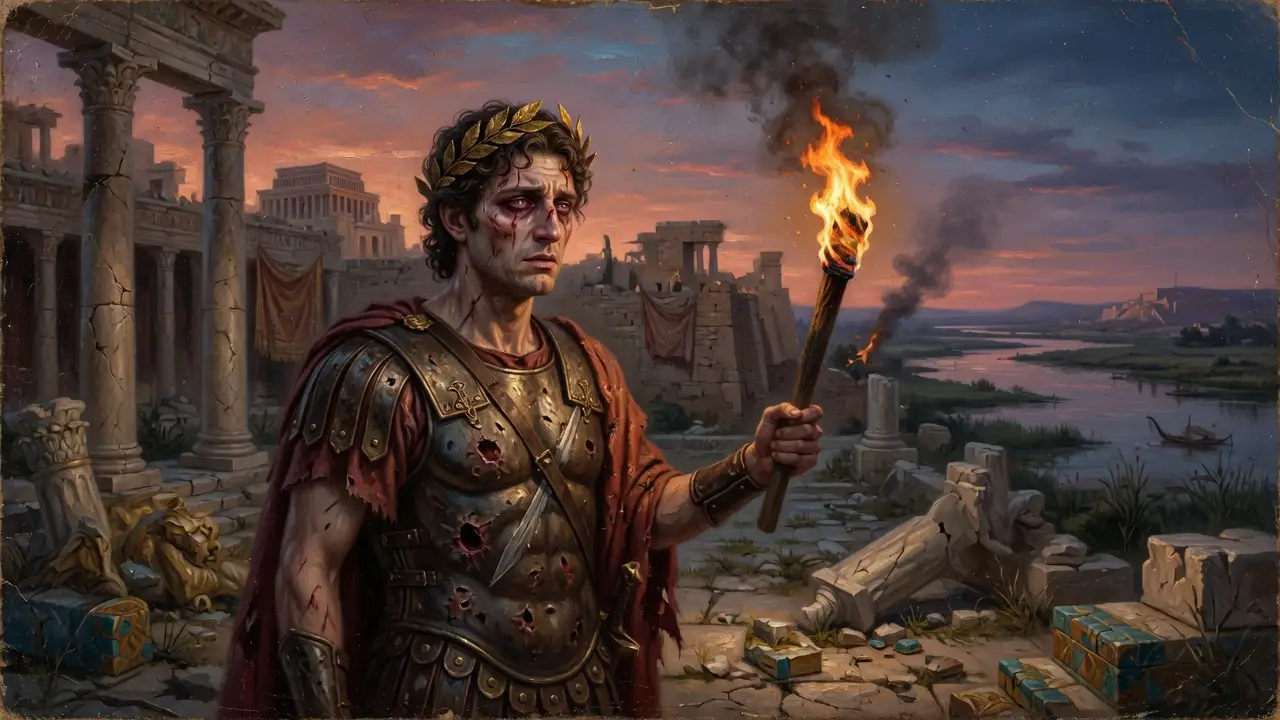
By the time Alexander the Great reached Babylon in 323 BC, his body had been through more than most men experience in three lifetimes.
He had suffered a near-fatal arrow wound to the chest at the siege of Multan in modern-day Pakistan, an injury so severe that a lung was punctured and his officers reportedly wept, believing he was dead. Before that, he took a sword blow to the thigh at Issus, an axe to the helmet at Granicus that nearly split his skull, and an arrow to the ankle at Gaza. He crossed the Gedrosian Desert, one of the most punishing environments on Earth, watching a quarter of his army die of thirst. He drank constantly, hard, the way men drink when they’re trying to outrun something they can’t name.
His closest friend, Hephaestion, had died eight months earlier. Alexander’s response was not quiet grief. He fasted. He ordered the manes of all horses and mules in the army shaved as a sign of mourning. He had Hephaestion’s physician crucified. He launched a punishing campaign against the Cossaeans, some historians believe simply to have something to kill. He petitioned the oracle at Siwa to have Hephaestion declared a divine hero and waited obsessively for the answer.
“Alexander mourned for him as Achilles mourned for Patroclus.”
Arrian, Anabasis of Alexander, Book VII
The man who arrived at that final Babylonian feast was not the invincible king his legend describes. He was a thirty-two-year-old who had been functionally dying by degrees for years.
The Night Everything Changed
The feast was hosted by a Macedonian officer named Medius of Larissa. Ancient sources describe it as a sprawling, multi-night affair. Alexander the Great drank a massive cup of unmixed wine, the kind referred to in Greek sources as a “Cup of Heracles,” deep enough to be theatrical, deep enough to be reckless.
Join The Archive Briefing
Weekly dispatches. The history they didn't teach you — sourced, subverted, delivered to your inbox.
Then he felt it. Something wrong. A sharp pain in the chest, according to some accounts. A fever that wouldn’t break.
He was carried back to the palace. The court doctors clustered around him. Over the following days, the fever climbed. He lost the ability to speak. His officers filed past him in silence, and he could no longer respond, only move his eyes and lift one hand slightly. By the eleventh day, he was gone.
“He drank a great draught and suddenly cried out as if smitten by a violent blow.”
Diodorus Siculus, Library of History, XVII.117
What no one wrote down was who was in that room. What no one recorded was what, exactly, was in that cup.
The Poison Theory: A Very Macedonian Problem
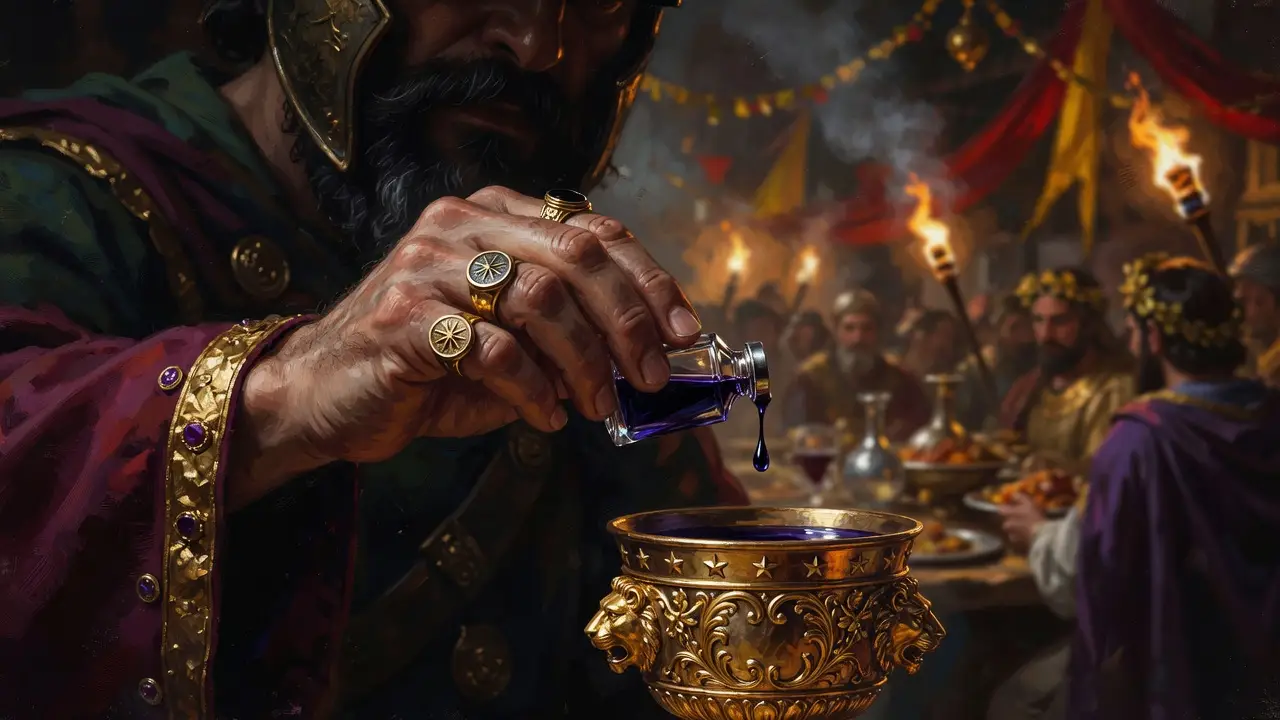
Poison was not exotic in the Macedonian court. It was practically a administrative tool.
Philip II, Alexander’s father, had been assassinated. Alexander’s own mother, Olympias, was widely suspected of poisoning Philip’s other wife and her son. The Macedonian succession was, by any modern standard, a continuous bloodbath. When Alexander died without a clear heir and his generals stood around his decomposing body dividing the world between them like a pie, the motive for someone wanting him dead before he could designate a successor becomes almost laughably obvious.
LESSER-KNOWN DETAILS
Alexander the Great carried a copy of the Iliad annotated by Aristotle with him everywhere. He kept it under his pillow alongside a dagger.
The ancient source Diodorus Siculus preserves an account claiming that Aristotle himself helped procure the poison, brought to Babylon by Alexander’s cup-bearer Iollas, the brother of Cassander, who would later murder Alexander’s son, mother, and wife to seize Macedonia. That’s not a coincidence. That’s a pattern.
The poison allegedly used was water from the River Styx, a toxic spring in Arcadia whose water was so corrosive it could dissolve metals. The story reads like mythology, but the Styx does exist. The spring at Mavroneri in Greece produces water from a species of cyanobacteria and is genuinely toxic. Modern toxicologist and researcher Dr. Adrienne Mayor has taken this theory seriously in peer-reviewed work.
“His body showed no signs of putrefaction for six days, which his admirers interpreted as proof of his divine nature.”
Plutarch, Life of Alexander
What makes the poison theory compelling isn’t just the opportunity. It’s the timing. Alexander had recently announced plans to conquer Arabia and, after that, the western Mediterranean including Carthage and Rome. His generals had been marching for thirteen years. Many of them were done. Some of them were afraid of where he might lead them next. A man who wouldn’t stop was, to the people around him, a liability.
Typhoid and the River They Shouldn’t Have Trusted
The other serious candidate is typhoid fever, complicated by alcoholism and a compromised immune system.
Babylon in 323 BC sat alongside the Euphrates, and the water supply was, by any modern assessment, catastrophic. The city had a persistent reputation for disease. Greek sources mention that Alexander’s army had already been weakened by the Babylonian climate and water. Typhoid spreads through contaminated water and food. Its symptoms match: fever, progressive weakness, eventual organ failure.
LESSER-KNOWN DETAILS
His eyes were reportedly two different colors (heterochromia), one grey-blue and one dark brown. Ancient sources mention this. His horse, Bucephalus, was said to also have one white eye.
A 1998 study in the New England Journal of Medicine argued that Alexander’s death was consistent with typhoid fever compounded by severe alcoholic liver disease. His drinking had escalated dramatically in his final years, particularly after Hephaestion’s death. A liver already damaged by chronic alcohol consumption would have had almost no ability to fight a systemic infection.
The detail that haunts this theory is the timing of decomposition. Ancient sources note that Alexander’s body showed no signs of decay for six days after his death. His physicians apparently took this as a sign of divinity. Modern pathologists have a different explanation: a condition called Guillain-Barré syndrome can mimic death, causing progressive paralysis while the patient remains conscious. If Alexander was not actually dead when he was declared dead, the lack of decomposition makes biological sense.
He may, in other words, have been buried alive.
What Grief Does to a Conqueror like Alexander the Great
There’s a version of this story that isn’t about poison or bacteria at all. It’s about a man who had already decided, somewhere below the level of consciousness, that he was done.
After Hephaestion died, Alexander’s behavior changed in ways his officers noticed and documented. He stopped eating regularly. He drank more. He became unpredictable, alternating between grandiose planning and a paralysis that was new to him. The campaigns he launched in those final months had a compulsive quality, the quality of someone who needs motion the way other people need oxygen.
Ancient writers who knew the court directly described Alexander as inconsolable. Not in the polite, aristocratic way of Macedonian mourning. Actually inconsolable. A man who had never lost anything suddenly confronted by the one loss that mattered more than any conquered city.
LESSER-KNOWN DETAILS
He was likely only about 5’5″ or 5’6″, making him short by Macedonian standards. His charisma and battlefield presence compensated in ways his height never could have predicted.
The Greeks had a word for it: penthos. A grief so extreme it disrupted the natural order of things. They wrote it about Achilles when Patroclus died. Alexander had grown up reciting Homer. He knew exactly what role he was playing.
The Silence of the Generals
Here is the detail most people skip over.
When Alexander lay dying and his soldiers asked who he left his empire to, he reportedly said, “to the strongest.” Some sources say he said “Kratisto,” which can also be read as the name Craterus, one of his top generals. The ambiguity was either genuine or manufactured. Either way, it was a catastrophe.
His generals didn’t try to save him. They didn’t summon more physicians. They gathered in an antechamber and began negotiating. While Alexander was still technically breathing, the men closest to him were already carving up Persia, Egypt, and Macedonia between themselves.
“He said that all of his chief friends would have a great funeral contest in his honor.”
Arrian, Anabasis, Book VII (referencing his deathbed words)
This is the context in which “we don’t know how he died” should be understood. The people who knew exactly what happened in that room had every reason to obscure it. Histories were written under the patronage of those same generals, now kings of their own territories. Ptolemy, who became pharaoh of Egypt, wrote his own account of Alexander’s campaigns. It has not survived, but it was used as a source by later historians who have. The version of events that reached us passed through hands that were not neutral.
The fog around Alexander’s death is not a failure of historical record-keeping. It is the record.
What the Mystery Actually Tells Us
Every civilization that concentrates absolute power in a single person eventually faces the same problem: what happens when that person becomes inconvenient?
Alexander’s death is a masterclass in how power protects itself. The uncertainty isn’t a gap in the evidence. It’s evidence of something else entirely: that the transition of power in the ancient world required the erasure of its own mechanics. You couldn’t write down who had poisoned the king if you wanted to rule the kingdom. You couldn’t preserve the real account if the real account was treasonous.
“I am dying with the help of too many physicians.”
Alexander the Great
Two thousand years later, we are still asking who killed Alexander because the people who knew made sure we never would. That’s not a mystery. That’s a system working exactly as designed.
The boy who had wept as a teenager because his father was leaving him no worlds to conquer died in a city he had just taken, surrounded by men who were already thinking about what to do next. Whether it was the poison in the cup, the bacteria in the water, the grief in his chest, or simply the accumulated wreckage of a body pushed past every reasonable limit, the result was the same.
The world’s largest empire dissolved in a matter of years. Not because Alexander the Great failed to build something lasting, but because he never imagined he’d have to. He planned to live forever. In a certain sense, given what we’re still arguing about, he almost has.