The armourers of medieval Milan and Toledo sold swords to anyone who paid, Christian or Muslim. Inside history’s first unregulated global arms market, and why the Crusades were partly fought with the same blades on both sides. The medieval arms trade was global, ruthless, and completely ignored the Holy War it was supplying.
A Blade Has No Allegiance
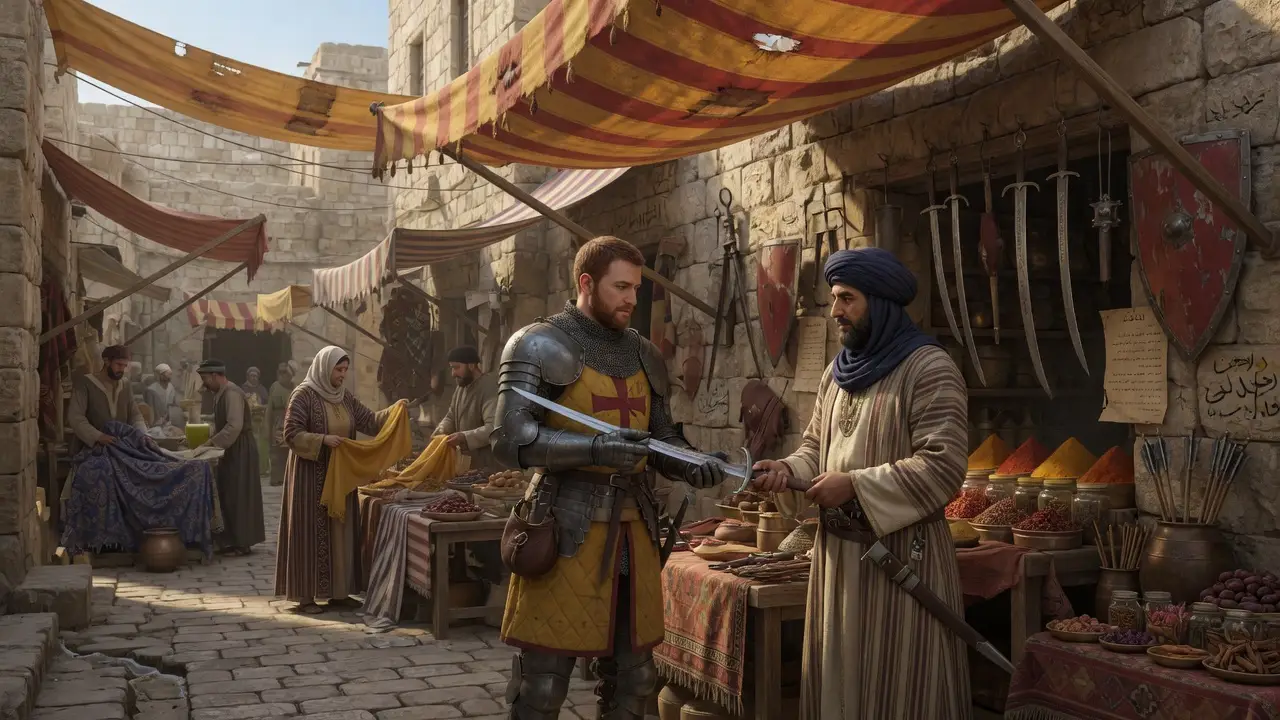
The sword that killed him was Milanese. The man who swung it was a Muslim warrior defending Jerusalem. The Crusader it killed had carried a blade forged in Toledo, sold through a Venetian merchant, purchased in a Syrian bazaar.
Nobody found this strange. Nobody tried to stop it.
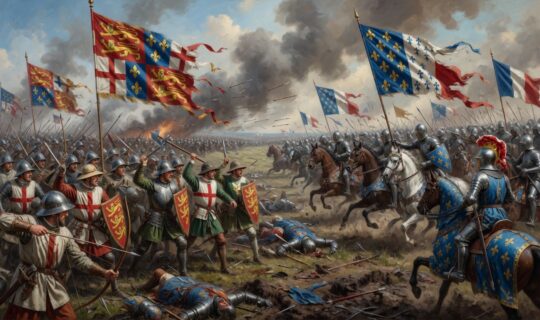
In the twelfth and thirteenth centuries, while popes declared holy wars and kings pledged their souls to God’s cause, the armourers of Europe were quietly selling their finest work to anyone with gold. Christian, Muslim, Mongol, it made no difference. A sword was a product. War was a market. And the medieval arms trade was one of the most ruthlessly efficient industries the ancient world ever produced.
The Forge Cities That Armed the World
Long before industrial capitalism gave us the concept of a supply chain, two cities had already perfected it for mass violence.
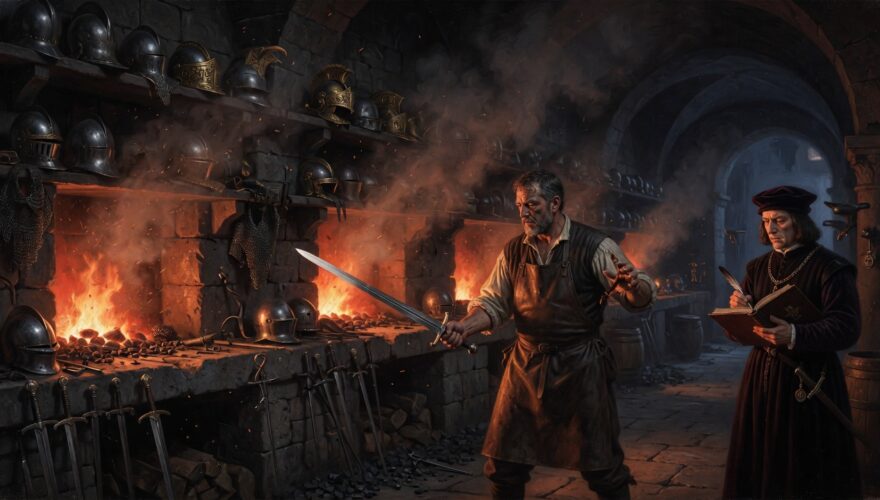
Milan and Toledo were the Sheffield and Pittsburgh of medieval weapons manufacturing. Milan, sitting at the crossroads of Alpine trade routes, had been producing armour since at least the eleventh century. By the 1300s, the Milanese workshops of the Missaglia and Negroli families weren’t just local suppliers. They were running what amounted to an international export operation, with agents in Venice, Genoa, and across the eastern Mediterranean.
“The merchants of Venice care more for pepper than for prayers.”
Common pejorative circulating in 13th century European church circles, recorded in various chronicles
Toledo’s blademakers were equally cosmopolitan in outlook, and arguably more sophisticated in craft. The city sat in a Spain that had spent centuries blending Islamic, Jewish, and Christian metallurgical knowledge. Toledo steel was the product of that unlikely cultural fusion: Spanish iron ore, techniques borrowed from Arab smiths, and a finishing process that produced a blade of unusual flexibility and edge retention. When Spanish reconquest eventually forced Muslim craftsmen out of their workshops, many of the secrets left with them, scattering trade knowledge across North Africa and the Levant.
What both cities understood, centuries before anyone put the concept into words, was that your best customer is whoever needs weapons most urgently. In a continent permanently at war with itself, that was everyone.
The Merchants in the Middle
Between the forge and the battlefield stood a figure history has mostly ignored: the arms merchant.
Join The Archive Briefing
Weekly dispatches. The history they didn't teach you — sourced, subverted, delivered to your inbox.
He rarely appears in chronicles. He had no romantic mythology, no chivalric code, no crusading purpose. He was simply the man who knew where the swords were and where the money was, and was talented at connecting the two.
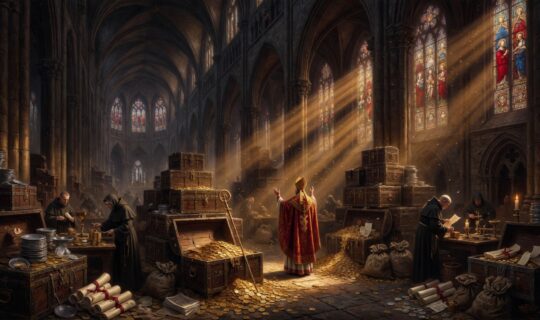
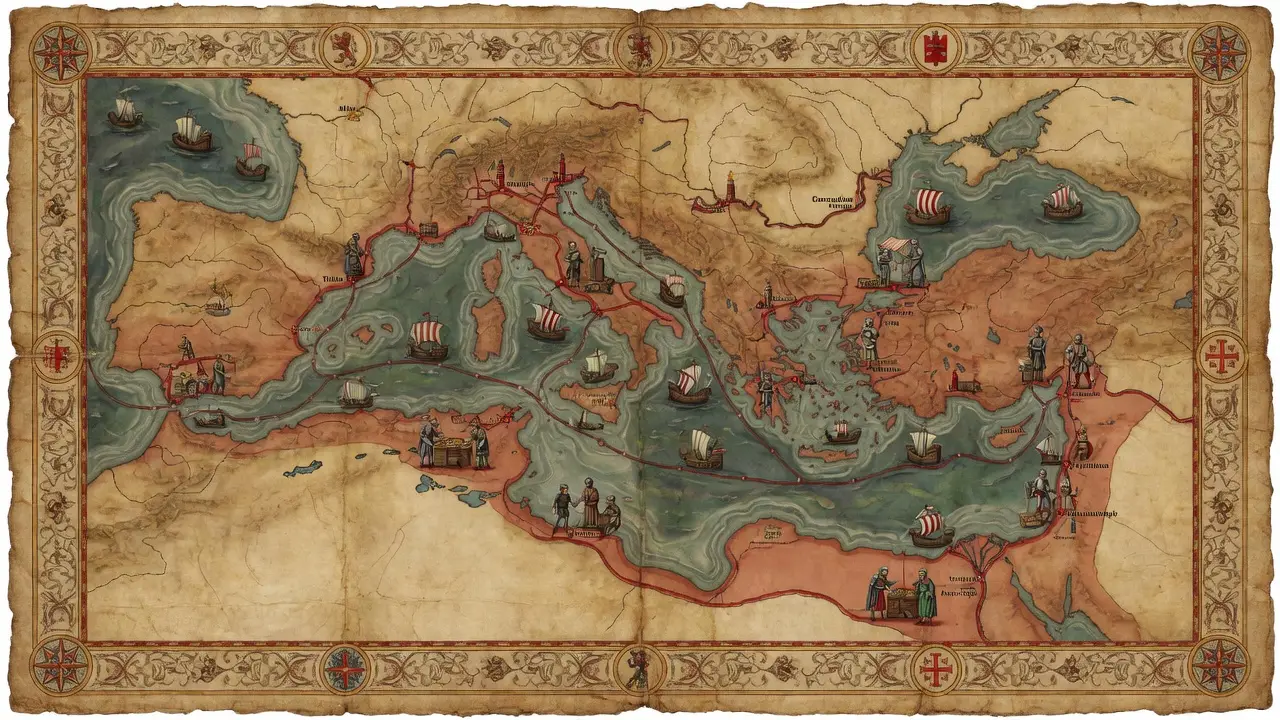
Venice was the great clearinghouse. Its merchants had maintained trading relationships with Islamic powers throughout the Crusades, a practice the Church condemned loudly and tolerated quietly. Venetian traders were caught selling timber, iron, and weapons to Egypt as late as the 1170s, even while Crusader armies were fighting Egyptian forces in the field. Pope Alexander III issued a furious ban. Venice paid the fine, continued trading, and built the finest merchant fleet in the Mediterranean on the profits.
The Genoese were no different. Their colonies dotted the eastern Mediterranean and the Black Sea, and their merchants supplied weapons to whoever held the ports. During the Mongol invasions of the thirteenth century, Genoese traders supplied iron goods, including weapons, to Mongol forces that were simultaneously devastating Christian kingdoms in Eastern Europe. In one documented case, Genoese merchants sold arms to the Golden Horde while Genoese crossbowmen were hired to fight against the Golden Horde in Byzantine service.
This was not considered scandalous. It was considered business.
What the Records Actually Show
The paper trail, fragmented as it is, tells a story that medieval propaganda desperately tried to suppress.
In 1198, Pope Innocent III issued Quia maior, explicitly forbidding Christian merchants from supplying arms, iron, timber, or ships to Saracen powers. The decree was reissued five more times over the next century, each reissue a tacit admission that the previous one had been ignored. Historians who have traced the trade documents from Venetian and Genoese archives have found consistent evidence of weapons moving through Syrian and Egyptian ports throughout the entire Crusading period.
LESSER-KNOWN DETAILS
The city of Brescia, north of Milan, specialized in producing bladed weapons so efficient at killing armoured knights that the Catholic Church attempted to ban its main export at the Fourth Lateran Council in 1215. The ban failed within a decade.
The Mamluk Sultanate, which ultimately expelled the Crusaders from the Holy Land in 1291, built much of its military capacity on imported steel. Egyptian and Syrian sources describe Frankish (Western European) swords being valued as status weapons among elite Mamluk cavalry. The finest European blades carried a prestige value in Islamic courts similar to the way Japanese swords would later be valued in European collections: objects of acknowledged excellence, regardless of their origin.
On the other side, Crusader knights were arming themselves from closer sources than people assume. The metal available locally in Syria and Palestine was often worked by Arab smiths using techniques that traced back to Damascus and Persian tradition. A Christian knight who broke his sword on campaign and bought a replacement from a Syrian market might find himself fighting with a blade that had passed through a dozen hands, including Muslim ones.
The irony wasn’t lost on everyone at the time. The chronicler Usama ibn Munqidh, a Syrian nobleman who fought both alongside and against Crusader forces, wrote with dry precision about the pragmatic relationships between warriors who were supposed to be eternal enemies. He described Crusader knights he considered friends, trading arrangements that benefited both sides, and the fundamental absurdity of a holy war conducted by men who were also, quietly, doing commerce with each other.
“Every Frank who comes from his country to ours is rougher in character than those who have been here longer. The latter are used to dealing with us.”
Usama ibn Munqidh, Kitab al-Iʿtibar, c. 1183
The Specialist Trade: Crossbows, Armour, and the Technology Gap
Not all weapons were equal, and the arms trade wasn’t simply swords changing hands.
The crossbow created one of the medieval period’s earliest examples of a controlled military technology gap. Christian armies had crossbowmen. Islamic forces initially did not, or had fewer and less powerful versions. The weapon was slow to reload, required significant upper-body strength or a mechanical spanning device, and demanded skilled manufacture. For a period in the twelfth century, European crossbow superiority was a genuine tactical advantage.
“We have seen them sell to the Saracens iron and timber, and give them every means to attack us. For gold they would sell Christ himself.”
Jacques de Vitry, Bishop of Acre, c. 1216–1228, in his letters from the Holy Land
The gap didn’t last. Genoese crossbowmen were the premier mercenary specialists of the medieval Mediterranean, and they sold their services to everyone. By the mid-thirteenth century, Genoese crossbow units appear in the service of Byzantine emperors, various Muslim rulers, and Mongol commanders simultaneously, in different theatres of war. The crossbow technology itself spread through captured weapons, defecting craftsmen, and direct purchase.
Armour followed the same pattern. Milanese plate armour was the best in the world by the fourteenth century, and it was exported east without restriction. The Ottoman court purchased it. Egyptian sultans kept examples in their armories. When European merchants were barred from direct sale by papal decree, the armour moved through intermediaries: Greek merchants, Jewish traders operating across the religious divide, Armenian merchants who navigated between Christian and Islamic spheres with remarkable freedom.
The Merchants Who Crossed Every Line
No figure in this story is more revealing than the renegade: the European craftsman or merchant who crossed over entirely, converting to Islam and taking his skills with him.
The phenomenon was more common than the Church liked to admit. A Genoese armourer who converted and settled in Alexandria was a genuine security threat in ways that a trading company exporting finished goods was not. He could train local craftsmen. He could adapt techniques to locally available materials. He could build a workshop that reduced dependence on European supply entirely.
LESSER-KNOWN DETAILS
Jewish merchants played a crucial and underappreciated role in the medieval arms trade, operating freely across religious boundaries. Because they were barred from guild membership in most Christian cities, they often worked as brokers and intermediaries, moving weapons through the Mediterranean in ways that left Christian merchants technically blameless.
The Mamluk arms industry of the thirteenth and fourteenth centuries showed exactly this kind of knowledge transfer. Mamluk armourers produced work of exceptional quality, blending European plate techniques with older Islamic traditions in mail and lamellar construction. The synthesis was not accidental. It came from contact, exchange, and the movement of people who carried knowledge in their hands.
Medieval European authorities tried various approaches to stop this. Craftsmen were sometimes required to swear oaths not to teach their trade to non-Christians. Guild regulations in some cities attempted to restrict who could learn the armourer’s craft. None of it worked in any lasting way. The market was too large, the profits too substantial, and the borders too porous.
When the Sword Comes Full Circle
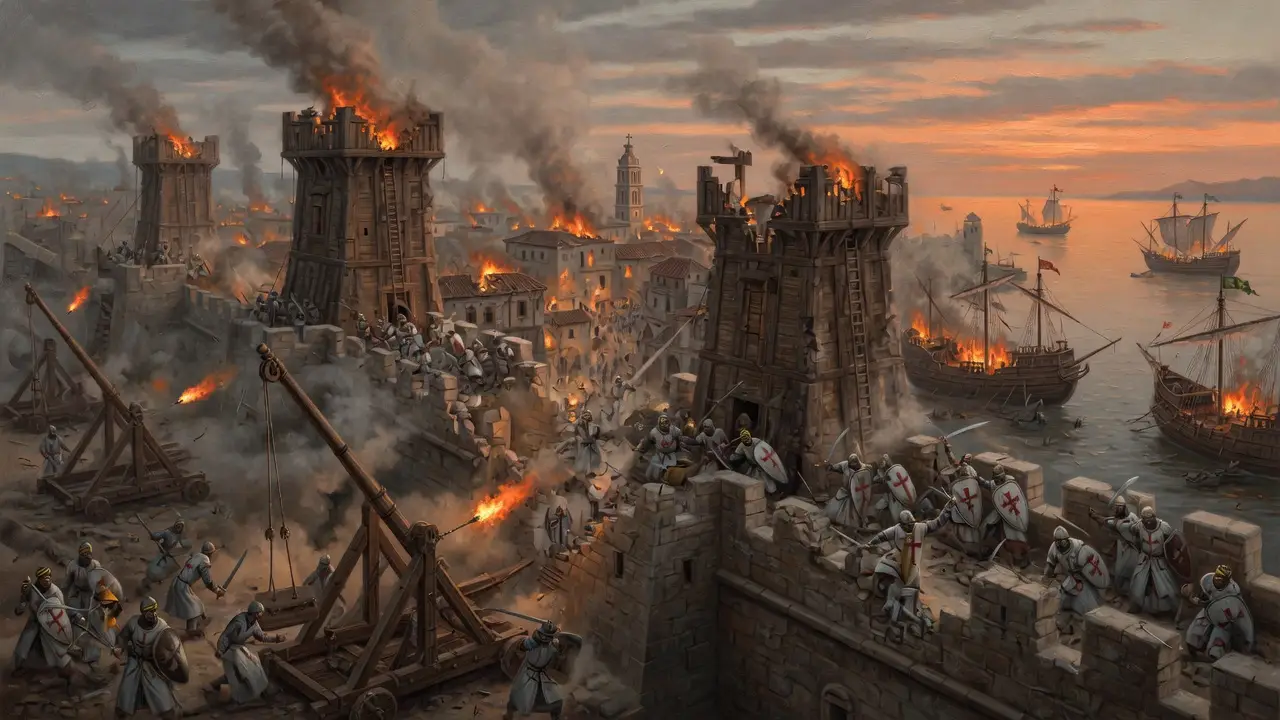
In 1291, the Crusader city of Acre fell to Mamluk forces under Sultan al-Ashraf Khalil. It was the effective end of the Crusader presence in the Holy Land, and it was accomplished with a military force that had been arming and training for decades, partly through access to European weapons technology, European mercenaries, and European trade networks.
The defenders of Acre fought with weapons from the same European workshops that had been supplying their enemies. Some of the siege equipment used against the walls was operated by engineers whose techniques derived from Islamic modifications of Western methods that had themselves been adopted from older Byzantine and Persian traditions.
The Genoese will sell their grandmother if the price is fair.”
Florentine merchant proverb, 14th century, recorded in several banking house correspondence collections
The arms trade hadn’t taken sides. It had simply flowed toward money and need, as it always does.
A generation later, when the Black Death began its sweep through Europe in the 1340s, the trade routes that had carried weapons east also carried the plague west. The Genoese merchants who had sold arms to the Golden Horde at Caffa on the Black Sea were in Caffa when the epidemic broke out. They carried it home to Messina, and from there it moved faster than any army.
The infrastructure of unregulated trade had no ideology. It moved whatever was profitable.
The Shadow Market That Never Really Ended
The medieval arms trade is usually treated as a curiosity, a footnote to the Crusades, proof that medieval people were hypocrites about their religious commitments. That reading misses the larger point.
What the armourers of Milan and Toledo built was the first genuinely global weapons market. It operated without international law, without arms control agreements, without any mechanism for stopping a finished blade from reaching whoever would pay for it. The merchants who ran it were sophisticated enough to use intermediaries, adjust for political risk, and absorb the cost of papal fines as simply another business expense.
LESSER-KNOWN DETAILS
A Damascus sword didn’t necessarily come from Damascus. By the 12th century, “Damascus” was a quality designation, not a geographic one, similar to how “champagne” works today. Blades marketed as Damascene were produced in Cairo, Persian workshops, and Indian forges.
The moral logic was identical to every arms deal made in the centuries since: the weapon itself is neutral, the violence is someone else’s responsibility, the profit is real and immediate, and the consequences are abstract and distant.
Richard I of England reportedly admired the craftsmanship of Saladin’s personal sword when the two leaders exchanged gifts during a diplomatic pause in their war. He would have recognized the metalwork. His own armoury contained pieces from the same tradition.
“A weapon is only as righteous as the man who wields it — and men, as God well knows, are rarely righteous at all.”
attributed to a Templar knight in a 13th century chronicle fragment, Gesta Crucesignatorum
The Crusaders and the Saracens died by blades from the same forges. The merchants counted the money. The popes issued new bans. And the ships kept sailing.