For 700 years, the Parthian and Sassanid empires controlled every trade route between Rome and China, humiliated Roman generals, captured a living emperor, and built a civilization history barely mentions. This is the story of the ancient world’s most overlooked superpower.
A King at the Edge of Two Worlds
In 53 BC, a Roman army of forty thousand men marched into the Syrian desert and did not come back.
Their commander, Marcus Licinius Crassus, was one of the richest men in the history of Rome. He had co-ruled the known world alongside Julius Caesar and Pompey. He wanted a military victory to match their legacies, and he had found what looked like an easy target: the Parthian Empire, a kingdom of horse lords and merchants that most Romans considered a loose confederation of glorified nomads.
The battle of Carrhae ended with Crassus dead, his son’s severed head paraded on a pike through the Parthian ranks, and the Roman eagles, the sacred military standards no general ever surrendered, captured and carried east. According to one account, the Parthian king Orodes II was watching a Greek play when the head of Crassus was thrown onto the stage. An actor picked it up and improvised new lines for Euripides. The audience laughed.
The Parthians are as great a power as Rome.”
Tacitus (Annals, Book VI)
Rome had just met the empire it would never conquer, and never quite understand. It would spend the next seven centuries trying.
The Empire History Skips Over
Ask most people to name the great empires of antiquity and you’ll hear Rome, Greece, Egypt, maybe Persia or the Han dynasty of China. The Parthians and their successors, the Sassanids, almost never make the list. They are the asterisk between East and West, the civilization that textbooks acknowledge exists and immediately move past.
This is a strange omission, because for roughly 700 years, from around 247 BC to 651 AD, these Iranian empires controlled the land corridor connecting the Mediterranean world to Central Asia and China. Every bolt of silk that reached Rome, every Roman coin that circulated in the markets of Luoyang, every diplomatic letter, exotic animal, and shipment of spices passed through their territory or paid their tolls. They were the hinge on which the ancient world turned.
“What the Romans could not conquer, they learned to trade with.”
Strabo
They also fought Rome to a standstill for centuries, humiliated multiple emperors, and at their peak under the Sassanids, came closer to destroying the Eastern Roman Empire than anyone before the Ottomans. None of this gets much airtime in the Western tradition, partly because the Parthians in particular left behind few written records compared to their neighbors, and partly because history has always been kinder to the people who wrote most of it.
Born from the Steppes
The Parthians did not begin as an empire. They began as a breakaway.
Join The Archive Briefing
Weekly dispatches. The history they didn't teach you — sourced, subverted, delivered to your inbox.
Around 247 BC, a semi-nomadic Iranian people called the Parni, led by a chieftain named Arsaces, seized the province of Parthia from the successors of Alexander the Great. The Seleucid Empire, which had inherited much of Alexander’s territory, was overextended and distracted, fighting wars on multiple fronts. The Parni moved quickly and quietly, and by the time anyone paid serious attention, Arsaces had declared himself king and established the Arsacid dynasty that would rule for the next four and a half centuries.
LESSER-KNOWN DETAILS
The Parthians minted coins with Greek inscriptions for over 200 years after the death of Alexander, presenting themselves as heirs to Hellenistic civilization even while fighting Greek-speaking Rome.
What followed was a century of careful expansion. The Parthians pushed west into Mesopotamia, taking Seleucia on the Tigris, one of the ancient world’s great cities, and making Ctesiphon their capital just across the river. They pushed east toward the borders of India. They absorbed Babylonian, Persian, and Greek cultural traditions without being swallowed by any of them, a quality that defined their civilization: they were brilliant synthesizers, less interested in imposing their own culture than in holding a vast, diverse empire together through tolerance and shrewd administration.
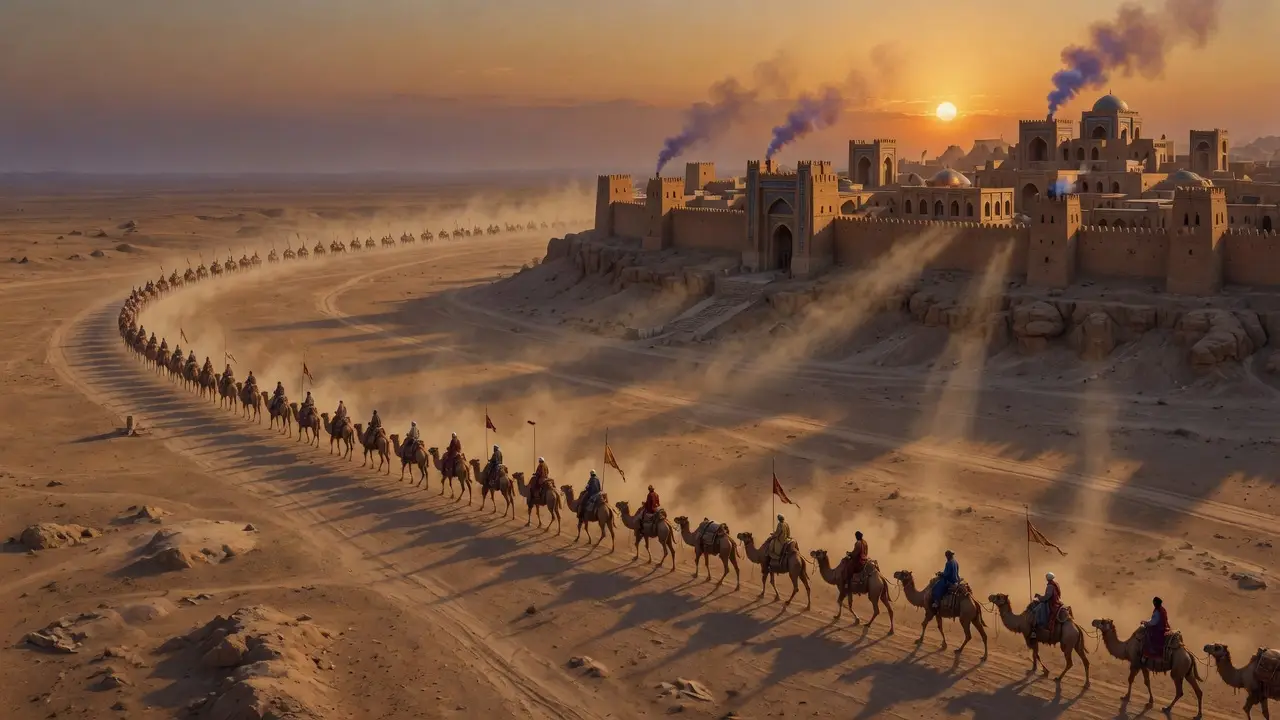
At their height, the Arsacid Parthians ruled a territory stretching from modern-day Turkey to Afghanistan. And sitting at the center of that territory were the Silk Roads.
The Silk Road’s True Landlords
Here is the detail most history books omit: the Parthians did not simply border the Silk Roads. They actively shaped, taxed, and at times deliberately restricted them.
When Roman merchants asked for direct access to Chinese goods, the Parthians said no. They positioned themselves as the sole intermediaries, buying silk and other luxury goods from Central Asian traders and reselling them westward at a significant markup. Roman sources complained bitterly about this. Pliny the Elder estimated in the first century AD that Rome was hemorrhaging 100 million sesterces per year to the East in trade deficits, with the Parthians collecting a portion of every transaction. He was furious. The Parthians were not.
There is a remarkable footnote from 97 AD: a Chinese Han dynasty general named Ban Chao sent an envoy named Gan Ying westward with instructions to reach Rome, which the Chinese called Daqin, and establish direct diplomatic contact. Gan Ying made it all the way to the Persian Gulf. There, Parthian sailors told him the sea crossing to Rome would take two or three years, and that sailors often became so homesick they wept and sometimes died of grief. Gan Ying turned around and went home. Modern historians suspect the story about the sea crossing was a deliberate lie. The Parthians had every reason to prevent a direct Roman-Chinese diplomatic relationship. They never explained themselves, and they never had to.
Rome’s Stubborn Enemy
The Romans never accepted Parthia as an equal. That was probably their most persistent strategic error.
After Carrhae, a succession of Roman leaders convinced themselves they would succeed where Crassus had failed. Mark Antony invaded in 36 BC and was forced into a disastrous retreat, losing a third of his army to hunger and Parthian harassment tactics. The emperor Trajan captured Ctesiphon in 116 AD, then found he could not hold it, and died on the way home. The emperor Septimius Severus sacked it again in 198 AD and hauled off 100,000 Parthian slaves. Each Roman “victory” in Mesopotamia proved temporary. The Parthians retreated, absorbed the blow, and waited.
LESSER-KNOWN DETAILS
The Sassanid Empire had a professional intelligence service and regularly intercepted Byzantine diplomatic communications.
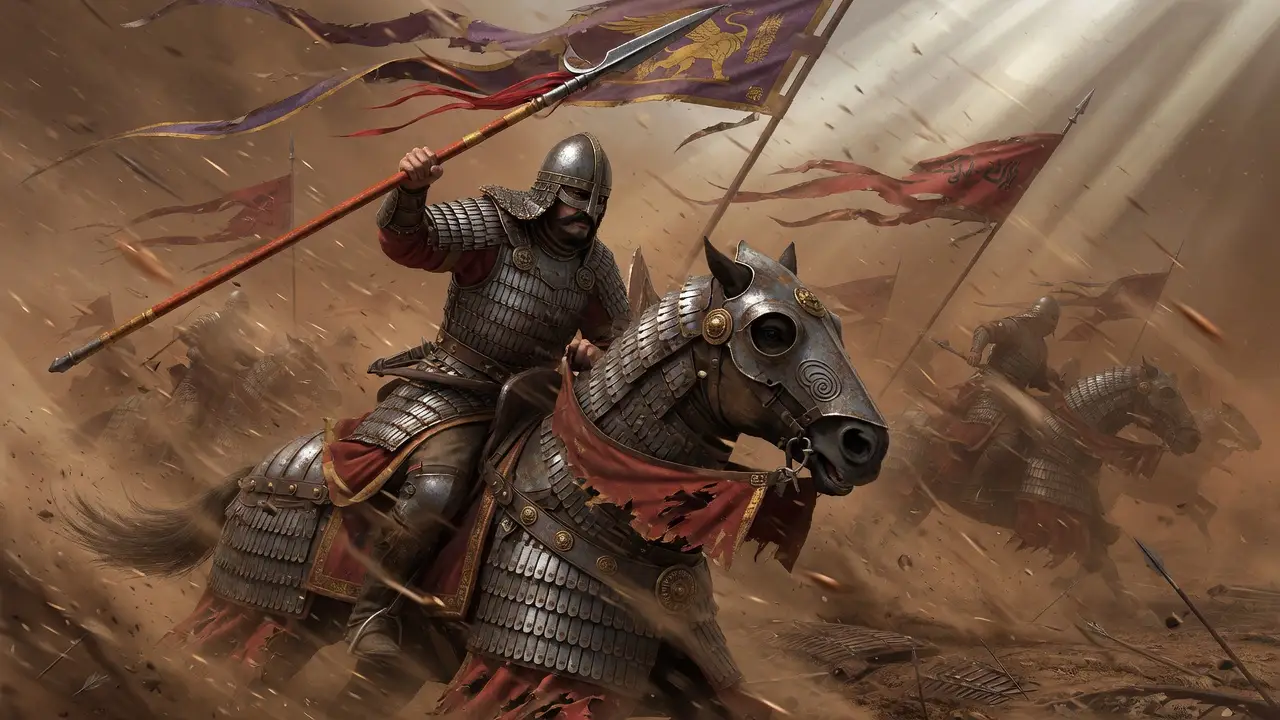
What made the Parthians so difficult to defeat was a fundamental mismatch in military doctrine. Roman legions were optimized for pitched battles: disciplined infantry, siege warfare, fortified camps. The Parthians fielded two kinds of fighters that Roman tactics struggled to counter. First, the cataphract: a heavily armored cavalryman on an armored horse, essentially a medieval knight a thousand years before Europe invented the concept. Second, the mounted archer, capable of the famous Parthian shot, firing backward at full gallop with devastating accuracy. Roman infantry that broke formation to chase Parthian archers were cut down by cataphracts. Roman infantry that held formation stood still while arrows fell on them from beyond the range of a pilum throw.
The Parthians had figured out how to make Rome’s greatest strength irrelevant.
The Sassanids: When the Pressure Became Existential
In 224 AD, a Persian vassal king named Ardashir I overthrew the last Arsacid ruler and established the Sassanid Empire on the same territory. If the Parthians had been formidable, the Sassanids became something closer to an obsession for Rome and later Byzantium.
Where the Parthians had been administratively loose, the Sassanids were centralized and ideologically driven. They revived Zoroastrian religion as a state faith, built a sophisticated bureaucracy, and reorganized their military. They also inherited 400 years of accumulated knowledge about exactly how Rome fought, and they used it.
In 260 AD, the Sassanid king Shapur I did something no enemy of Rome had ever done: he captured a sitting Roman emperor in battle. Valerian, who had led a campaign into Mesopotamia, was taken prisoner at the Battle of Edessa. Shapur commemorated the moment in massive rock reliefs carved into cliffs at Naqsh-e Rostam in modern Iran. The carvings still exist. They show Shapur on horseback, with Valerian kneeling before him. One version shows the emperor gripping Shapur’s stirrup in submission.
Shapur reportedly used Valerian as a human footstool when mounting his horse. Whether this is literal or propaganda is debated. Either way, the image worked.
A Civilizational Bridge, Not Just a Battlefield
The conflict with Rome and Byzantium tends to dominate how the Parthian and Sassanid empires get discussed, when they get discussed at all. But the more durable legacy is what they transmitted.
Paper-making technology, developed in China, moved westward through Sassanid Persia before reaching the Islamic world and eventually Europe. Buddhist missionaries traveled through Parthian territory on their way to Central Asia. Indian mathematical concepts, including the numerical system that would eventually become Arabic numerals, passed through Sassanid Persia. The game of chess, originating in India as chaturanga, was adapted in Persia into chatrang, and the version that reached Europe was already a Persian creation.
LESSER-KNOWN DETAILS
Khosrow I (531–579 AD), considered the greatest Sassanid ruler, invited Greek philosophers expelled from Athens by Justinian to live and teach at his court. He included a clause protecting them in his peace treaty with Byzantium.
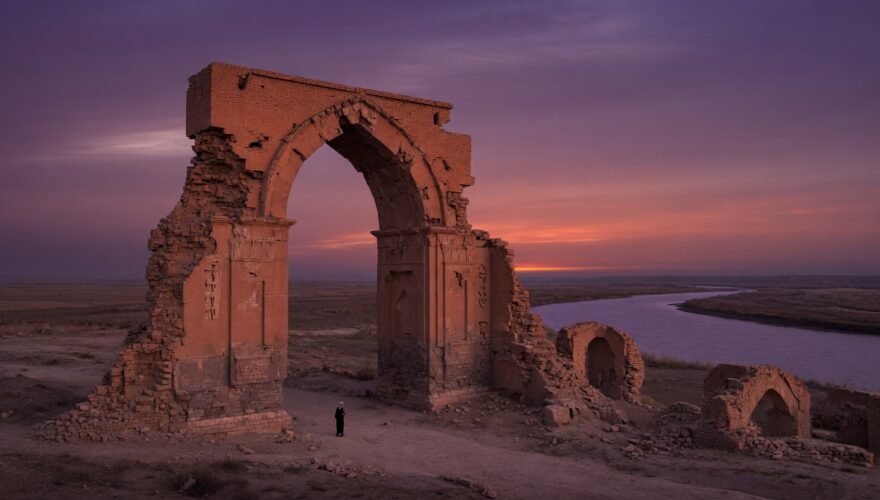
The Sassanid capital at Ctesiphon contained the Taq Kasra, an audience hall with a barrel vault spanning 83 feet, the largest unreinforced brick arch ever built. When Arab armies conquered the city in 637 AD, they reportedly stood before it and recited the Quran, moved by what human hands had built. A portion of the arch still stands today outside modern Baghdad. It survived 1,400 years of wars, floods, and neglect. Tourists almost never visit it.
The Fall, and What It Left Behind
The end came quickly, by imperial standards.
The Sassanid Empire and the Byzantine Empire had spent the early 600s locked in one of the most destructive wars of late antiquity. The Sassanid king Khosrow II nearly delivered the killing blow, capturing Jerusalem in 614, seizing the True Cross, and advancing to the walls of Constantinople itself. The Byzantine emperor Heraclius then launched a stunning counterattack that drove the Sassanids back and recaptured everything. Both empires emerged from the war financially broken, their frontier populations exhausted and resentful.
In 633 AD, Arab armies riding out of the Arabian Peninsula under the banner of Islam began their conquests. The Sassanids, who should have been able to repel them with relative ease, collapsed in less than two decades. The last Sassanid king, Yazdegerd III, was assassinated in 651 by one of his own subjects while fleeing across Central Asia. A mill owner killed him for his purse. The greatest empire between Rome and China ended not in a climactic battle but in a grain store somewhere in Khorasan.
LESSER-KNOWN DETAILS
The Sassanids operated a postal relay system so efficient that messages could travel from one end of the empire to the other in days.
Byzantine survived another 800 years. The Sassanid Empire did not. But the civilization it had spent four centuries building did not disappear; it dissolved into the Abbasid Caliphate, into Persian Islamic culture, into the very idea of cosmopolitan urban life in the medieval Middle East. The administrators, astronomers, architects, and physicians of the early Islamic world were largely former Sassanids doing what they had always done, just under new management
The Map That Still Explains the World
The modern Middle East, Central Asia, and the border tensions between Iran and the West are not accidents of recent history. They are, in many ways, the long shadow of this forgotten civilizational fault line, a region that has been simultaneously a bridge and a battleground for more than two millennia.
Iran, which is what Persia called itself long before the West adopted the Greek name, carries the Sassanid inheritance more directly than most nations carry anything. The Persian language, the Zoroastrian traditions still practiced by Parsi communities in India, the architecture of the iwans seen in mosques from Tehran to Delhi, the administrative culture that shaped the Abbasid Caliphate and everything downstream from it: these are Sassanid legacies dressed in later clothes.
“From China to the edges of the Byzantine world, no merchant moved without crossing Parthian land.”
Isidore of Charax’s Parthian Stations
Seven centuries of empire, and what remains is mostly the shape of things. The way trade routes still follow the same mountain passes. The way empires still fight over the same Mesopotamian river valleys. The way the space between East and West keeps producing civilizations that neither side quite knows how to categorize.
Crassus went into the desert certain he knew what he was dealing with. He was wrong in every direction. The empire he underestimated outlasted him by five hundred years, and its ghost has been haunting the region ever since.