The Mongol Empire killed millions, burned Baghdad, and unleashed the Black Death on Europe. It also built the trade routes that sparked the Renaissance, transferred gunpowder to the West, and accidentally triggered the collapse of feudalism. Here’s how the most destructive empire in history created the conditions for the modern world.
The Day the World Changed Forever
In 1258, the Tigris River ran black.
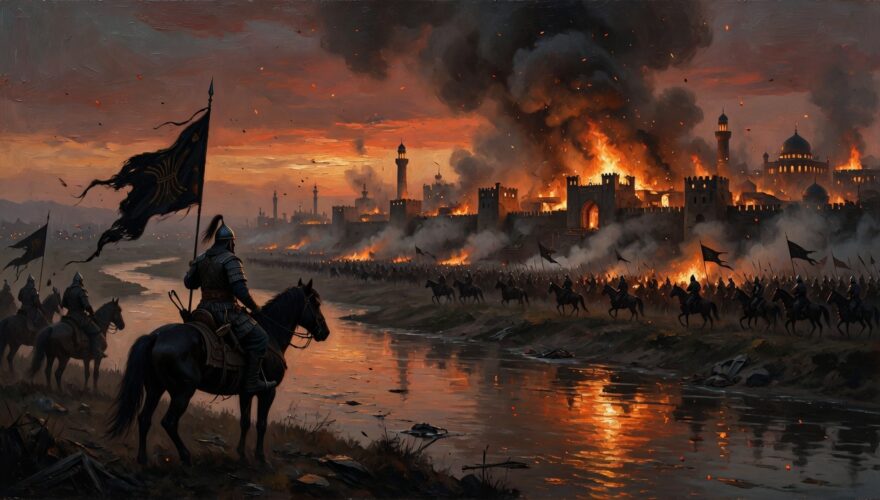
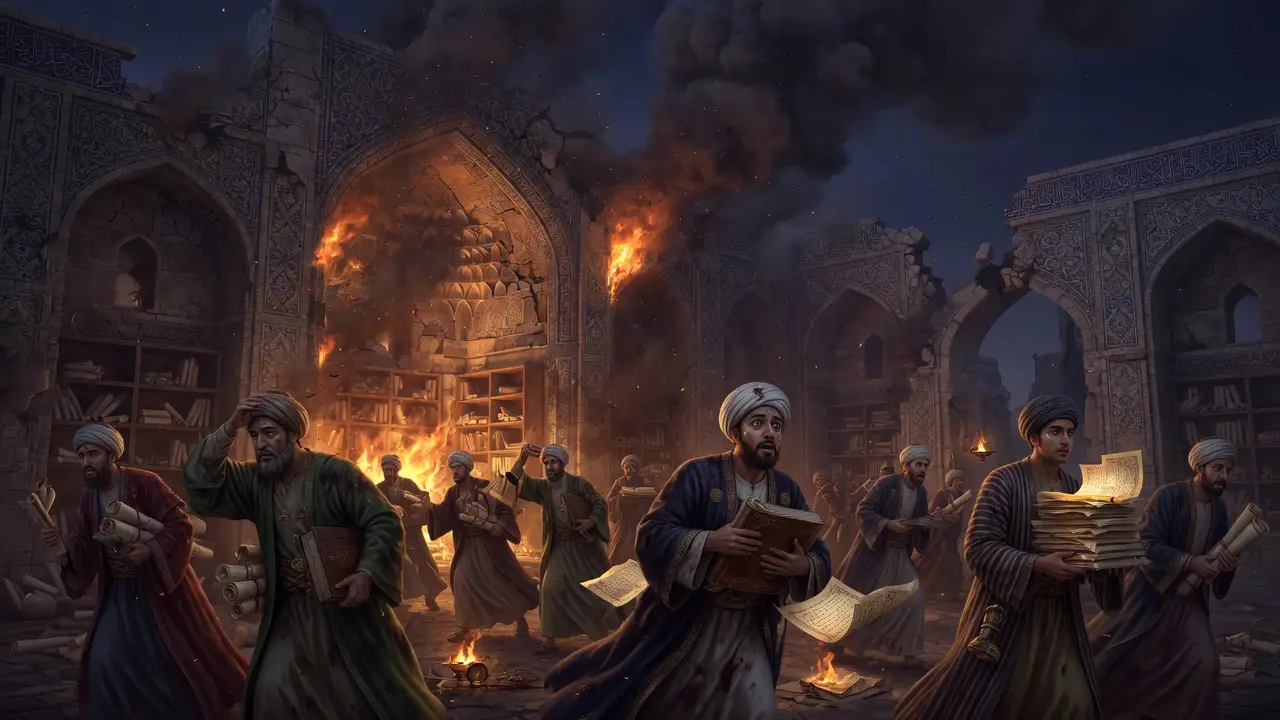
Not from rain. Not from silt. From ink. Hundreds of thousands of books, the accumulated knowledge of the Islamic Golden Age, were thrown into the water by Mongol soldiers sacking Baghdad. The river ran black from ink, then red. The Abbasid Caliph Al-Musta’sim, ruler of the world’s most sophisticated civilization, was rolled into a carpet and trampled by horses. The Mongols believed spilling royal blood on open ground was a desecration. So they did it quietly, methodically, inside wool.
By the time Hulagu Khan’s army left, the city that had been the intellectual capital of the world for five centuries was rubble. The House of Wisdom, which had translated Aristotle, pioneered algebra, and mapped the stars, was gone. Scholars estimate that what was lost in Baghdad in that single month set human progress back by at least two centuries.
And yet.
Without the Mongols, there is no Renaissance. No Black Death reshaping European society. No Silk Road trade network connecting China to Venice. No gunpowder reaching Western hands. The Mongol Empire was the most destructive force in human history and the most inadvertent architect of the modern world. Both things are true. That tension is exactly why it matters.
The Man Who Started Everything
Temujin was born, according to Mongolian tradition, clutching a blood clot in his fist. His father was poisoned when he was nine. His wife was kidnapped. He spent years as a slave. By every measure, he should have died obscure on the steppe.
Instead, through a combination of psychological brilliance, ruthless pragmatism, and a talent for turning enemies into allies, he unified the Mongolian tribes under a single banner, took the name Genghis Khan, and proceeded to conquer more territory in 25 years than the Roman Empire managed in four centuries.
“In the countries that have not yet been overrun by them, everyone spends the night afraid that they too will be destroyed.”
Ibn al-Athir, Arab historian, writing around 1220
He was not simply a conqueror. He was a systems builder. Genghis outlawed the torture and enslavement of fellow Mongols. He introduced freedom of religion across his empire when European monarchs were burning heretics alive. He created one of the first international postal systems. He promoted officers based on merit, not birth. For those who submitted, he offered extraordinary tolerance. For those who resisted, he offered a precedent: total obliteration, designed to make the next city surrender without a fight.
Join The Archive Briefing
Weekly dispatches. The history they didn't teach you — sourced, subverted, delivered to your inbox.
The brutality was a policy decision. The mercy was also a policy decision. Both served the same architecture.
The World’s First Globalization
At its peak, the Mongol Empire stretched from Korea to Hungary, from Siberia to Persia. It controlled about a quarter of the Earth’s total land surface and roughly 40% of the world’s population. Nothing before or since has come close.
What this created, almost as a side effect, was the first truly interconnected global trade network.
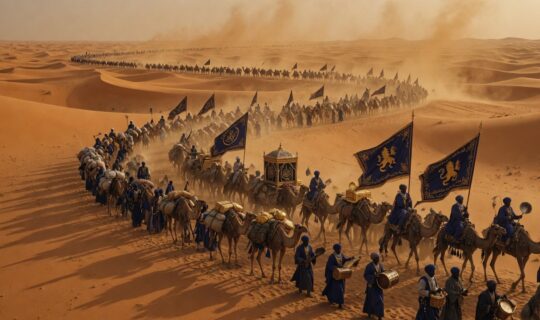
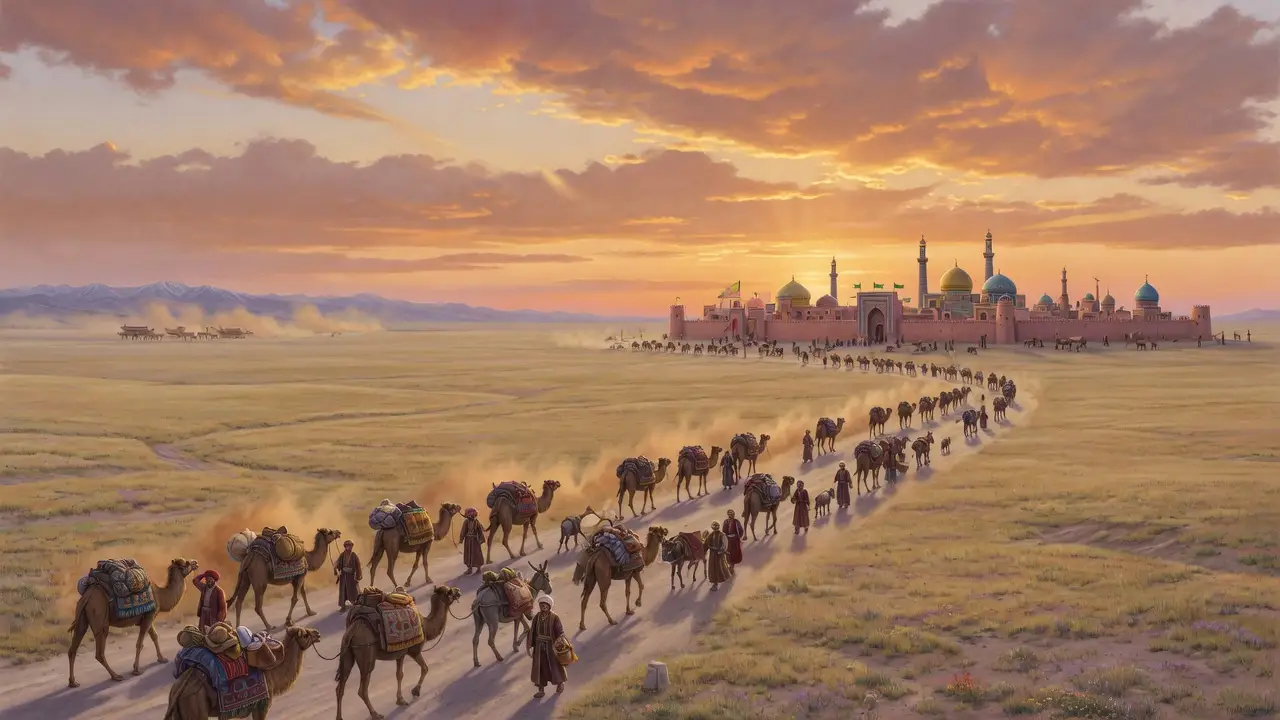
The Silk Road had existed in pieces for centuries. Merchants could move goods between nodes, but the journey was fragmented by hundreds of different kingdoms, taxes, warlords, and border checkpoints. The Mongols eliminated all of that. They created the Pax Mongolica, a period of enforced peace across Central Asia that allowed a merchant, a diplomat, or a plague bacterium to travel from China to the Mediterranean without meaningful interruption.
“They came, they sapped, they burned, they slew, they plundered, and they departed.”
Juzjani, Persian historian, on the Mongol conquests
Marco Polo is the famous example. He made his journey east because the roads were safe enough for a Venetian teenager and his merchant family to attempt it. He was not exceptional in this regard. Thousands of traders made that journey during the Pax Mongolica. The goods that flowed along those routes, silk, spices, porcelain, paper, gunpowder, transformed European material culture and, ultimately, European ambition.
The problem with connecting the world, as the 14th century would discover, is that you connect everything. Including what you cannot see.
The Cargo Nobody Ordered
Somewhere along the trade routes opened by the Mongol peace, Yersinia pestis boarded a rat. The rat boarded a merchant ship. The ship docked in Sicily in 1347.
Within three years, roughly a third of Europe was dead.
The Black Death was not simply a catastrophe. It was, as historians now recognize, one of the most consequential social reorganizations in Western history. When a third of the population dies in three years, the labor shortage that follows is absolute. Serfs who survived could demand wages. Landlords who needed workers had to pay them. The rigid hierarchies of feudal Europe cracked under the weight of all those empty fields and abandoned manors.
LESSER-KNOWN DETAILS
Genghis Khan’s tomb has never been found. He reportedly requested a secret burial, and historical accounts suggest thousands of slaves were killed after constructing it to keep the location unknown. An entire river may have been diverted over the site.
The plague gave surviving peasants leverage they had never possessed. It accelerated the collapse of serfdom in Western Europe. It created conditions for a nascent middle class. It forced European society to think differently about medicine, about God’s relationship to human suffering, about the authority of institutions that had utterly failed to protect their people.
The Church, which had no explanation for the plague and no cure, lost a measure of its moral authority it would never fully recover. Into that vacuum walked humanism, reason, and eventually, the Renaissance.
The Mongols did not plan the Black Death. They simply built the road it traveled.
What Died in Baghdad
Return for a moment to that river running black.
The destruction of Baghdad in 1258 was not just a military event. It was a civilizational rupture. The Abbasid Caliphate had been the center of global knowledge production for five hundred years. Muslim scholars had preserved and extended Greek philosophy, developed decimal mathematics, invented the algorithm, mapped the human body, and built observatories that tracked celestial mechanics with startling precision. The House of Wisdom held hundreds of thousands of manuscripts. Most of them ended up in the Tigris.
Contemporary chronicler Ibn al-Athir wrote that the catastrophe was so great he wished he had not been born to witness it. He described it as an event without parallel in history, a wound in Islam that would not close.
He was not wrong about the scale. The Islamic Golden Age, the most scientifically productive civilization on Earth at that moment, was functionally over.
“At the Khan’s court, Christians, Muslims, and Buddhists all dispute. Each is free to follow his own religion.”
William of Rubruck, Flemish friar who visited the Mongol court, 1253
But here is the uncomfortable twist: some of those scholars fled west, into Byzantine territories, into Anatolia, into the Italian city-states that had trading relationships with the Levant. They carried texts. They carried methods. When Constantinople fell in 1453 and another wave of Byzantine scholars fled west, they brought more. The great influx of classical and Islamic knowledge into Western Europe that powered the Renaissance was not organic. It was the result of two civilizations being destroyed and their intellectual survivors running somewhere safer.
The Renaissance was built partially on what the Mongols drove out of the East.
The Military Technology Transfer
Gunpowder was invented in China, probably in the 9th century, by Taoist alchemists who were trying to make something else entirely. For several centuries, its use remained largely Chinese, deployed in fire arrows and early cannons.
The Mongols changed that.
As they absorbed Chinese military technology into their conquests westward, gunpowder weapons traveled with them. By the time the Mongol advance reached Eastern Europe, European soldiers had encountered weapons that produced fire and smoke and impact in ways they had no framework to understand. The technology filtered into European hands through capture, trade, and imitation.
By the 14th century, European armies were experimenting with cannon. By the 15th, artillery had become the decisive military technology of the age. The cannon made castle walls irrelevant. It redistributed military power away from entrenched nobility toward centralized states that could afford to manufacture and maintain heavy artillery. Feudalism was already dying from economic pressures. The cannon helped bury it.
Nation-states, with their centralized taxation and standing armies built around gunpowder, were the direct consequence. The political map of the modern world was drawn with a weapon the Mongols carried west.
The Empire That Swallowed Itself
The Mongol Empire’s greatest structural weakness was also its most human one. Genghis Khan had no stable succession plan.
When he died in 1227, the empire passed to his sons and then fractured into competing khanates. The Golden Horde dominated the Russian steppe. The Ilkhanate controlled Persia and Iraq. The Chagatai Khanate ruled Central Asia. The Yuan Dynasty controlled China. These khanates traded, occasionally cooperated, and periodically went to war with each other.
LESSER-KNOWN DETAILS
Genghis Khan likely has more living descendants than any person in history. Genetic studies suggest that roughly 16 million men alive today, about 0.5% of the global male population, carry a Y-chromosome lineage traceable to him or his close male relatives.
Critically, many Mongol rulers were absorbed into the cultures they conquered. The Ilkhanate converted to Islam. The Yuan court became substantially Sinicized. Within a century of Genghis Khan’s death, his grandchildren were ruling as Persian sultans and Chinese emperors, governing through local administrative traditions, speaking local languages, practicing local religions.
This was the empire’s exit strategy, though nobody called it that. It dissolved not through defeat but through assimilation. The Mongols became the peoples they had conquered.
What they left behind was permanent: trade networks, administrative systems, demographic catastrophe, technological transfer, and the psychological shock of a world that had learned, definitively, that no civilization was safe from sudden, total destruction.
That lesson would echo for centuries. It still does.
The Fingerprints Are Everywhere
Every time you use the word “algorithm,” you are using a Latinization of the name of al-Khwarizmi, a Baghdad scholar whose works survived because they had already been copied to libraries in Spain and Sicily before the Mongols arrived. Every time a vaccine crosses a border without being stopped at customs, it travels a version of the logic that the Pax Mongolica first demonstrated: connected systems move things faster than divided ones. Every time a pandemic follows a trade route, it follows paths the Mongols widened.
The Renaissance, the rise of nation-states, the Black Death’s transformation of European labor and theology, the gunpowder revolution in warfare, the first true globalization of trade: all of these trace, in some essential way, back to a man born on the Mongolian steppe who died having never set foot in the lands that would change most because of him.
The Mongols are remembered as destroyers. That part is accurate and should not be softened. The cities they erased, the populations they killed, the libraries they burned: these were real losses that changed the trajectory of human civilization in ways we can still only partially measure.
LESSER-KNOWN DETAILS
The Mongols were terrified of dogs. Multiple historical sources describe Mongol soldiers refusing to enter villages unless dogs were removed first. Their own laws, the Yasa, strictly regulated how dogs should be treated.
But destruction, when it is complete enough, creates the conditions for something else. Floods deposit soil. Forests regrow after fire. The world that emerged from the Mongol century was not the world that would have developed without them. It was faster, more connected, more violent, more intellectually dynamic, and pointing toward modernity in ways that no other single historical event can claim.
The most consequential empire in history did not set out to build the modern world. It set out to conquer it.