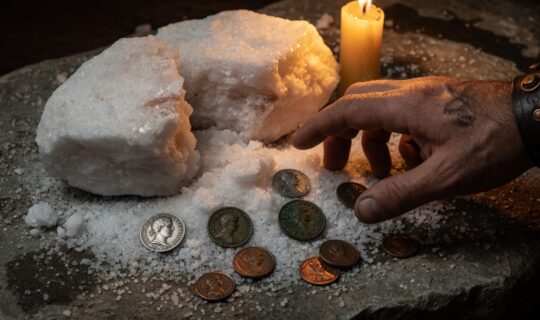
The Vatican needed to move money across borders without calling it interest. The theological gymnastics that accidentally built Western finance.
The Body of Christ Has a Cash Flow Problem
It is 1148. The Second Crusade has just collapsed in humiliation outside Damascus, and the armies of Christendom are retreating, broke and broken. Back in Rome, the Pope has a more immediate problem than theology: how do you fund a holy war across three thousand miles of hostile territory when your currency is too heavy to carry and your bankers are going to Hell?
The Church had declared usury a mortal sin. Lending money at interest, it said, was the province of thieves and Jews and the spiritually depraved. Dante would later drop usurers into the Seventh Circle of Hell, seated beneath a rain of fire beside the sodomites, which tells you exactly where medieval Christianity ranked the profession.
And yet, the Church needed money. Desperately. Constantly. The Crusades cost fortunes. The cathedrals cost more. The papal bureaucracy stretched across a continent and required salaries, couriers, bribes, and the occasional small war. Someone had to figure out how to move that money without God noticing.
What happened next was one of the great unintentional acts of civilizational construction in history. The Catholic Church, in trying to avoid sin, invented banking.
God’s Law vs. the Ledger
The prohibition on usury was old. Ancient, really. The Hebrew Bible forbade charging interest to fellow Jews. Aristotle had called money “barren,” incapable of breeding more money on its own, making interest philosophically absurd. The early Church Fathers absorbed both traditions and hardened them into doctrine.
“To take usury for money lent is unjust in itself, because this is to sell what does not exist, and this evidently leads to inequality which is contrary to justice.”
Thomas Aquinas, Summa Theologica, c. 1265
The Council of Nicaea in 325 AD banned clergy from lending at interest. By the twelfth century, the Third Lateran Council extended that ban to laypeople and threatened excommunication for anyone who persisted. Thomas Aquinas framed the philosophical case with characteristic precision: when you sell wine, you sell the wine and keep nothing. But when you lend money and charge for time, you are selling something that belongs to God alone. Time was divine property. Interest was theft from the Almighty.
The problem, of course, is that theology doesn’t pay invoices.
The medieval Church collected tithes from England to Armenia. It sent money to crusaders, paid architects, funded missionaries, and maintained a diplomatic apparatus that would have impressed the Roman Empire. The papacy, functionally, was also a state. And states bleed money.
Join The Archive Briefing
Weekly dispatches. The history they didn't teach you — sourced, subverted, delivered to your inbox.
Someone had to figure out how to make the math work without triggering hellfire.
The Knights Who Cracked the Code
The first institution to solve the problem wasn’t a bank. It was an army.
The Knights Templar were founded in 1119 to protect pilgrims traveling to Jerusalem, and they quickly became something stranger and more powerful: the first international financial network in the Western world. A pilgrim could deposit gold in a Templar house in Paris and receive a coded letter. He’d hand that letter to a Templar garrison in Acre or Jerusalem, and receive the equivalent in local coin. No gold traveled. No interest was charged. The fee was buried in the exchange rate.
It was, in effect, a wire transfer. Eight hundred years before the phrase existed.
The Templars built commanderies across Europe and the Holy Land, creating a physical infrastructure of trusted intermediaries. They held deposits for kings, issued lines of credit to nobles, and managed the accounts of crusading armies. When Philip IV of France needed to destroy them in 1307, his primary motive was almost certainly financial. The Templars held his debts. Burning them as heretics was cheaper than repaying them.
But the model survived. It just migrated south, to Italy.
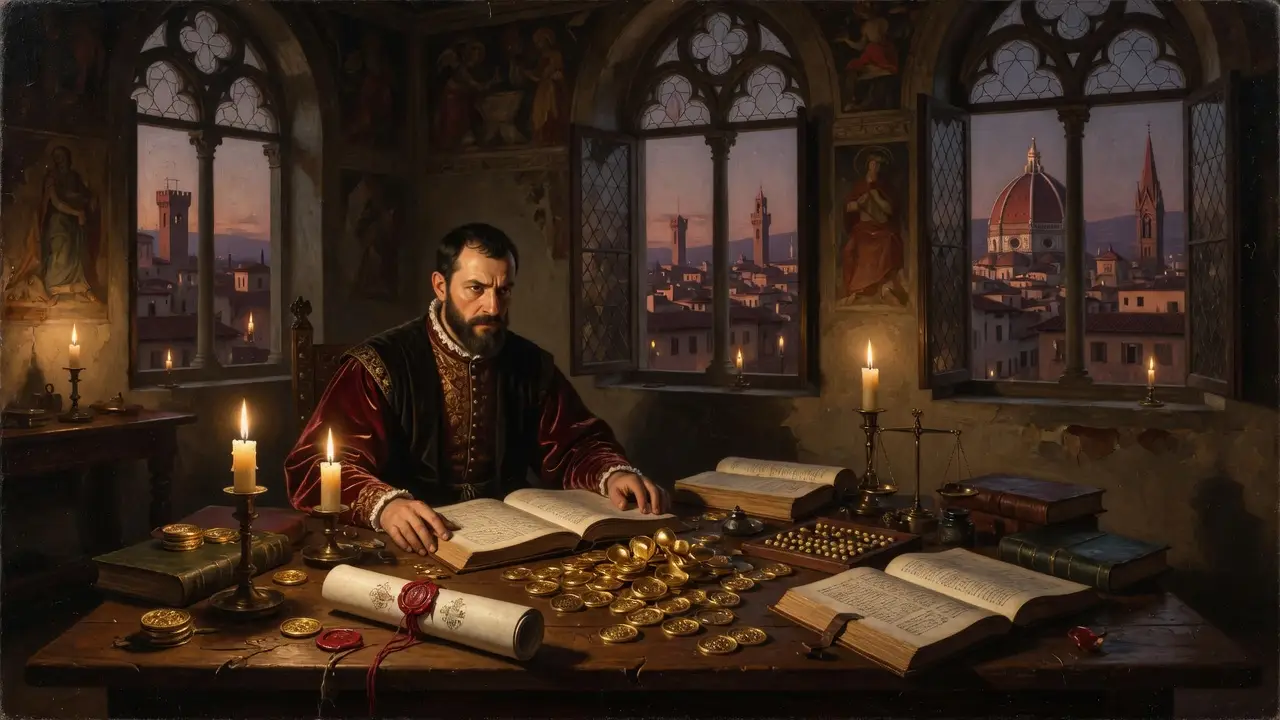
The Florentines and the Art of Godly Loopholes
Florence in the thirteenth century was a city of about 100,000 people and an almost supernatural talent for creative accounting. The great merchant banking families, the Bardi, the Peruzzi, the Acciaiuoli, were financing the papacy while attending Mass every Sunday and sleeping soundly afterward. They had found the loopholes.
The primary instrument was the lettera di cambio: the bill of exchange. In its simplest form, it worked like this. A merchant in Florence wanted to lend money to a buyer in London and earn a return on it. Instead of a loan, they conducted two currency exchanges. The merchant in Florence would hand over florins, receiving a bill that could be redeemed in sterling in London after some agreed delay. When the bill matured and was “re-changed” back to florins, the difference in exchange rates across time and geography produced a profit. No interest was ever named. No sin was technically committed.
A merchant shall not sleep soundly who is not certain of his bookings.”
Luca Pacioli, Summa de Arithmetica, 1494
Medieval theologians were not stupid. They knew what was happening. But the cambium transaction was complex enough, and legally distinct enough from a straightforward loan, that many canonists were willing to look past it. God’s law was clear. Financial reality was negotiable.
The Bardi and Peruzzi families grew so large on this model that they became the de facto treasury of the English crown. Edward III of England owed them fortunes. When he defaulted in the 1340s, both families collapsed, triggering one of the earliest recorded banking crises in European history. But their model endured.
The Medici Walk Into Church
Of all the families who refined this machinery, none did it more elegantly or more hypocritically than the Medici.
Cosimo de’ Medici, who built the family bank into the most powerful financial institution of the fifteenth century, was a man of genuine religious conviction. He funded the construction of churches. He patronized monks. He died clutching his faith. He also ran a network of banking branches from London to Constantinople and made his fortune on practices that, by strict canonical standards, were at minimum questionable.
The Medici Bank’s relationship with the papacy was the cornerstone of the operation. The Church’s finances were enormous, its needs constant, and its geographic reach impossible to manage without sophisticated banking intermediaries. The Medici became the Church’s preferred bank. They collected papal revenues across Europe, held deposits, issued letters of credit, and transferred funds with an efficiency that no government institution could match.
The papacy, in turn, helped the Medici. Not officially. But when the Church needed financial services it couldn’t technically endorse, it looked the other way with practiced grace.
Cosimo reportedly confided his anxieties about usury to the theologian Antoninus of Florence, who helpfully distinguished between legitimate exchange operations and sinful lending. The distinction was fine. Perhaps too fine. But it held.
I neither want to be poor nor to be thought rich; I want to live and die with the reputation of a good merchant.”
Giovanni di Bicci de’ Medici, attributed, early 15th century
There is a detail that didn’t make it into the official histories for a long time: the Medici ledgers used a private bookkeeping code that separated the bank’s “exchange” operations from its straightforward interest-bearing deposits. Two sets of records, essentially. The theological records and the real ones.
The Invention That Changed Everything
Behind all the theological maneuvering, something genuinely new was being built.
Medieval Italian bankers, in solving the problem of moving money without touching it, developed most of the core mechanisms of modern finance. Bills of exchange became negotiable, meaning they could be transferred between parties, creating rudimentary securities markets. Deposit accounts paid “discretionary gifts” rather than interest, which was interest under a different name but generated the same effect: savings became productive capital.
The Genoese bankers introduced insurance contracts. The Venetians refined maritime finance. Double-entry bookkeeping, formalized by the Franciscan friar Luca Pacioli in 1494, gave merchants a rigorous way to track complex transactions across time and distance. Pacioli was a friar. He taught mathematics and accounting as complementary disciplines, apparently without noticing the irony.
The Church’s insistence on categorizing these instruments, debating whether they were or weren’t usury, forced extraordinary legal and intellectual precision onto financial practice. Every new instrument had to be designed to survive theological scrutiny. That scrutiny, paradoxically, made the instruments better. More sophisticated. More abstract. More transferable.
The prohibition on usury pushed finance to evolve around it, the way roots push around stone, finding every crack.

When the Church Finally Admitted It
By the sixteenth century, the game was up.
The Reformation had fractured Christian Europe. Protestant reformers, Calvin especially, were far more willing to accept interest as morally neutral under certain conditions. As Protestant cities became financial centers, the Catholic Church found itself in an increasingly absurd position: condemning a practice that its own financial infrastructure depended on.
The final capitulation came slowly, in stages, dressed in the same theological language that had built the prohibition. Pope Benedict XIV’s encyclical Vix Pervenit in 1745 still technically condemned usury. But the Catholic states had long since legalized interest-bearing loans, and the Church’s banks operated inside those legal frameworks without incident.
By 1830, the Holy Office in Rome quietly advised confessors that they need not disturb penitents who lent at the legal rate of interest. No encyclical announced this. No council debated it publicly. The centuries of theological architecture simply dissolved, in a single administrative memo.
The Church that had placed usurers in Hell stopped worrying about it.
The Ledger Outlasts the Cathedral
Here is what is worth sitting with. The Catholic Church’s attempt to contain finance produced it instead. The prohibitions that were meant to keep money moral forced the invention of instruments that are still operating today. Bills of exchange became checks, then wire transfers, then SWIFT codes. Letters of credit are still the primary mechanism of international trade finance. Double-entry bookkeeping is the foundation of every corporate accounting system on earth.
The Medici’s method of booking exchange profits rather than interest survives in contemporary foreign exchange transactions, which are technically currency swaps but functionally carry implicit interest rates embedded in the spread. The theological workaround became the standard instrument.
And the moral question that started it all, whether money can legitimately breed money, has never actually been resolved. Modern Islamic finance has revived something close to the medieval Catholic position, prohibiting riba (interest) and engineering around it through instruments that look, from the outside, almost identical to the ones the Florentines invented. The tools are different. The structure is the same.
The Church wanted clean hands. What it got was the modern economy.
There is something almost darkly comic in that, and something genuinely instructive. The rules we build to contain human behavior have a habit of shaping it in ways we never planned. The cathedral goes up, stone by stone, funded by instruments the bishop cannot legally endorse, balanced on ledgers written in two different languages simultaneously: one for God, one for the world.
The world, as it turns out, keeps better books.