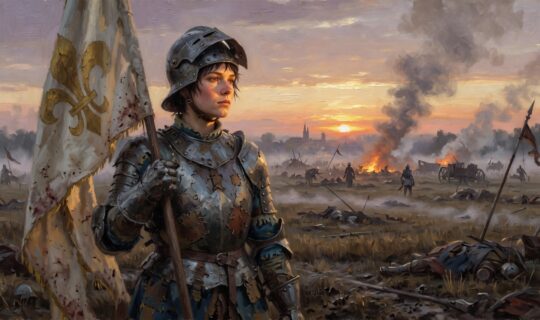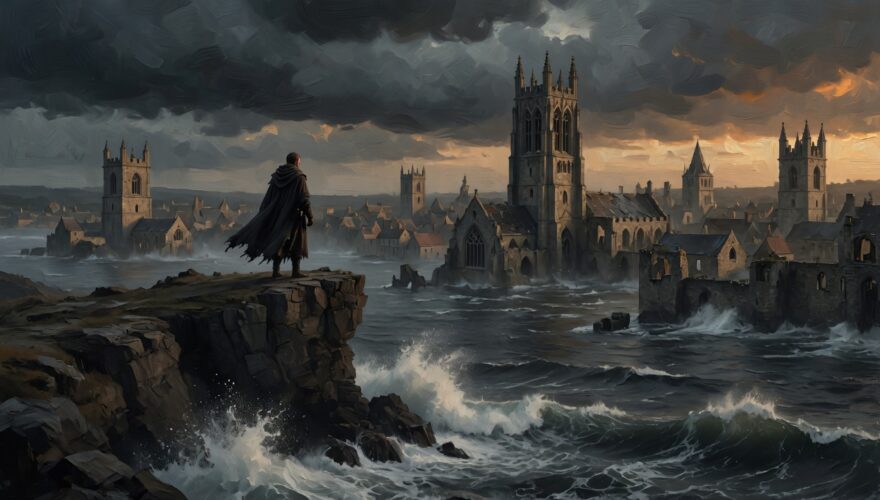
Dunwich was once one of medieval England’s most powerful port cities. Then the sea took it, church by church, street by street. Here is the full story of history’s most haunting act of coastal erasure.
The Last Man Standing on a Disappearing Shore
In 1826, an old man named Jacob Forster reportedly sat on the cliffs above the North Sea and listened. Not to the waves, exactly. To what was under them. On certain calm days, the people of Suffolk had long claimed you could hear it: the ghostly toll of submerged church bells rising through the water, ringing from a city that had ceased to exist centuries before. Whether Forster believed it or not, he was among the last people alive who could point to the exact spot where Dunwich had stood and feel something more than legend. By his time, it was almost entirely gone.
The sea hath eaten up the greatest part of the town, and in likelihood will devour the rest in short time.”
From a Suffolk county survey, circa 1589
At its peak, Dunwich was one of the most important cities in medieval England. A busy port. A bishop’s seat. A place of shipbuilders, merchants, fishermen, and pilgrims. It sent ships to the Crusades. It had a mint. Eight parish churches, multiple friaries, a leper colony, a thriving market. By the 14th century, it ranked among the top ten ports in the kingdom.
Today, Dunwich is a village of around 120 people. The sea has consumed all of it. And it is still consuming more.
A City Built on Borrowed Ground
Dunwich was never an easy place to live. The city sat on a headland of soft glacial till, essentially compressed sand and gravel left behind by ice age glaciers, perched above a beach that the North Sea had always treated as its own. The coastline there faces northeast, directly into the teeth of storm surges driven by North Sea gales. It had no natural harbor to speak of, just a river mouth that required constant attention to stay open.
None of that stopped people from building there. The Romans established a settlement. The Anglo-Saxons expanded it. By the time the Normans arrived, Dunwich was already a going concern, valuable enough that William the Conqueror’s Domesday survey of 1086 recorded it as a major trading center with a population of perhaps three thousand people and significant tax obligations to the crown.
“Of eight parish churches which this town once had, there are remaining but two, the rest being swallowed by the sea.”
Robert Reyce, Breviary of Suffolk, 1618
What made Dunwich worth the risk was what lay behind it: the great estuary of the River Blyth and the agricultural wealth of East Anglia. Wool, grain, and leather flowed out through Dunwich. Timber, wine, and cloth flowed in. The city grew fat on the commerce of a prosperous hinterland. For two centuries after the Conquest, it flourished.
What nobody could fully reckon with was the arithmetic of erosion. Each storm removed a few feet of cliff. Each winter gale chewed a little more of the headland away. It was slow enough to ignore, until suddenly it wasn’t.
The Storm That Changed Everything
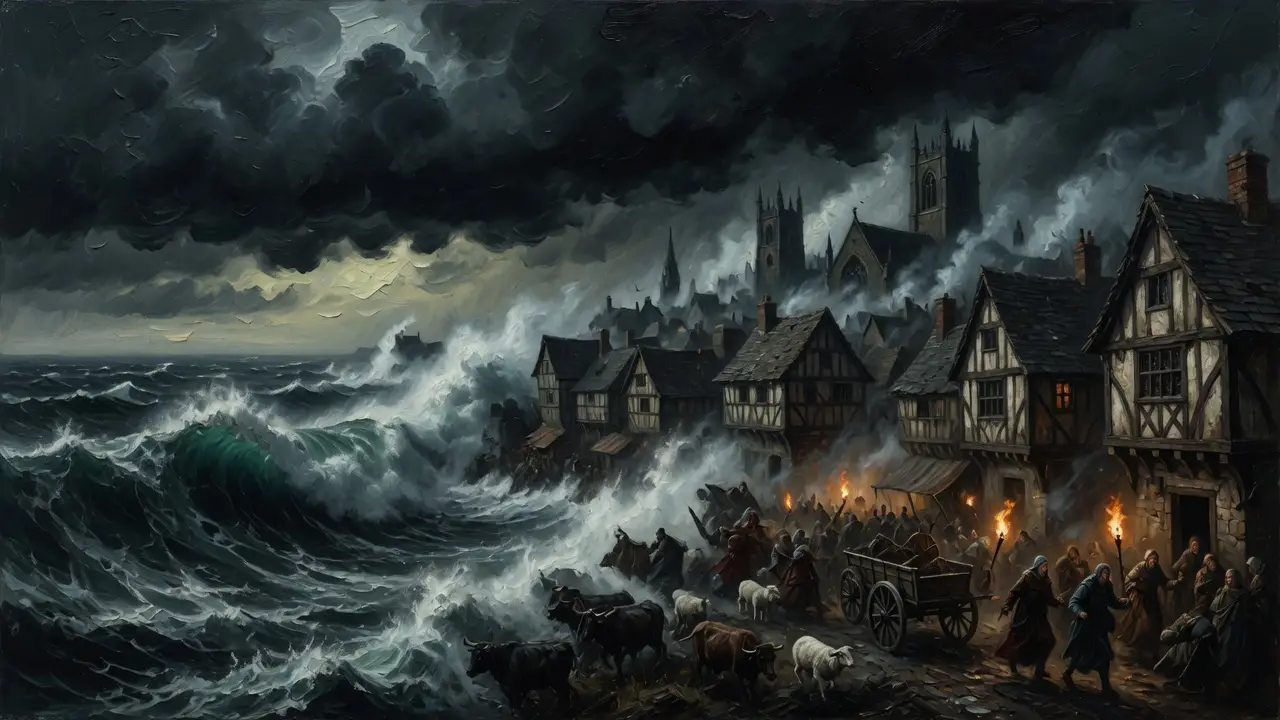
The catastrophe came in January 1286. A massive storm surge — the kind produced when a deep Atlantic low drives a wall of seawater into the shallow funnel of the southern North Sea — struck the Suffolk coast with a force that contemporary chroniclers described in terms usually reserved for divine punishment. The harbor mouth, which the people of Dunwich had maintained for generations through labor and investment, was destroyed overnight. The sand and shingle that had protected the town from direct wave attack shifted dramatically southward, sealing off the river and leaving the harbor stranded behind a barrier of beach.
Join The Archive Briefing
Weekly dispatches. The history they didn't teach you — sourced, subverted, delivered to your inbox.
LESSER-KNOWN DETAIL
During the Black Death (1348-1350), Dunwich was already in decline. The plague further devastated what was left of the population, compounding a crisis that was already structural.
A second catastrophic storm in 1328 finished what the first had started. By then, the southern part of the city was already falling into the sea. Streets that had been lined with houses were gone. The market district was reduced to rubble at the waterline. Dozens of homes disappeared into the water within living memory of people who had been born in them.
The economic consequences were ruinous. Without a functioning harbor, Dunwich had no reason to exist. Trade migrated north to Walberswick and Southwold, which had better-protected anchorages. Merchants left. Population collapsed. The tax base evaporated. And still the sea came.
Churches Falling Into the Water
What makes the story of Dunwich so viscerally strange is its slowness. This was not a single day of catastrophe, like Pompeii. It was a death measured in decades and centuries, and people watched it happen generation by generation, often powerless to do anything but move their belongings back from the advancing edge.
The churches fell one by one. All Saints was the last to go, and its collapse in the early 20th century was documented well enough to leave behind photographs. In 1904, its tower still stood on the clifftop, half the churchyard already lost, the graves of the medieval dead exposed in cross-section in the eroding cliff face. The bones of Dunwich’s citizens literally tumbled from their burial places into the waves. By 1919, the tower itself followed.
Before All Saints, there was St. Peter’s, which fell in 1702. St. Francis, gone by the 16th century. St. Michael’s, St. Bartholomew’s, St. Nicholas’s, St. Martin’s, St. Leonard’s, and more: each consumed in turn, the records of their passing sometimes preserved in parish documents that grew increasingly desperate in tone as each generation recorded more losses than gains.
LESSER-KNOWN DETAIL
The city contributed ships to the Third Crusade under Richard I, a detail that places it in the same category as far larger and better-remembered English ports.
One detail that rarely makes it into popular accounts: in 1677, the town of Dunwich formally petitioned Parliament for relief funds, on the grounds that they were still paying taxes on properties that had been underwater for over a century. The crown had never updated the assessments. The people of a drowning town were being taxed on a city that existed only in official records.
Parliament ignored them.
What Lies Beneath
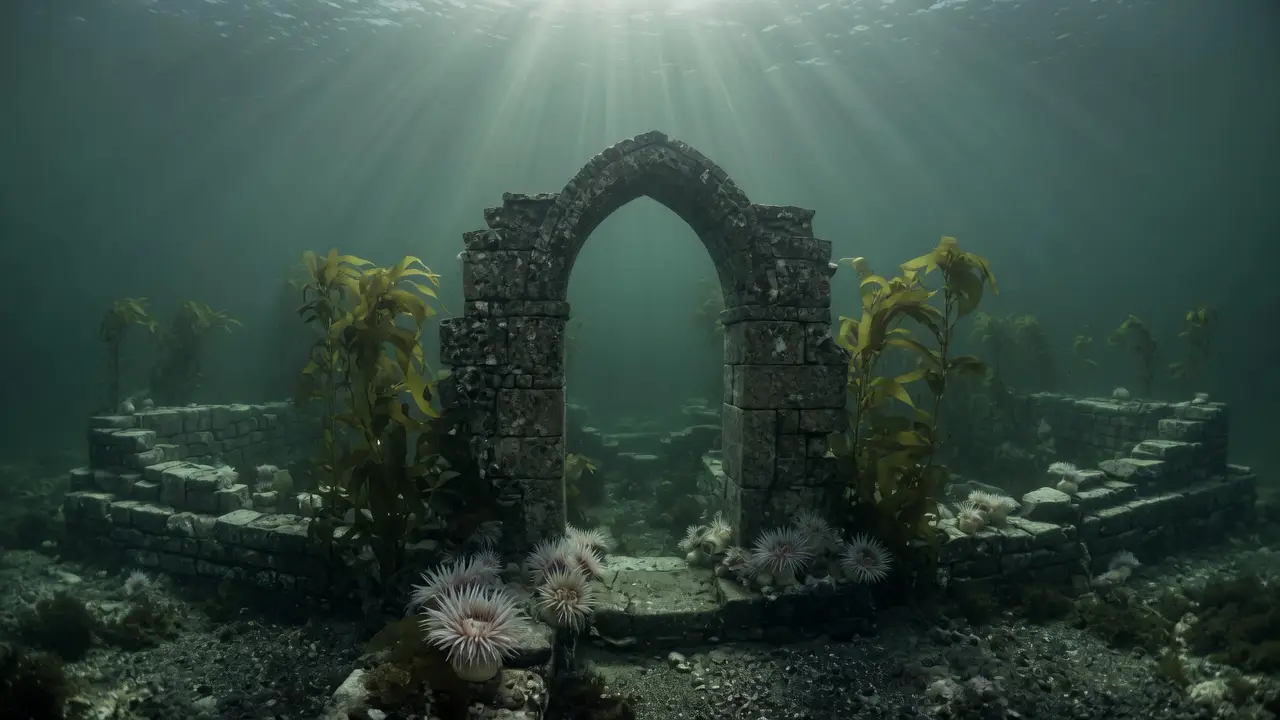
The modern seafloor off Dunwich is not empty. Archaeological surveys, particularly a major project conducted by the University of Southampton between 2008 and 2013, have mapped the remains of the submerged city in extraordinary detail using sonar and diving surveys. What they found reframed what had been largely a local legend into documented fact.
The surveys identified the foundations of multiple medieval churches on the seafloor at depths between two and ten meters. The footprint of the medieval street grid is detectable in the sediment. In calm conditions with good visibility, divers have reported seeing worked stone, roof tiles, and in some cases the tops of walls still standing just below the surface.
One of the more remarkable findings was the discovery of cemetery remains offshore. The survey confirmed that human skeletal material from the collapsed churchyards remains on the seabed, a detail that struck the researchers with particular force. The people of Dunwich are still there, in a sense. Scattered in the sediment of a sea that has swallowed everything they built.
The rate of erosion has not slowed. The current estimate is that the cliff continues to retreat by approximately one meter per year. What remains of the original medieval headland, including the ruins of Greyfriars friary, is measurably closer to the edge than it was a decade ago.
The Town That Kept Sending MPs to Parliament
Perhaps the most bitterly absurd chapter in Dunwich’s long decline is its political history. Under English electoral law, Dunwich retained the right to send two Members of Parliament to Westminster long after it had ceased to exist in any meaningful sense. By the 18th century, the “town” consisted of a handful of houses, a few dozen voters, and nothing resembling civic life. Yet it continued to exercise parliamentary representation that larger, genuinely functioning cities were denied.
LESSER-KNOWN DETAIL
The name Dunwich is believed to derive from the Old English “Dommoc”, possibly related to a Celtic or Latin root meaning “deep water” or “harbour.” The original name anticipated the city’s fate more accurately than anyone knew.
Dunwich became one of the most notorious examples of what reformers called “rotten boroughs” or “pocket boroughs”, constituencies where the electorate was so small that a single wealthy patron could simply purchase the seats. John Selden, the 17th-century legal scholar, was returned for Dunwich despite the place being largely underwater by his era. The pocket borough persisted until the Great Reform Act of 1832, which finally stripped Dunwich of its parliamentary representation along with dozens of other decayed constituencies.
The Reform Act passed over the furious objections of those who profited from the system. But for Dunwich, the abolition of its rotten borough was almost elegiac, the formal political recognition that the city had finally, after five and a half centuries, stopped being a city.
What a Drowned City Teaches the Living
Dunwich is a useful thing to know about in an era of rising seas and shifting coastlines. The story is not a metaphor so much as a precedent. Coastal erosion of this kind was not unique to medieval Suffolk. What was unusual was the visibility of the loss: a major urban center, documented in records and tax rolls and parliamentary registers, reduced to a handful of ruins and a sonar image.
The engineers and climate scientists who study coastal vulnerability sometimes reference Dunwich as a case study not in failure but in trajectory. Medieval Dunwich had roughly 600 years between its founding and its effective end. The process of loss was neither sudden nor unrecognized. People knew, and largely continued building and investing anyway, because the alternative was to abandon what had been built. That tension between the knowledge of impermanence and the very human need to treat where we live as permanent, is not a medieval problem.
“In my grandfather’s memory, there stood here a fair market town, with streets and buildings where now is only sea.”
Suffolk clergyman in a 1612 manuscript
The remaining ruins of Greyfriars friary stand about 50 meters from the current cliff edge. The estimates suggest it may be at the cliff edge within decades. The bells people once imagined hearing under the waves were a myth. The walls already mapped on the seabed are not.