The victors wrote the textbooks. A genuine reassessment of the empire history decided to cast as the villain. But the past is more interesting than the version that survived.
In 480 BC, Xerxes I stood at the edge of the Hellespont and watched his army cross a bridge of boats. Not one bridge. Two, lashed together from hundreds of warships, stretching nearly a mile across the strait between Asia and Europe. His engineers had threaded bronze cables through the hulls and laid planks of wood across the top, smooth enough for horses and supply carts. When a storm destroyed the first attempt, Xerxes reportedly had the sea itself flogged with three hundred lashes and thrown in chains.
That is the kind of man he was. And that is the kind of empire he commanded.
The Greeks, by contrast, were a loose, quarrelsome collection of city-states who spent nearly as much energy fighting each other as they did any external enemy. Their cities were small. Their infrastructure was modest. Their population was a fraction of what Persia commanded. And yet, if you learned about this era in any standard Western classroom, you probably absorbed the story through Greek eyes: the noble defenders of democracy standing firm against an oriental tyrant, holding civilization itself at the pass of Thermopylae.
That story is not a lie. But it is half a picture, painted by the survivors.
An Empire That Built Roads Before Rome Did
Before Greece produced its philosophers, Persia had already solved the problem of governing a continent.
Cyrus the Great founded the Achaemenid Empire around 550 BC, and within a generation, Persian rulers administered territory stretching from the Indus Valley to the borders of Egypt, covering roughly 5.5 million square kilometers. Rome, at its height centuries later, would govern roughly 5 million. The Persian achievement was not simply size. It was coherence.
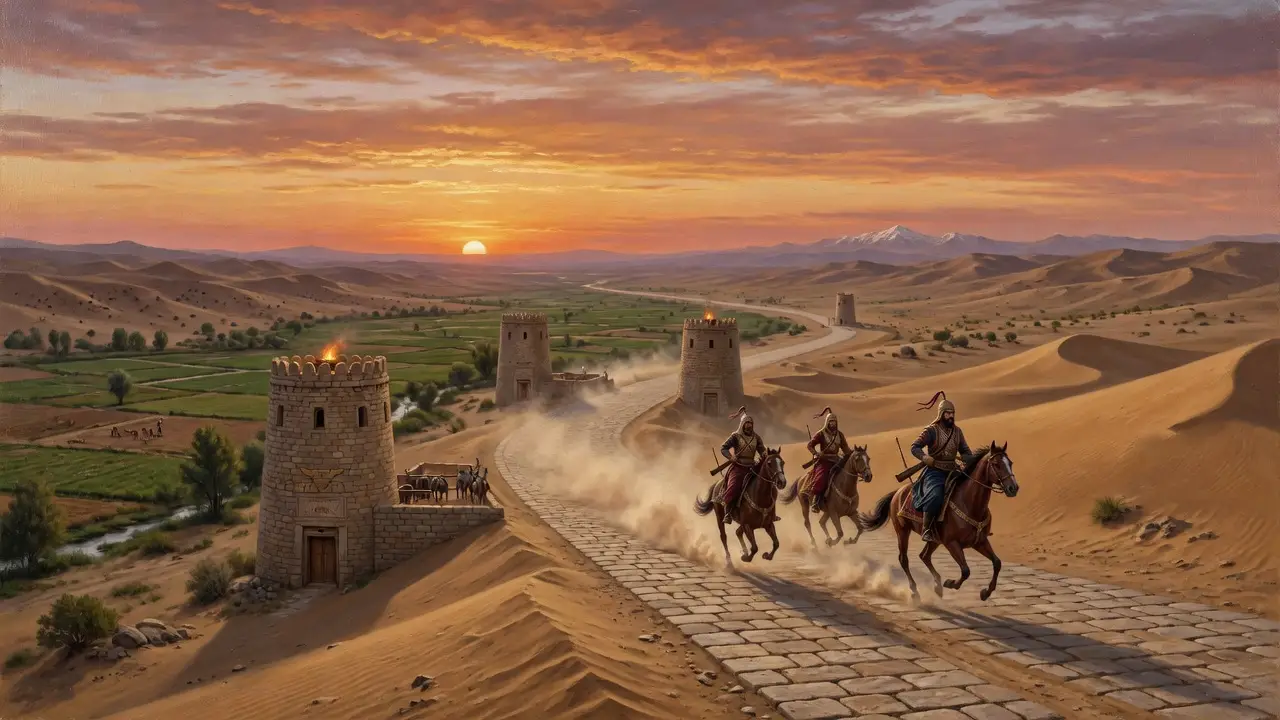
The Royal Road ran nearly 2,700 kilometers from Susa, in modern-day Iran, to Sardis, near the Aegean coast. Along it, royal couriers operated a relay system so efficient that Herodotus, a Greek, marveled at it without embarrassment: “Nothing mortal travels so fast as these Persian messengers.” That phrase would later be adapted by the United States Postal Service as their unofficial motto. The Persians got no credit.
“Nothing mortal travels so fast as these Persian messengers. The entire plan is a Persian invention.”
Herodotus on the Persian messengers (Histories, Book VIII)
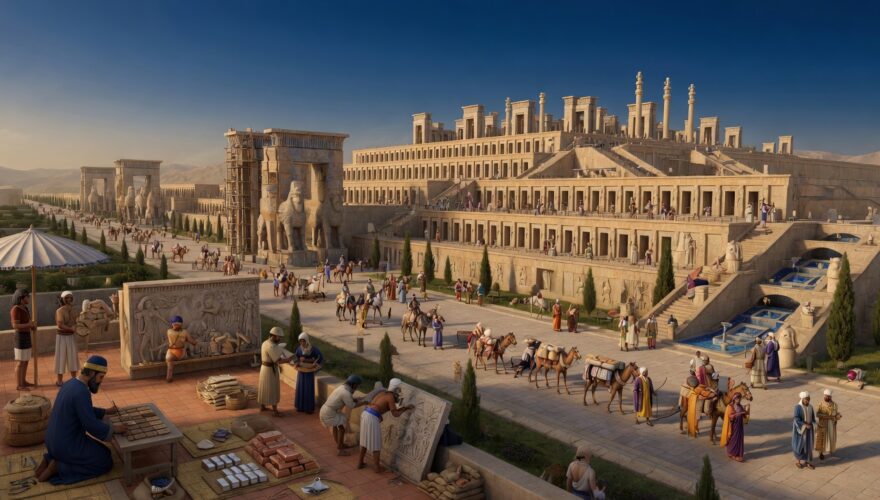
Persian engineering was not just logistical. The empire’s capital at Persepolis was a city of sculpted stone terraces, audience halls supported by seventy-two columns, and reliefs depicting delegations from every corner of the known world arriving with tribute. The art was cosmopolitan by design. Craftsmen from Egypt, Babylon, Greece, and Lydia all worked there simultaneously, each bringing their own traditions into a single imperial aesthetic. It was a civilization that absorbed rather than erased.
Join The Archive Briefing
Weekly dispatches. The history they didn't teach you — sourced, subverted, delivered to your inbox.
The Tolerance That History Forgot
When Cyrus the Great conquered Babylon in 539 BC, he did not raze the temples, enslave the population, or install a puppet from his own ethnicity. He issued what is now called the Cyrus Cylinder, a clay document in Akkadian that declared freedom of religion, prohibited forced labor, and allowed deported peoples to return to their homelands. The Jews of Babylon were permitted to go back to Jerusalem and rebuild their temple. In the Hebrew Bible, Cyrus is called a shepherd, a messiah, the only non-Jewish figure in scripture to receive that title.
The Greeks would later portray Persia as the land of despotism. But the Achaemenid system, whatever its flaws, was built on a principle of managed pluralism. Subject peoples kept their local customs, languages, and gods. Provincial governors called satraps maintained order but reported to the king, creating something structurally closer to a federated empire than a traditional conquest state. The system had corruption and violence, absolutely. But “oriental despotism” as a monolithic description is a caricature Greeks wrote and we repeated.
Contrast this with Athens, the supposed birthplace of democracy: a democracy that excluded women, enslaved perhaps a third of its population, and voted to execute Socrates for asking uncomfortable questions.
LESSER-KNOWN FACT
Persian women in the royal court owned property, ran estates, and appear in palace ration tablets as directors of their own economic households. The “harem” image is almost entirely a Greek male fantasy projected onto foreign architecture.
What Thermopylae Actually Was
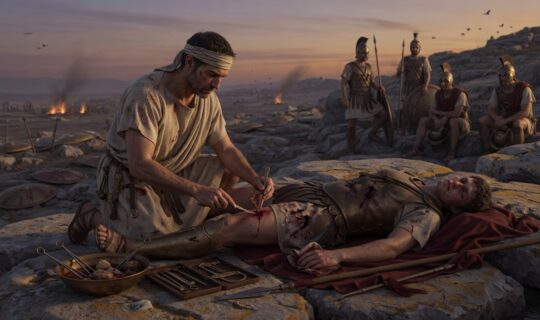
In 480 BC, a Greek force of somewhere between 7,000 and 20,000 men held the coastal pass at Thermopylae for three days against Xerxes’ advancing army. Among them were 300 Spartans under King Leonidas. The Persians eventually flanked them through a mountain path shown to them by a Greek traitor named Ephialtes, and the rearguard was annihilated.
It was a military defeat. That needs saying plainly. The Greeks lost.
But loss and legend operate by different rules. The 300 Spartans died holding the pass to buy time for the Greek fleet to regroup. Their sacrifice was real, their discipline extraordinary. But the Persian army that defeated them was not a horde of faceless slaves, as Herodotus sometimes implies and as modern film has doubled down on. Persian infantry were professional soldiers with standardized equipment, organized logistics, and centuries of battlefield experience. The Immortals, Xerxes’ elite 10,000-man force, were among the most effective light infantry of the ancient world, rotated constantly to maintain exact numbers after casualties.
“What man is lord and shepherd of their host? Who is king over them to command?”
Aeschylus, The Persians (472 BC), the Persian Queen speaking of Athens
The Greeks who fought them were not outmatched by inferior soldiers. They were outmatched by an enormous, well-organized military machine, and they barely survived even then. The naval battle at Salamis, where the Athenian strategos Themistocles lured the Persian fleet into shallow waters and used superior local knowledge to neutralize their numbers advantage, was a genuine tactical masterpiece. But it was a Greek victory by ingenuity, not by inherent moral superiority.
The War of Narratives
Persia’s problem was not military. It was literary.
After the Persian Wars ended, Greece produced Herodotus, Aeschylus, and eventually Thucydides. Aeschylus, who fought at Marathon, wrote a play called The Persians in 472 BC, depicting the Persian court mourning their defeat. It remains one of the oldest surviving plays in Western literature and is almost entirely sympathetic in its portrayal of Persian grief, which is remarkable. But even that nuance got lost. What survived in the cultural memory was Greek heroism, not Persian humanity.
Persia had its own court records, its own royal inscriptions, its own administrative documents. But they were written in Elamite, Old Persian, and Babylonian, languages that European scholarship would not decode for another two millennia. By the time Western historians started reading Persian sources directly, the Greek framework had already calcified into fact.
There is a Darius inscription at Behistun, carved into a cliff face in three languages, in which the king describes his own conquests with measured pride: “By the grace of Ahura Mazda, I am king. Ahura Mazda brought me the kingdom.” It reads nothing like tyranny. It reads like any other ancient monarch crediting divine favor for political success. Including the Greek ones.
The Library That Burned and the One We Never Built
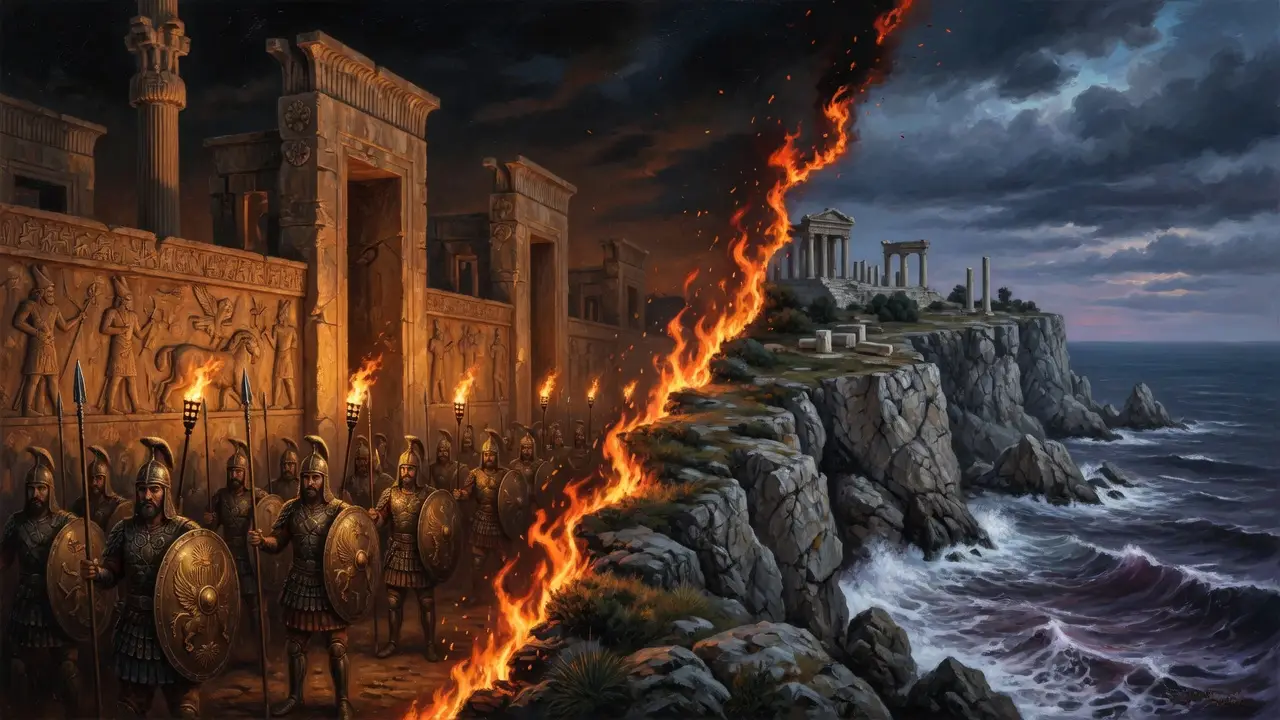
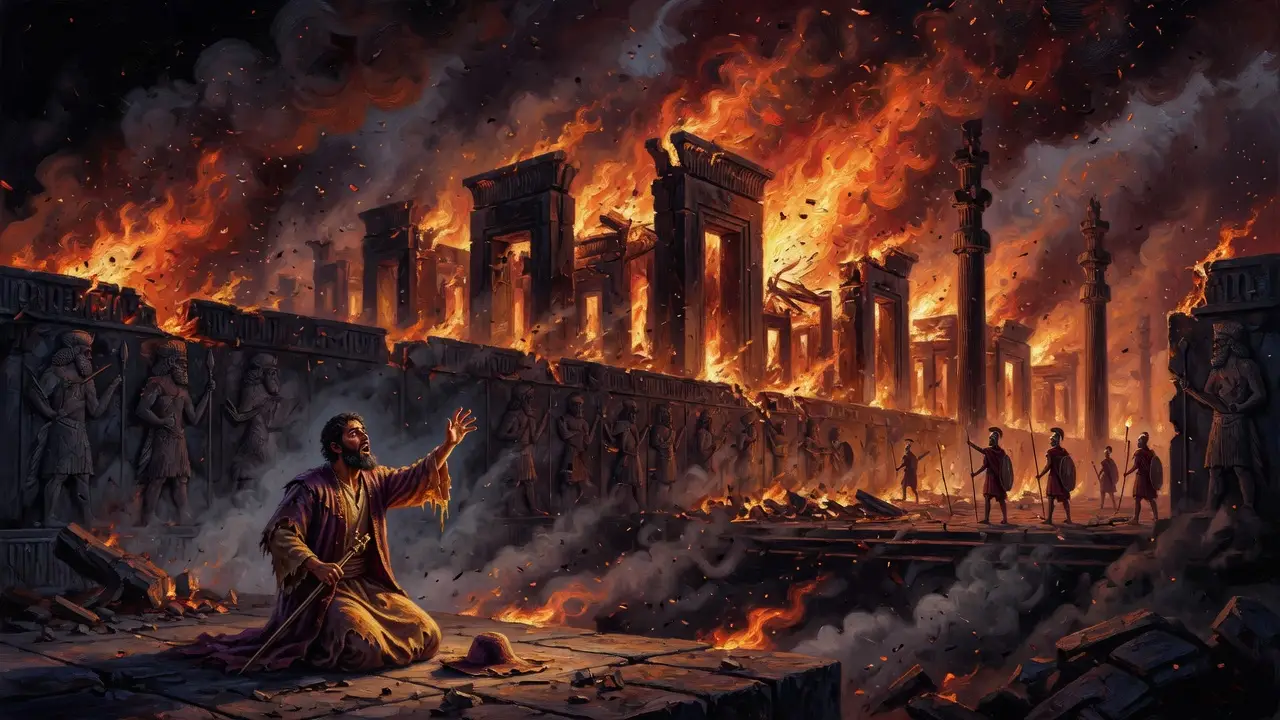
Alexander the Great burned Persepolis in 330 BC, reportedly after a drunken banquet where a Greek woman named Thais suggested it as revenge for the Persian burning of Athens 150 years earlier. Whether that story is true or theatrical exaggeration, the destruction was real.
The ceremonial capital of the greatest empire the world had yet seen was reduced to ash.
“I have not learned how to tune a harp or play the lute; but I know how to raise a small and inconsiderable city to glory and greatness.”
Themistocles
Alexander, who was educated by Aristotle and considered himself heir to Greek civilization, also adopted Persian dress, Persian court customs, and married Persian women, enraging his Macedonian generals. He recognized what he had conquered. His historians, writing in Greek, recorded it on their own terms.
The archives of Persepolis were gone. The administrative records of Susa survived in fragments. What we know of the Persian Empire’s interior life comes primarily from Greek sources, Babylonian commercial tablets, and the archaeology that serious scholars only began conducting properly in the twentieth century.
We have been reading this story through one lens. That lens has a name: it is called cultural survivorship bias. The civilization that produced more writing in an accessible language shaped how the story got told.
What the Persepolis Ruins Are Still Saying
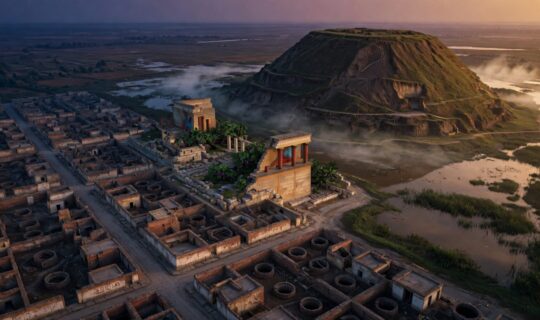
When French archaeologists began excavating Persepolis in the nineteenth century, they expected barbarian ruins. What they found were architectural proportions so refined that scholars initially assumed Greek influence. The discovery that the influence had partly traveled in the opposite direction, that Persian artistic traditions had fed into the Greek world through trade, war, and intermarriage, quietly reshaped a few academic circles and barely registered in popular culture.
LESSER-KNOWN FACT
The Persian postal relay system, the pirradaziš, is the oldest confirmed postal system in the world and ran with enough reliability that private merchants used it for commercial correspondence.
The treasury at Persepolis contained clay tablets in Elamite recording payments to workers. Not slaves. Workers, paid in silver and rations of wine, grain, and livestock. The records are meticulous. Among those receiving wages were women, listed separately and paid on par with men for equivalent work in certain categories. This is not the empire of 300. This is something considerably more complicated.
Persian satraps in the western provinces interacted with Greek city-states for generations before the wars broke out, funding Greek temples, employing Greek mercenaries, and in some cases being more fluent in Greek political life than many Greeks imagined. The conflict that followed was not a clash of opposites. It was a family argument between civilizations that had been borrowing from each other for decades.
Why the Victor’s Version Outlasted the Empire
Greece did not survive antiquity as a political entity either. The city-states collapsed, Macedonia absorbed them, Rome eventually swallowed the whole region. But Greek language became the intellectual currency of the Roman Empire, the early Christian church, and through those channels, the foundation of European scholarly tradition. When Renaissance humanists recovered ancient texts, they reached for Greek. When Enlightenment thinkers built theories of democracy, they reached for Athens.
Persia had no such transmission pipeline.
The Islamic conquest of the Persian Sassanid Empire in the seventh century AD reshaped the region culturally and linguistically. Pre-Islamic Persian history survived in Iranian oral tradition, in the epic poetry of Ferdowsi, in Zoroastrian communities. But it did not feed directly into the European tradition that built our universities, our history textbooks, or our popular imagination.
So the story calcified as Greeks told it: rational, democratic, heroic West against despotic, irrational East. Edward Said named this pattern Orientalism in 1978. But the pattern itself is far older. It was cast in bronze at Marathon and gilded in the classrooms of nineteenth century Europe.
The Verdict History Never Delivered
The Persian Empire lasted more than two hundred years, administered dozens of cultures without erasing them, built infrastructure that Rome would imitate, and treated conquered peoples with a flexibility that its rivals rarely matched. It fell not to Greek superiority but to a Macedonian king using a Greek-trained army with Persian-style cavalry and Persian-funded logistics.
Alexander did not defeat Persia because Greek civilization was better. He defeated Persia because he had a genius for battle, an army hardened by years of campaign, and Persian satraps who saw him as a preferable alternative to Darius III, a king who had twice fled the battlefield and lost the confidence of his own commanders.
LESSER-KNOWN FACT
The Greek city of Athens received Persian financial backing from Spartan rival satraps during the Peloponnesian War. Persia bankrolled both sides of Greek internal conflicts at different points.
Greece did not win the war of civilizations. Greece won the war of archives.
That distinction has consequences. The story of the ancient world as a contest between Western reason and Eastern despotism is not history. It is propaganda that outlived the people who wrote it. Understanding Persia on its own terms, through its own records, its own architecture, its own administrative logic, does not diminish what Greece achieved. It simply stops letting one civilization’s self-portrait serve as the other’s mugshot.