Some of history’s greatest deceivers didn’t die in prison. They died in palaces, in the arms of admirers, wrapped in the warmth of institutional prestige. Their portraits hang in university halls. Their names are carved above library doors. The foundations they built with stolen money, fabricated science, and invented nations still stand, still educate, still inspire, still bear their names with solemn pride.
This is the story of the men who didn’t just beat the system. They became it.
The Settlers Who Sailed to a Country That Didn’t Exist
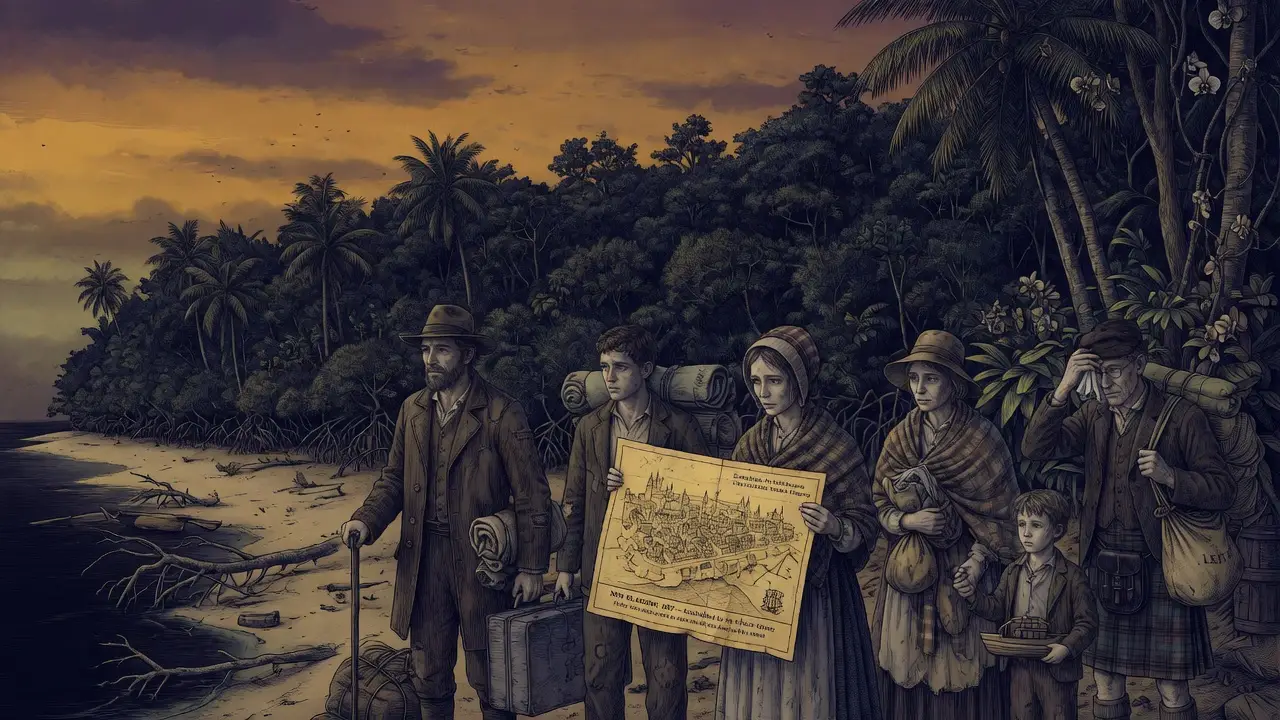
In September 1822, a ship called the Honduras Packet dropped anchor off the coast of Central America and disgorged 70 Scottish settlers onto a beach. They had sold everything. Farms, furniture, the silver candlesticks passed down from their grandmothers. They had purchased land grants, maps, and a Guidebook to Poyais. A detailed, lovingly illustrated account of a thriving British-friendly colony nestled along the Black River, complete with a cathedral, a bank, a market square, and rich farmland ready for cultivation.
There was no cathedral. There was no bank. There was jungle, disease, and the ruins of an abandoned English settlement from fifty years prior. Of the 240 settlers who eventually made the crossing, roughly a third would die before rescue ships arrived.
The man who sold them this dream was Gregor MacGregor , a Scottish soldier, decorated veteran of Simón Bolívar’s liberation campaigns, and one of the most breathtaking con artists in recorded history. He had simply invented a country, given himself the title of Cazique (prince) of Poyais, and sold it to desperate people who wanted to believe the world held something better than what they had.
What makes MacGregor’s story genuinely unsettling isn’t the audacity of the fraud. It’s what came after.
LESSER-KNOWN DETAILS
MacGregor produced an actual printed Poyaisian currency, bank notes for a country he invented. Some still exist in private collections.
When the survivors staggered back to Britain, gaunt and traumatized, the story broke in the newspapers. There were arrests. There was outrage. MacGregor fled to France, where he ran the same scheme again, this time selling Poyaisian bonds on the Paris market. When that collapsed, he returned to Venezuela, the country where he had legitimately fought as a general decades earlier. Venezuela welcomed him back. They restored his military rank, granted him a pension, and when he died in 1845, he was given a state funeral in Caracas Cathedral.
The man who killed dozens with a fictional map was buried with full military honors.
Join The Archive Briefing
Weekly dispatches. The history they didn't teach you — sourced, subverted, delivered to your inbox.
The Man Samuel Johnson Called His Favorite Companion
Around the same time MacGregor was still a young soldier, London literary society was captivated by a figure who called himself George Psalmanazar a pale, blue-eyed young man who claimed to be a native of Formosa, the island we now call Taiwan.
He spoke a language he had invented himself. He described rituals of human sacrifice and described how Formosans ate raw meat and lived underground. He wrote an entire book: An Historical and Geographical Description of Formosa (1704), complete with a grammar guide to the Formosan language he had fabricated word by word. The book sold enormously. The Bishop of London personally sponsored him. Oxford invited him to teach the Formosan language to missionaries.
He was from southern France. He had never been within three thousand miles of Formosa.
When real Dutch traders who had actually visited the island challenged him, Psalmanazar didn’t blink. He accused them of lying. He was a curiosity, a celebrity, a source of drawing-room entertainment for decades. The fraud eventually collapsed under its own contradictions, and he eventually confessed (privately, vaguely) sometime around 1728.
LESSER-KNOWN DETAILS
Psalmanazar’s invented Formosan alphabet and grammar were so internally consistent that linguists studying it centuries later marveled at its structural logic. He was, in his own way, a genius.
But this is where the story turns strange. Instead of exile or ruin, Psalmanazar reinvented himself as a writer of religious and historical tracts. He worked for a London magazine. He became, by all accounts, genuinely devout, genuinely humble, and genuinely beloved. Samuel Johnson, one of the sharpest minds of the eighteenth century, later said that of all the people he had sought out to meet, Psalmanazar was the one he most treasured … “I should seek to sit by Psalmanazar of all people.”
Johnson, who had read the man’s fake Formosa book as a boy and had been enchanted by it, chose to spend his evenings with him as an old man. When Psalmanazar died in 1763, he left behind a memoir, deliberately unsealed for posthumous publication, in which he expressed genuine remorse. London mourned him. His confessor called him one of the most sincerely penitent men he had ever known.
The man who invented an entire culture died beloved. The culture he invented influenced European ideas about Asia for a generation.
The Amateur Who Fooled Forty Years of Science
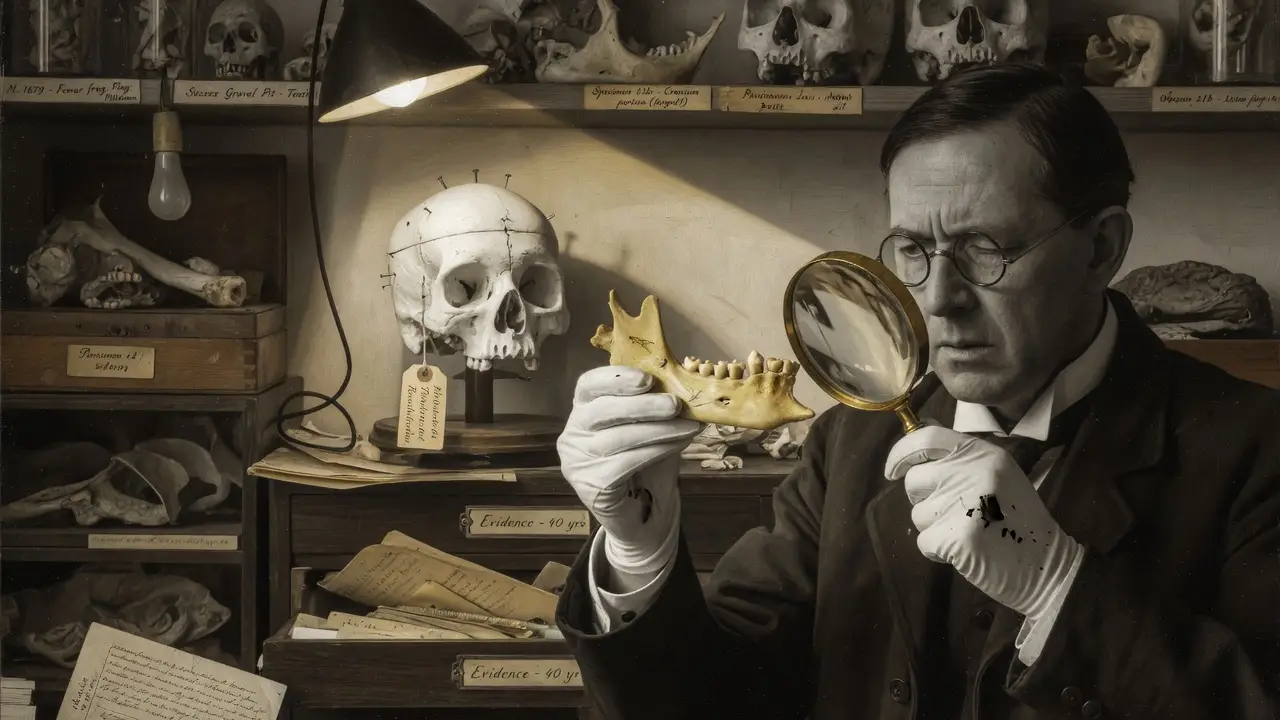
In 1912, a solicitor named Charles Dawson walked into the Natural History Museum in London with a box of bones. Inside were fragments of a skull and a jawbone, dug up near Piltdown Common in Sussex. The skull appeared human. The jaw appeared ape-like. Dawson suggested what the scientific world desperately wanted to hear: this was the missing link, proof of the evolutionary bridge between apes and modern humans.
Arthur Keith, one of Britain’s most eminent anatomists, examined the remains and declared it “the most important fossil find in the history of human evolution.” The newspapers called it Piltdown Man. The Natural History Museum built a plaster reconstruction. Schools taught it. Papers cited it. For four decades, Piltdown Man sat at the center of paleoanthropology like a cornerstone.
In 1953, scientists applied fluorine dating to the bones. The skull was perhaps 50,000 years old. The jaw was from a modern orangutan, filed and stained with potassium dichromate to look ancient. The teeth had been deliberately abraded.
LESSER-KNOWN DETAILS
Charles Dawson had at least 38 separate fossil “discoveries” during his career. Subsequent analysis has cast doubt on nearly a third of them.
Someone had faked it. The leading suspect, after more than a century of investigation, remains Charles Dawson, who had also submitted other suspicious fossil finds during his career, several of which later proved to be either misidentified or fabricated. Dawson, however, had died in 1916, a celebrated member of the Society of Antiquaries, a gentleman-scholar praised in obituaries for his contributions to Sussex history.
He never faced a single question. His reputation survived him by four decades. When the fraud was finally exposed, he wasn’t there to answer for it.
The Railroad Baron Who Built a University on Fraudulent Books
In 1885, Leland Stanford broke ground on a university in Palo Alto, California, naming it after his deceased son. The institution he founded — Stanford University, became one of the most influential centers of learning in the world. Its endowment today exceeds $40 billion. Its alumni include presidents, Nobel laureates, and the founders of companies that have reordered civilization.
The fortune that built it came substantially from what modern historians describe without much ambiguity as systematic fraud.
Stanford was a central figure in the Central Pacific Railroad’s construction of the transcontinental line. The federal government paid the railroad by the mile, more money for difficult mountain terrain, less for flat plains. Stanford and his partners, known as the Big Four, submitted surveys that deliberately misrepresented California’s geography, declaring that the Sierra Nevada foothills began dozens of miles west of where they actually did. The government overpaid by millions. A congressional investigation later confirmed the manipulation but produced little consequence.
The men who built the railroads were the men who built America, and they built themselves first.”
political observation of the Gilded Age
The railroad was also built through a company called Crédit Mobilier, a construction firm owned by the same men who owned the railroad, which billed the railroad at rates so inflated they constituted one of the largest legal thefts of public money in nineteenth-century America. Stanford died in 1893, a Senator, a Governor, a philanthropist, a patriarch of California progress.
His university has never returned the money. It continues, year after year, to produce remarkable things.
What Endures When the Lie Is Forgotten
There is a particular cruelty to history’s selective memory. It remembers the cathedral but not the bodies buried in its construction. It preserves the name on the library wall and allows the method of accumulation to blur into something called “the spirit of the age.”
What these men understood, MacGregor with his maps, Psalmanazar with his invented grammar, Dawson with his stained jawbone, Stanford with his doctored surveys is that credibility is a performance. Dress it correctly. Speak with enough confidence. Give people what they want to believe, and they will protect the illusion even after the evidence arrives to dismantle it.
They weren’t low-level grifters working a confidence trick on a train platform. They operated at the level where fraud becomes legacy. Where the institution absorbs the crime and moves on, and where the name of the man who built it becomes synonymous with the thing he built rather than the method he used.
Joseph Psalmanazar once wrote, late in life: “I have reason to fear that a just and impartial God will make me account for every lie I have maintained with so much obstinacy.” He sounds genuinely afraid.
But God, it turns out, was not the only judge with a short memory.
The buildings are still standing.