History’s most successful double agents carried their secrets to the grave. The medals on their chests told one story. The truth was something else entirely. These men fooled the world and died as heroes.
The telegram arrived in London on a Tuesday morning in 1972. Juan Pujol García, the Spanish agent codenamed GARBO by British intelligence, had died of malaria in Angola. MI5 wrote him off. His file was closed. The world moved on.
Except García wasn’t dead.
He was living quietly in Venezuela under a false name, having faked his death with the help of MI6, possibly to escape reprisals from former Nazi contacts who still believed he had served the Reich faithfully. Or perhaps as some historians have quietly suggested, there was another reason to vanish. A man who has deceived everyone is, by definition, capable of deceiving everyone.
That tension between the celebrated hero and the unknowable truth, sits at the heart of every great double agent story. These were people who made deception their entire identity. And when you do that long enough, even the people who know you best start to wonder.
The Greatest Spy Who Might Have Been Playing Everyone
Juan Pujol García spent the Second World War feeding the German high command an elaborate fiction. Working from a London bedsit, he invented a network of twenty-seven imaginary sub-agents across Britain, generated thousands of fabricated intelligence reports, and ultimately convinced the Wehrmacht that the D-Day landings at Normandy were a feint, that the real invasion was coming at Calais. German armored divisions sat and waited. The Allies poured ashore.
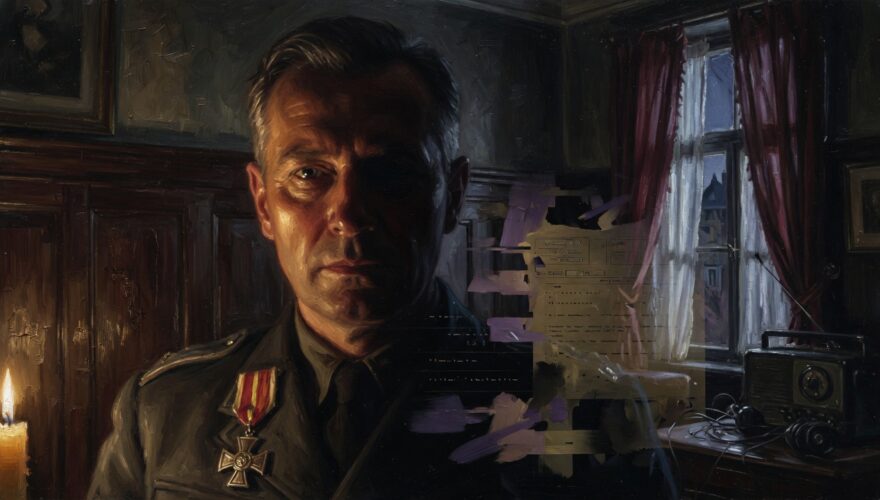
He was, by every official measure, one of the most consequential spies in history. The Germans awarded him the Iron Cross. The British awarded him an MBE. He remains the only person in recorded history to have received military honors from both sides of the same war.
Here is what historians still cannot agree on: how much of García’s operation was genuinely his own invention, and how much was quietly shaped by German intelligence, who some believe may have suspected the deception all along and were running a counter-game of their own.
“Every intelligence service believes it is running its agents. The question is always: running them toward what?”
A declassified CIA internal memo, 1968
The deeper strangeness is García’s disappearance. He faked his death in 1949, resurfaced decades later in Venezuela, and only “came back from the dead” publicly in 1984, when the historian Nigel West tracked him down. García faked his own death so convincingly that his handler, MI5 officer Tommy Harris, attended a memorial service. Harris died in a car accident in Majorca in 1964; García survived him by twenty-four years.
Join The Archive Briefing
Weekly dispatches. The history they didn't teach you — sourced, subverted, delivered to your inbox.
His explanation for the deception was plausible. But a man who spent four years professionally lying to two superpowers simultaneously is not a man whose explanations should be taken entirely at face value.
He died in 1988. The Venezuelans buried him with honors. He never gave a full accounting of his years in the shadows.
The Gentleman Traitor
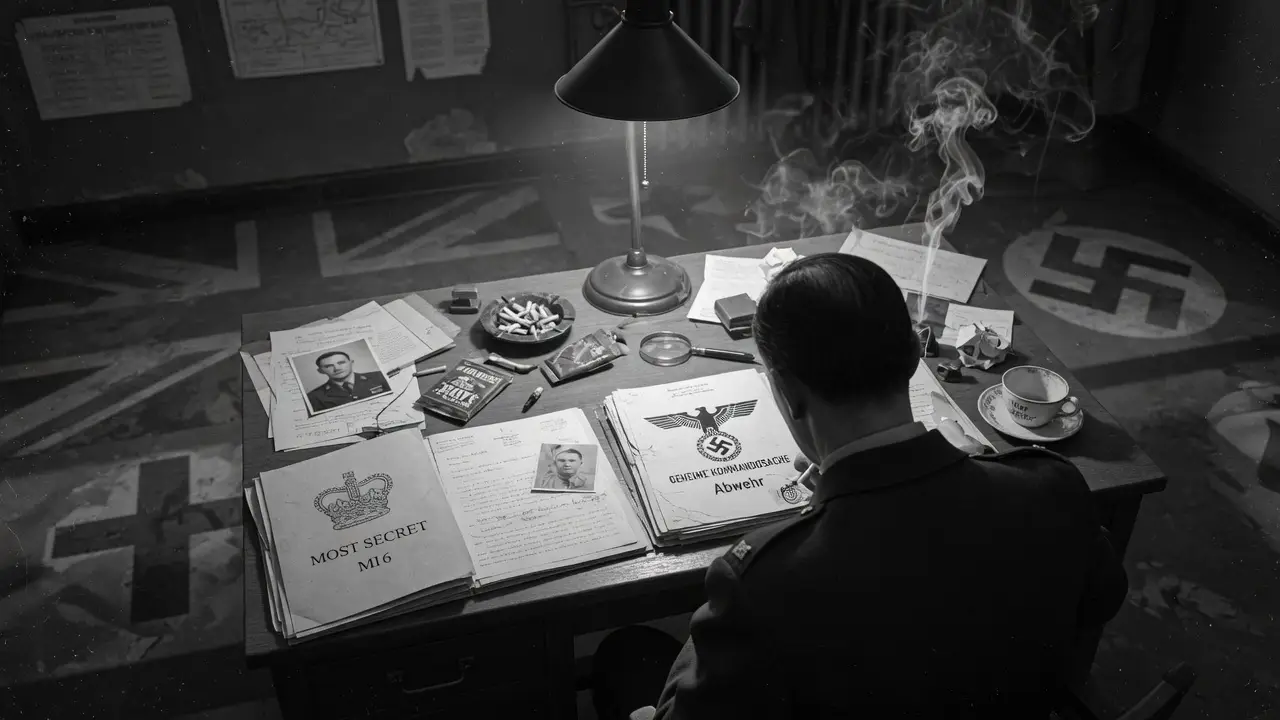
If García’s story is a puzzle with missing pieces, Kim Philby’s is a masterpiece of sustained theater, fifty years of polished performance, and a curtain call that horrified everyone who had applauded him.
Harold Adrian Russell Philby (“Kim” to his friends) served as head of MI6’s anti-Soviet section during the height of the Cold War. He was charming, brilliant, and well-bred in exactly the way that made the British establishment trust him instinctively and question him rarely. His colleagues described him as the kind of man you simply wanted to be near.
He had been a Soviet agent since 1934.
The scale of what Philby passed to Moscow is still not fully calculated. He betrayed networks across Albania and Ukraine, sending agents to their deaths. He tipped off his fellow Cambridge spies, Guy Burgess and Donald Maclean, before their cover was blown, allowing them to defect. For years, he ran the CIA’s joint operations with MI6 while simultaneously feeding everything he learned to the KGB.
“To betray, you must first belong.”
Kim Philby, My Silent War, 1968
What makes Philby’s case philosophically strange, is the question of whether he ever stopped being a double agent, even in Moscow. After his defection in 1963, he was feted by the KGB and given a comfortable apartment near the Kremlin. He lectured at their training academy. He appeared in propaganda.
And yet multiple Soviet defectors later reported that the KGB never fully trusted him. They suspected, with the paranoid logic of intelligence services, that a man who had betrayed his country once might betray any country. They gave him access to carefully curated material. Some analysts believe Philby, brilliant and bored, may have spent his Moscow years running a quiet, personal counter-operation that has left no traceable record.
He died in 1988. The Soviets buried him with full military honors. The British press could not decide whether to call him a traitor or a genius.
The answer, of course, was both.
The Nazi General Who Became the West’s Best Asset
Reinhard Gehlen never claimed to be anything other than what he was: a cold, methodical professional in the service of whoever was winning.
By 1944, Gehlen was one of the most important intelligence officers in the Wehrmacht, head of Fremde Heere Ost, the German military’s Eastern intelligence section, with files on Soviet military capacity going back years. He understood, before most of his colleagues, that Germany had lost the war. He made preparations accordingly.
Before the Reich collapsed, Gehlen microfilmed his entire archive… years of intelligence on Soviet military capacity, agent networks, infiltration reports and buried it in waterproof canisters in the Austrian Alps. Then he surrendered to American forces, personally, with an offer.
The Americans took it.
By 1946, Gehlen was operating out of a compound in Pullach, Bavaria, running what became known as the Gehlen Organization, a shadow intelligence service staffed largely by former Wehrmacht and SS officers, fully funded by the CIA, and quietly embedded into the emerging architecture of West German government. When the BND, West Germany’s foreign intelligence service, was formally established in 1956, Gehlen became its first president.
“He who controls the files controls history.”
Attributed to Reinhard Gehlen, source disputed
Here is the problem that historians have never cleanly resolved: Gehlen’s entire value to the Americans rested on his Soviet intelligence files. But Soviet intelligence was almost certainly aware of Gehlen’s operation from its earliest stages. The KGB had penetrated the Gehlen Organization deeply, they had agents at every significant level. Which means that the intelligence the CIA received from Gehlen may have been shaped, curated, and in places outright fabricated by Soviet counterintelligence.
The question is not whether Gehlen was working for the Americans. He clearly was. The question is whether he was simultaneously, consciously or not, serving as a conduit for Soviet disinformation on a scale that would represent one of the most audacious intelligence operations of the Cold War.
Gehlen retired in 1968 and spent his final years writing his memoirs. He died in 1979, celebrated in West Germany as a founding architect of postwar security. The full extent of Soviet penetration of his organization was still being untangled decades later.
The Man the CIA Trusted Most
James Jesus Angleton spent twenty years as the CIA’s chief of counterintelligence, the man whose job was to find the mole.
He may have been the mole.
That is not a claim made lightly, and it remains firmly in the realm of serious historical dispute rather than established fact. But the case, assembled by a handful of intelligence historians over decades, is not easily dismissed.
Angleton was a close personal friend of Kim Philby, who had been his primary British liaison during the early Cold War. The two men met regularly, drank together, exchanged intelligence. Philby later described Angleton as the most impressive American intelligence officer he had ever encountered. After Philby’s defection, Angleton was devastated. Or appeared to be.
What followed Philby’s defection was one of the strangest episodes in CIA history. Angleton, convinced that the agency had been penetrated at the highest level, launched a years-long mole hunt that paralyzed CIA operations, destroyed careers, and prevented the handling of multiple legitimate Soviet defectors who were deemed suspect. Dozens of officers were accused, investigated, and ruined. None were ever proven to be moles.
“Deception is a state of mind, and the mind of the state.”
James Jesus Angleton, speaking to a Senate committee, 1975
Some analysts have argued that this precisely calibrated paranoia, which incapacitated the CIA’s Soviet operations for the better part of a decade was the most effective piece of intelligence work the Soviets ever achieved in the United States. Whether it was achieved through Angleton is the question that has never been answered.
Angleton was forced out of the CIA in 1974. He died in 1987, never charged with anything, his reputation oscillating between legend and catastrophe depending on which historian you asked. His personal files, which he had maintained obsessively for decades, were largely destroyed before they could be examined.
He tended orchids in his retirement. He said very little about anything that mattered.
Richard Sorge: The Spy Who Saved the Soviet Union
Of all the figures in this story, Richard Sorge comes closest to an uncomplicated hero, except that his heroism was purchased entirely through deception, and his true allegiance, while almost certainly Soviet, was built on layers of performance so complete that the Japanese officials who executed him in 1944 reportedly did so still half-convinced there had been some mistake.
Sorge was a German communist who embedded himself in Tokyo as a correspondent for the Frankfurter Zeitung, cultivated a close friendship with the German ambassador Herbert von Dirksen, and spent nearly a decade feeding Moscow intelligence of extraordinary quality. His most important contribution came in 1941, when he confirmed for Stalin that Japan would not attack the Soviet Union’s eastern flank, intelligence that allowed Stalin to pull divisions from Siberia and throw them in front of the German advance at Moscow.
It is not an exaggeration to say Sorge’s network may have saved the Soviet state.
“I am a Communist, and I will remain so until I die.”
Richard Sorge, final statement before execution, November 7, 1944
The Japanese executed him on the anniversary of the Russian Revolution. Possibly a coincidence, possibly a darkly deliberate choice. Stalin refused to acknowledge him for years, either because Sorge’s information had initially been doubted, or because admitting to the operation would have complicated ongoing diplomatic arrangements.
In 1964, the Soviet Union named him a Hero of the Soviet Union, issued a commemorative stamp, and erected a statue. Streets were named for him in East Germany. His story was told in Soviet schools as an example of revolutionary sacrifice.
And yet: his German handler, the Reich, never definitively concluded he was a spy rather than a genuine patriot who had been manipulated. Some German intelligence officers, reviewing his file after the war, argued he had been playing both sides simultaneously, feeding enough real intelligence to Berlin to maintain his credibility while prioritizing Moscow. The ratio of what he gave versus what he kept back has never been precisely calculated.
He died certain of who he was. Whether historians can say the same is a different matter.
Why the Grave Keeps Its Secrets
The men in this story shared something beyond talent for deception. They understood, each in their own way, that identity is not a fixed thing. It is a performance, maintained under pressure, revised as circumstances demand. García played a Nazi asset while being a British asset while possibly playing both. Philby played an Establishment man for thirty years. Gehlen played the patriot, then the pragmatist, and may have played everyone in between. Angleton played the guardian while being the very thing he hunted.
What makes them matter now is not their tradecraft, though that was often remarkable. It is what they reveal about the limits of institutional trust. Every agency that celebrated these men did so based on incomplete information, filtered through their own assumptions about loyalty and nationality and human nature.
A man who lies to his enemies must lie to himself first, or the lie will not hold.”
British SOE training
In an age where disinformation is industrialized, where digital identities are constructed and discarded, the lesson these men teach is uncomfortable: the people most trusted by the system are the ones best positioned to hollow it out from within. Not because institutions are stupid, but because the same qualities that make a person effective also make them convincing. And a convincing enough person, sustained long enough, becomes indistinguishable from the thing they are pretending to be.
García died in 1988. Philby died in 1988. Gehlen died in 1979. Angleton died in 1987.
None of them told the whole truth. None of them had any reason to.