Joan of Arc didn’t become a legend because the Church decided she was holy. She became a legend because she did something that no trained soldier, no seasoned general, no royal advisor had managed to do in a generation: she made France believe it could win. And then she proved it.
A Girl at the Gates of History
The year is 1429. France is losing a war it has been losing for nearly a century.
English soldiers control Paris. The French king is a nervous, indecisive man hiding in his own court, too afraid to be crowned. And a teenage girl from a village most people have never heard of is standing in front of his military commanders, telling them exactly what God wants them to do next.
Strip away the halo and what you find is stranger, sadder, and far more remarkable than any stained-glass version of the story.
A Kingdom on Its Knees
By the time Joan was born around 1412 in the village of Domrémy, France was a country barely holding its own shape. The Hundred Years’ War had been grinding through fields, cities, and dynasties since 1337. England and its Burgundian allies controlled enormous stretches of French territory. The legitimate French heir, Charles VII, was mockingly called “the King of Bourges” because that was roughly the size of France he actually controlled.
Domrémy sat right on the contested border between loyalist and Burgundian territory. Joan grew up watching soldiers pass through, watching neighbors choose sides, watching the world break along fault lines that had nothing to do with peasant life but touched it constantly. She was not sheltered from the war. She lived inside its shadow.
She never learned to read or write. She tended animals. She was, by every external measure, nobody.
Then, at roughly thirteen years old, she began hearing voices.
The Voices She Wouldn’t Deny
She described them as coming with light. Saint Michael. Saint Catherine. Saint Margaret. Whether you believe in divine intervention or not, what’s historically certain is that Joan believed absolutely, without a flicker of doubt, that she had been commanded by God to drive the English out of France and lead Charles VII to his coronation at Reims.
Join The Archive Briefing
Weekly dispatches. The history they didn't teach you — sourced, subverted, delivered to your inbox.
This wasn’t quiet personal faith. She acted on it with a specificity that borders on the unsettling. She knew what she was supposed to do, she knew where she was supposed to go, and she walked straight into a world that had every reason to dismiss her and refused to be dismissed.
At sixteen, she traveled to the nearby town of Vaucouleurs and asked the garrison commander, Robert de Baudricourt, to give her an armed escort to the royal court. He told her to go home. She came back. He told her to go home again. She came back a third time with such conviction that he eventually, baffled and possibly a little unnerved, gave her what she asked for.
LESSER-KNOWN DETAILS
The voices Joan described began when she was around twelve or thirteen and never stopped. Even during her imprisonment, she reported hearing them.
In February 1429, Joan of Arc rode across enemy-controlled France in men’s clothing, cutting her hair short. A journey that should have been impossible for a peasant girl. She arrived at Chinon and asked to speak to the king.
The Test She Wasn’t Supposed to Pass
Charles VII was not known for his courage. Contemporary accounts describe a man plagued by self-doubt, convinced he might not even be the legitimate heir to the French throne. When Joan arrived, he reportedly disguised himself among his courtiers to test her. According to later testimony, she identified him immediately without hesitation.
What followed was a private conversation that no one else heard. Whatever Joan said to Charles in that room, he emerged from it transformed. He ordered her examined by theologians at Poitiers, who questioned her for three weeks and found nothing heretical, nothing deceptive. They recommended she be given a chance.
She was given armor, a horse, and an army.
One of her contemporaries, Jean d’Aulon, who served as her chief of staff, later wrote that he never saw her afraid. Not once.
Orleans and the Commanders Who Feared Her
The city of Orléans had been under English siege since October 1428. It was the key strategic stronghold in the Loire Valley, and if it fell, so would the rest of loyalist France. Joan arrived in late April 1429.
Here is what’s rarely emphasized: the French commanders didn’t want her there. Jean de Dunois, the Bastard of Orléans and one of France’s most experienced military leaders, tried to route her convoy away from the city’s main gate, thinking he knew better. Joan confronted him directly, accused him of bad strategy, and insisted they go back the right way. According to his own later testimony, he complied.
Within nine days, the siege of Orléans was broken.
Nine days. A siege that had lasted six months.
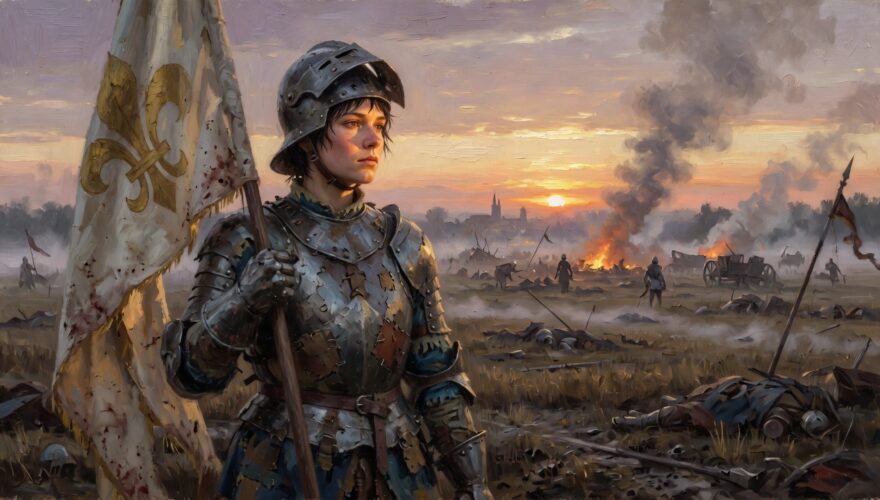
She was wounded by an arrow through the shoulder during the assault on the fortress of Les Tourelles. Witnesses said she pulled it out herself, had the wound dressed, and went back into the fight. Whether that’s precise history or early mythologizing, it fixed something in the minds of the soldiers around her. She changed the psychological temperature of the entire campaign.
“I was not sent here to perform signs and wonders. I was sent to relieve the siege of Orléans.”
Joan of Arc, from her trial testimony, 1431
The English commanders, for their part, were genuinely rattled. Historians have found letters from this period in which English officers described her in terms that border on demonological. One wrote that the French, under her influence, fought “as though they had risen from the dead.”
The Coronation She Rode Toward
After Orléans, Joan’s momentum was extraordinary. French forces recaptured a string of towns along the Loire, and she set her eyes on the one thing she had always said was essential: the coronation of Charles VII at Reims Cathedral.
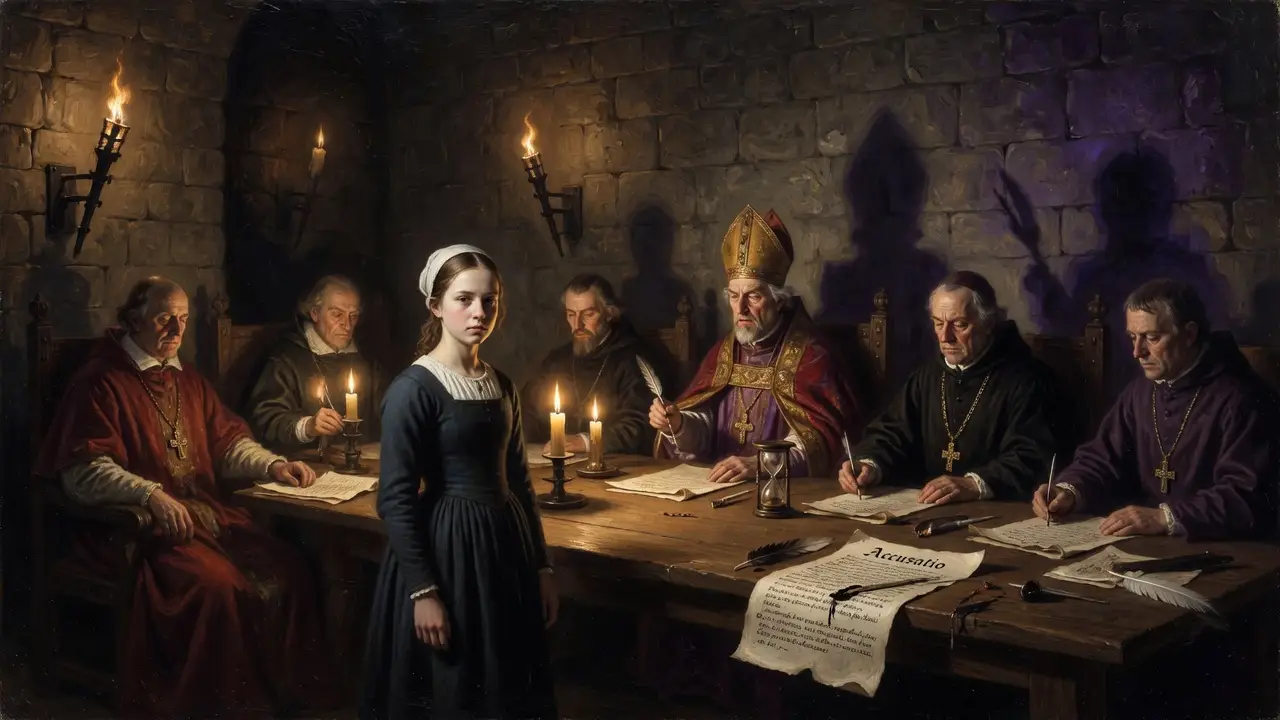
Reims was deep in Burgundian-controlled territory. To reach it meant riding through land held by the enemy, gambling that towns would surrender rather than resist. Most of them did. The army moved with a confidence it hadn’t felt in decades, and on July 17, 1429, Charles VII was crowned King of France at Reims Cathedral.
Joan stood in the cathedral holding her banner. She had done what she came to do.
She was seventeen years old.
When the Crown She Saved Let Her Fall
What happened next is the part the legend tends to soften, because it is deeply uncomfortable.
Charles VII, now crowned and secure, began to cool toward Joan. She had become politically inconvenient. Her insistence on continuing the campaign, particularly on retaking Paris, clashed with the king’s preference for negotiation. The assault on Paris in September 1429 failed, partly due to insufficient royal support. Joan was wounded again.
LESSER-KNOWN DETAILS
Her sword, she claimed, had been found buried behind the altar of the church of Saint Catherine de Fierbois. She wrote to the priests there and asked them to dig for it. They found it exactly where she said it was.
In May 1430, during a skirmish near Compiègne, Joan was captured by Burgundian forces. She was sold to the English for ten thousand livres, roughly equivalent to the ransom of a king.
Charles VII made no serious attempt to ransom or rescue her.
Let that settle for a moment. The man whose crown she had secured, whose throne she had ridden across enemy territory to defend, left her in enemy hands without meaningful effort.
She spent months in a cold tower, chained at night, guarded by men who threatened her continuously. She attempted escape twice, once jumping from a tower seventy feet high, landing so hard she was unconscious for days and unable to eat. She survived.
The Trial That Was Never About Heresy
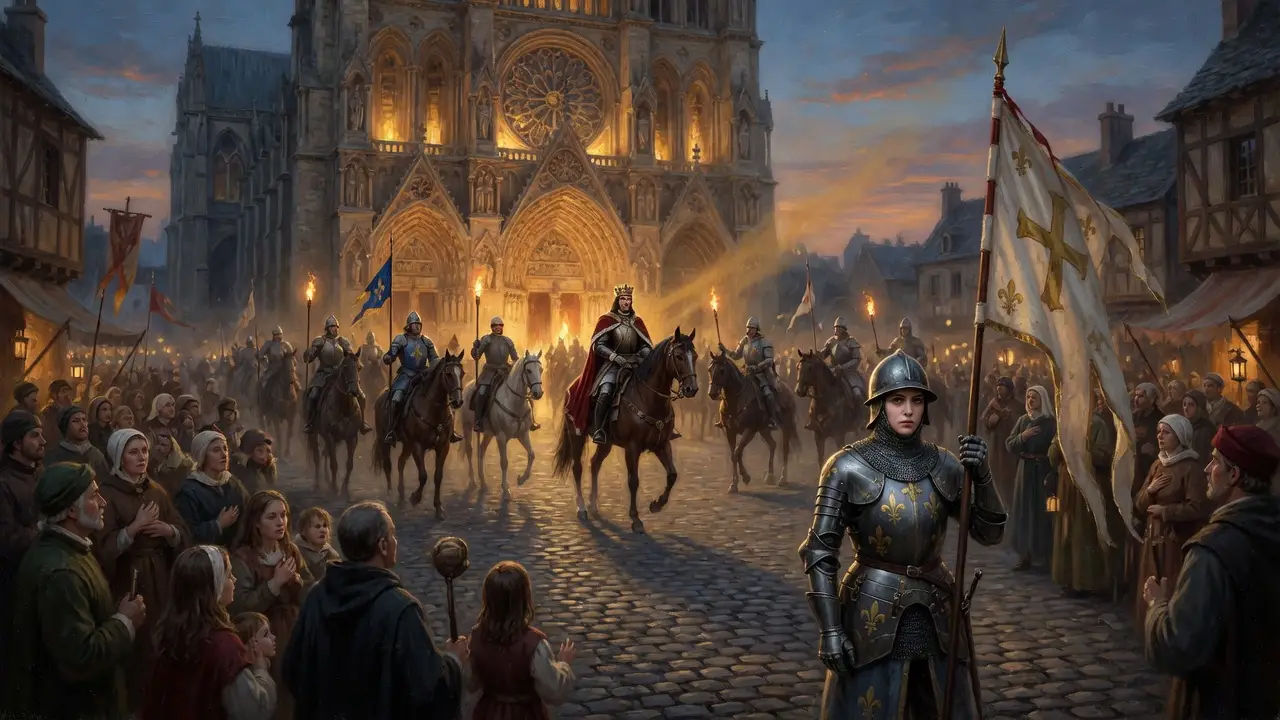
The trial of Joan of Arc, conducted in early 1431 in Rouen, is one of history’s more brutal pieces of theater. It was presided over by Pierre Cauchon, Bishop of Beauvais, a man whose career was tied to the English cause and who had a specific political interest in seeing Joan condemned. The charge was heresy. The reality was politics.
She was questioned for months. The transcript of her trial survives, and it is astonishing. Untrained in law, unable to read, facing a panel of theologians and legal experts determined to find her guilty, she answered with precision that left her examiners visibly frustrated. When asked whether she knew if she was in God’s grace, a question designed as a trap, she replied:
“If I am not, may God put me there; if I am, may God keep me there.”
Her questioners reportedly fell silent. It was an answer that neither confirmed nor denied the premise, and they could find nothing to condemn in it.
They eventually trapped her on a technicality, the wearing of men’s clothing, which she had refused to abandon partly for practical reasons and partly, she maintained, because God had told her to. After initially signing a document of abjuration under duress, she recanted within days and resumed wearing male dress. That recantation gave the court what it needed.
On May 30, 1431, Joan of Arc was burned alive in the marketplace of Rouen. She was nineteen years old.
She asked for a cross to hold. An English soldier made one from two sticks and gave it to her. She held it until the end.
The Verdict History Reversed
Twenty-five years after her execution, Charles VII, now in a much stronger position politically, commissioned an inquiry into Joan’s trial. In 1456, a papal court overturned the conviction and declared it null and void, riddled with procedural and theological violations. Joan’s mother, Isabelle Romée, who had petitioned for the retrial herself, lived to see it.
“We are all ruined, for we have burned a saint.”
English chronicler present at her execution
Joan was not canonized until 1920, nearly five centuries after her death. The Church moved slowly on the question of a peasant girl who heard voices and wore armor.
But France had already decided what she was long before the Vatican caught up.
What a Teenage Girl Broke Open
The reason Joan of Arc still matters, beyond nationalism and religion, is what she did to the fixed categories of her time. She was poor, female, young, and illiterate. Every structure in her world said she had no role in the events she was witnessing. She disagreed with every structure.
She walked into the room anyway.
Her trial testimony is read in law schools. Her campaign is studied in military academies. Her refusal to recant under pressure, her consistency under interrogation, her refusal to implicate others when she could have, these are studied as examples of moral resilience.
She saved a kingdom. The kingdom buried her.
And then, quietly, shamefully, revised the record.