We were taught that ancient medicine was little more than superstition dressed up as science. Herbs, prayers, and desperate guesswork. The idea that someone in 3000 BCE could open a human skull and send the patient home alive sounds like myth. Except… the bones say otherwise.
When modern researchers started examining skeletal remains from ancient surgical sites, they didn’t find what they expected. They found survival rates that rivaled early 20th century medicine. They found healed amputations, sealed cranial openings, and wound treatments that modern hospitals are quietly reintroducing today.
The Skull That Changed Everything
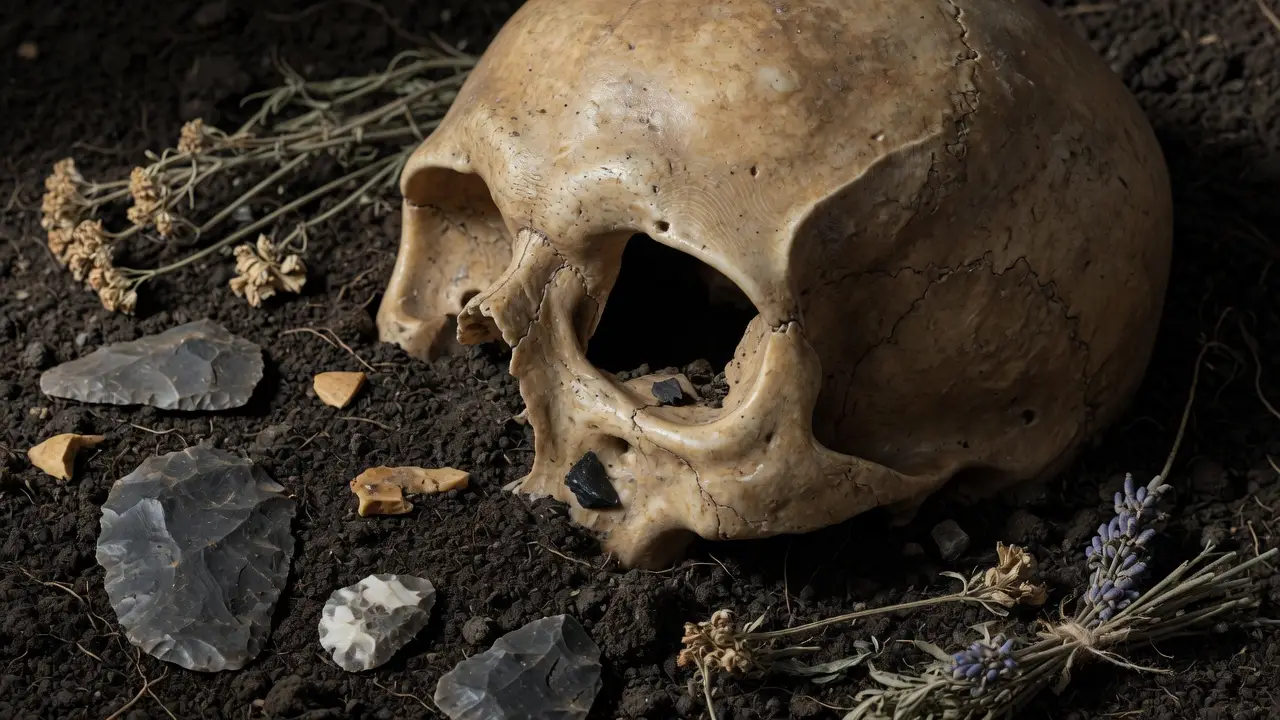
In 1865, a French archaeologist named Ephraim George Squier pulled a human skull from a Peruvian burial site and couldn’t make sense of what he was looking at. There was a hole in it, deliberate, precise and rectangular, cut through solid bone. Not the result of a weapon or an animal. This had been done carefully, by human hands, with tools. What stopped him cold wasn’t the hole itself. It was the bone growth around the edges. Smooth, healed, rounded. Whoever owned this skull had survived the operation. They had lived for months, possibly years, after someone cut into their head.
Squier took the skull to Paul Broca, one of the most respected neurosurgeons in Europe. Broca examined it and confirmed the impossible: this was intentional surgery, performed thousands of years before germ theory, before anesthesia as medicine knew it, before anything that looked remotely like a modern operating room. And the patient had walked away.
That skull cracked open a question that archaeologists and medical historians are still arguing about today: were the ancient surgeons better than we assumed? Not better in the way we measure medicine now, not in terms of antibiotics or imaging or sterile technique. Better in a different way. Practical. Empirical. Brutally effective in circumstances that should have killed everyone on the table.
What the Bones Don’t Lie About
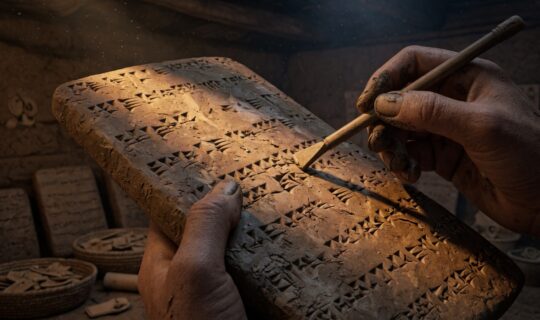
The problem with ancient medicine is that most of what we know comes from texts… and texts can be wrong, exaggerated, or just plain lost. Papyri decompose. Clay tablets get mistranslated. A physician writing in 1500 BCE had every reason to make himself sound competent.
Bones, on the other hand, have no agenda.
When paleopathologists, the researchers who study disease and injury in ancient skeletal remains, started systematically cataloguing surgical evidence in the 20th century, they kept running into the same uncomfortable finding: survival rates that didn’t fit the narrative. The narrative being that ancient medicine was mostly superstition and guesswork, and that patients who encountered a Bronze Age surgeon were essentially on their own.
“The best physician is also a philosopher.”
Galen of Pergamon (c. 160 CE)
The skulls disagreed. Across Peru, France, Greece, Ukraine, and the American Southwest, trepanned skulls showed healing. Not in a few cases. In the majority of cases. Some sites showed survival rates above 70 percent. One study of Neolithic specimens from France found that out of 120 trepanned skulls examined, nearly 90 showed evidence of bone regeneration, meaning the patient didn’t just survive the surgery, they lived long enough afterward for the bone to begin remodeling itself.
Join The Archive Briefing
Weekly dispatches. The history they didn't teach you — sourced, subverted, delivered to your inbox.
Seventy percent survival for elective brain surgery performed with stone tools, in the open air, five thousand years ago. Modern neurosurgery, for context, didn’t reliably cross that threshold until well into the 20th century.
The Art of Opening the Head
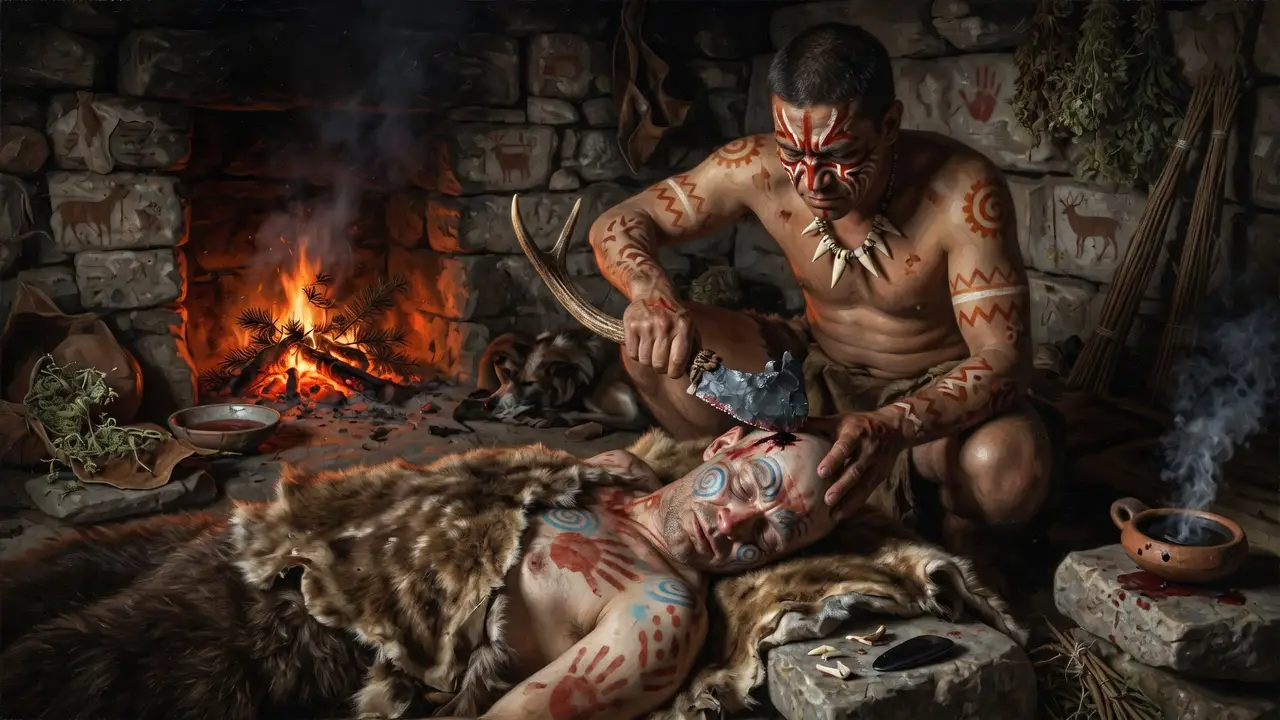
Trepanation is the oldest known surgical procedure. That’s not a metaphor or an approximation, it is literally the oldest. We have trepanned skulls going back to 6500 BCE. We have evidence of it on every inhabited continent. Whatever it was treating, like seizures, head trauma, unbearable migraines, spirits that needed an exit, certain people kept doing it because, at some level, it worked.
The technique varied by culture and era. Neolithic surgeons in France used a scraping method, grinding through the bone slowly with a flint blade in a rotational motion, less traumatic than it sounds, because it avoided the sudden shock of a cut and reduced the risk of the tool slipping into the dura mater beneath. Pre-Columbian surgeons in Peru used small, bow-like drills or stone knives to cut a series of intersecting lines and then lift the resulting piece of bone free, a technique so consistent across different sites that researchers believe it was being formally taught, passed from practitioner to practitioner across generations.
A physician who fails to enter the body of a patient with the lamp of knowledge and understanding can never treat diseases.”
Sushruta Samhita (c. 600 BCE)
The Hippocratic corpus, written in ancient Greece around 400 BCE, dedicates an entire text to head injuries and trepanation. It describes, in precise clinical language, exactly which fracture types require surgery and which do not, where to place the incision, how to feel for the edges of a depressed skull fracture with your fingertips, and when to stop. It warns against drilling too deep. It warns against heat from friction damaging the bone. These aren’t folk remedies. This is a surgical protocol.
“First, do no harm,” attributed to the Hippocratic tradition, though the exact phrase is a later paraphrase, was less a philosophical principle and more a practical surgical rule. The ancient physicians understood that intervention carried its own risk. They chose their cases carefully.
Blood in the Dust: Battlefield Surgery
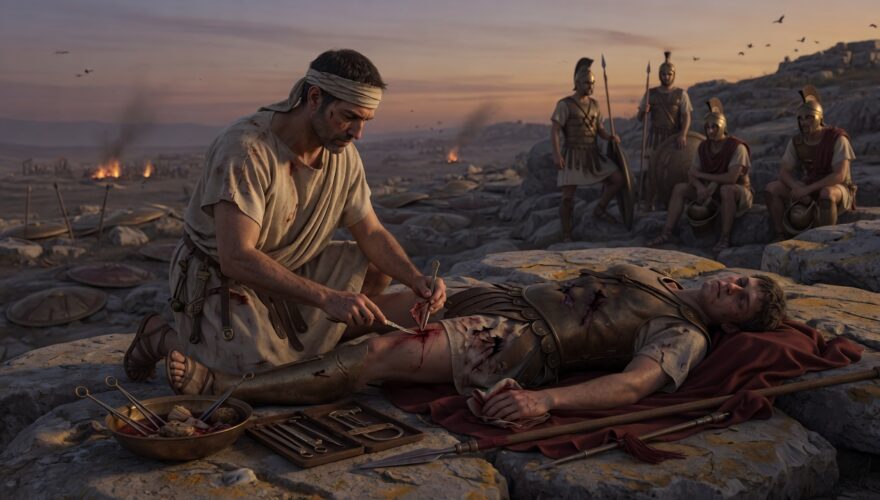
If trepanation is the most dramatic example of ancient surgical skill, battlefield medicine is the most revealing one. War, in every era, has been the greatest accelerator of medical knowledge. The injuries are immediate, the volume is overwhelming, and the feedback is instant: either the treatment worked or the soldier died.
The ancient world produced some of the most systemized battlefield care in human history before the 19th century. Greek physicians traveling with armies were not mere attendants, they were trained surgeons with defined roles. The Iliad, written sometime in the 8th century BCE, contains over 140 distinct wound descriptions, and classicist scholars who have analyzed them note that the injuries are anatomically accurate and the treatments described are medically plausible. Homer, whoever he was, had clearly observed the work of military physicians up close.
“For a physician is worth more than several other men put together, for he can cut out arrows and spread healing herbs.”
Homer, the Iliad
That line reads like poetry. It was also Roman and Greek military policy. Roman legions had trained medici (physicians) assigned to each unit. The army also employed capsarii, soldiers trained in rapid wound management whose name came from the capsa, the cylindrical case they carried holding bandages. They were, in essence, combat medics. Rome had them in the first century CE. The modern formalized battlefield medic role wasn’t established until the Napoleonic Wars, nearly 1,800 years later.
What did Roman battlefield surgeons actually do? The archaeological record at sites like Vindolanda on Hadrian’s Wall and the ancient port of Rimini has produced surgical instrument caches of surprising sophistication. Bone-handled scalpels. Probes for locating embedded arrows. Retractors for holding wounds open. Forceps calibrated for extracting projectiles without enlarging the wound channel. These weren’t crude. The Roman volsella, a toothed forcep used in tissue manipulation, is nearly identical in form to instruments still used in surgical procedures today.
When Honey Was a Prescription
The surgical instruments are impressive, but some of the most effective ancient medical interventions weren’t surgical at all, they were pharmacological. And they worked in ways that practitioners didn’t understand but empirically confirmed over centuries of use.
Honey was applied to wounds across ancient Egypt, Greece, Mesopotamia, and India. It sounds quaint. It was not. Honey is hygroscopic, meaning it pulls moisture out of bacteria, killing them through osmotic shock. It also produces small amounts of hydrogen peroxide as a byproduct of enzyme activity. Modern wound care has rediscovered this, medical-grade Manuka honey is now used in hospitals for treatment-resistant infections and chronic wounds. The Edwin Smith Papyrus, written in Egypt around 1600 BCE (though believed to copy an even older source), describes 48 case studies of traumatic injuries, each assessed and treated with a clinical logic that would not be out of place in a field surgery manual.
“If thou examinest a man having a gaping wound in his head, penetrating to the bone, thou shouldst feel the wound; shouldst thou find his skull uninjured, thou sayest regarding him: One having a gaping wound in his head. An ailment which I will treat.”
Edwin Smith Papyrus, Case 1
The papyrus distinguishes between treatable cases, uncertain cases, and hopeless ones, a triage system. The author tells physicians to simply observe and do nothing in cases they cannot help, rather than worsen the patient’s condition with intervention. This is rational, evidence-based triage. In 1600 BCE.
Willow bark containing salicin, the compound modern chemistry turned into aspirin, was used for pain and inflammation in ancient Mesopotamia, Egypt, and Greece. Archaeological evidence from Çatalhöyük in Turkey suggests cannabis was used medicinally before 3000 BCE. The Ebers Papyrus recommends opium for pain management in children. The ancient pharmacopoeia was empirically built over thousands of years of trial and observation, and a surprising amount of it has been vindicated by modern biochemistry.
The Survival That Shouldn’t Have Happened
Perhaps the most striking individual case in ancient surgical history isn’t from a famous civilization at all. It comes from a burial site in France, near Ensisheim, dated to approximately 5100 BCE. The skeleton of a man, probably in his fifties, showed two large trepanation holes in the skull, both of which had healed. He had survived two separate brain surgeries. In Neolithic Europe. With no metal tools.
His skeleton also showed signs of significant physical trauma, healed fractures across the body suggesting a hard, violent life. And yet he lived to old age. He survived things that, by any reasonable estimate, should have killed him repeatedly.
He is not unique. Across the archaeological record, ancient surgical patients keep appearing who lived when they had no business surviving. A skeleton from Peru shows an amputated lower leg, the bone at the amputation site is healed, rounded, remodeled. The patient survived the amputation, survived the infection risk, and lived long enough for bone to grow over the wound. In the pre-Columbian Andes. Without a hospital.
These cases aren’t anomalies being cherry-picked by enthusiasts. They are part of a systematic pattern that has forced medical historians to revise their assumptions about what ancient practitioners understood and could accomplish.
What We Lost, and What We’re Rediscovering
The collapse of the Roman Empire didn’t just end an empire. It ended a medical infrastructure. The trained medici, the organized military hospitals called valetudinaria, the accumulated surgical knowledge stored in Alexandria’s great library, much of it was lost or scattered during the long dissolution of the ancient world. Medieval European medicine, in many respects, was a step backward from what Rome had systematized. The empirical thread was broken.
Some of it survived through Islamic scholars, particularly Ibn Sina, whose Canon of Medicine preserved and extended Greek and Roman medical knowledge through the 11th century. Some was rediscovered slowly, painfully, through the same process the ancients used: watching what happened when you tried something, and adjusting accordingly.
The real lesson of ancient surgery is not that they were primitive and got lucky. The evidence suggests something more interesting: that brilliant, observant people working within the limits of their technology developed genuinely effective techniques through centuries of careful practice. They didn’t know about bacteria. They didn’t understand infection at the molecular level. But they noticed that honey healed wounds faster than other substances. They noticed that clean wounds closed better than dirty ones. They figured out, through generations of watching people survive or die, exactly how hard to press a flint blade against a human skull.
Knowledge doesn’t always require understanding the mechanism. Sometimes it just requires paying close enough attention.
A Debt We Haven’t Acknowledged
Today, when surgeons use wound irrigation to clean battlefield injuries, a technique described in Greek medical texts, they are, knowingly or not, following a protocol developed long before they were born. When burn units use honey-based dressings for resistant infections, they are reaching back past the antibiotic era to a remedy that never stopped working. When archaeologists find another trepanned skull in another corner of the world, healed and whole, it pushes the question a little further: how much of what we assume to be “discovered” was actually remembered?
The ancient surgeons left their evidence in the bones of their patients. Not in the bones of people who died on the table (those tell a different story), but in the bones of people who walked out of a makeshift operating space, somewhere in Neolithic France or pre-Columbian Peru or Bronze Age Greece, and went on to live their lives. Quietly validating, for anyone who looked closely enough, that the person with the knife knew what they were doing.
The skull Squier found in 1865 is still in the collection of the Smithsonian Institution. The healed edges are still there, still smooth, still proof that five thousand years ago, someone put a hole in another person’s head and they both knew it was going to be alright.