Comparative mythology meets archaeology. The uncomfortable possibility that some myths encode real catastrophic memory.
Imagine standing at the edge of a world that is ending. Not slowly, not metaphorically. The water is real. It is rising faster than you can run. Behind you, the village where your grandmother was born is already submerged. Around you, livestock spin in the current. And in front of you, there is nothing but a horizon of grey, churning water that has swallowed what used to be land. You survive. Barely. And for the rest of your life, you tell that story. So do your children. And their children. And somewhere, ten thousand years later, a scribe in Mesopotamia writes it down.
That is the theory. It sounds like speculation. But the more archaeologists dig, and the more mythologists compare notes, the harder it becomes to dismiss.
The Story That Would Not Die
Flood myths do not belong to one people or one god. They belong to almost every culture that ever existed. Researchers have catalogued over 200 distinct flood narratives from civilizations across every inhabited continent. Babylonian. Sumerian. Hebrew. Hindu. Greek. Norse. Aztec. Chinese. Mayan. Aboriginal Australian. The Yoruba of West Africa. The Haida of the Pacific Northwest. All of them describe, with remarkable consistency, a world drowned and then reborn.
The skeptical answer has always been that water is a universal human fear, and storytellers naturally reach for the most terrifying image available. Flood as metaphor. Flood as punishment. Flood as reset button for a corrupt world. Tidy. Reasonable. But it does not explain certain details that keep crawling out of these stories like something that refuses to stay buried.
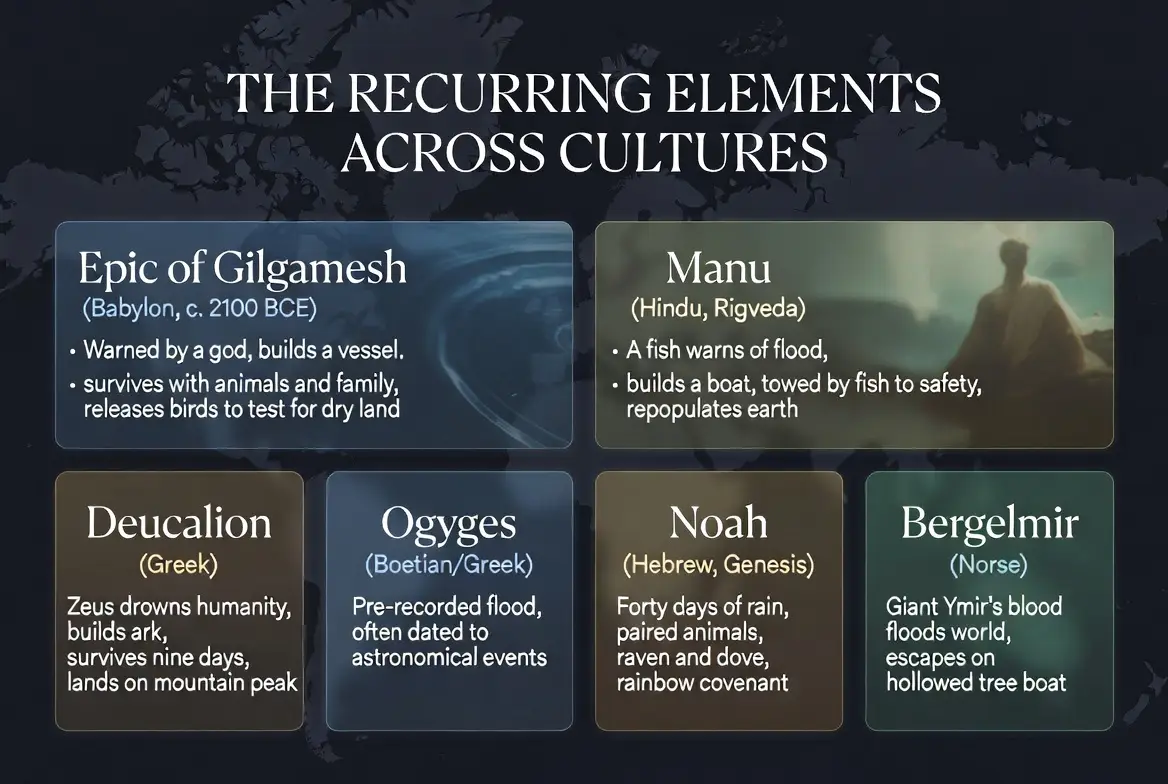
Notice what threads through all of them. A divine warning. A righteous individual chosen to survive. An enclosed vessel. Animals saved. A watery apocalypse. And then dry land, found by a bird sent out to scout. The overlap is not symbolic. It is structural. These are not independent artistic inventions. They share a skeleton.
The Gilgamesh Problem
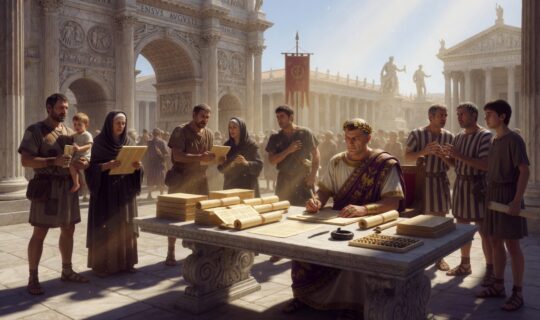
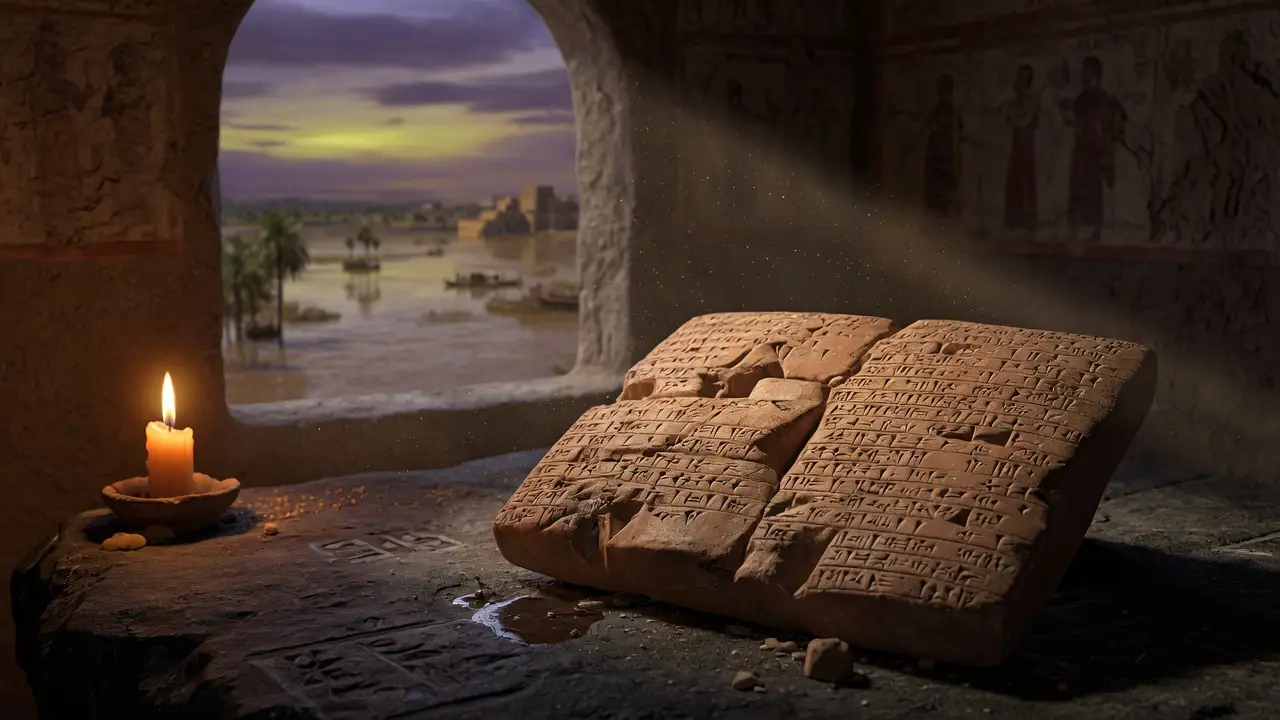
In 1872, a man named George Smith was sifting through clay tablet fragments at the British Museum when he found something that stopped him cold. The tablets, excavated from the ruins of Nineveh in ancient Assyria, contained a flood story. Not Noah’s flood. An older flood. A Babylonian flood, written centuries before Genesis was composed, featuring a hero named Utnapishtim who received a divine warning, built a boat, loaded it with animals, and released birds to find land. When Smith read the crucial passage aloud in the museum’s study room, he reportedly stood up, began pacing, and started removing his clothing in stunned agitation. His colleagues chose not to comment.
What Smith had found was the Epic of Gilgamesh, the oldest substantial work of literature ever discovered. And it contained, embedded inside a larger story about the fear of death, an almost word-for-word precursor to the Noah narrative. The implication was scandalous in 1872, and remains quietly uncomfortable now. The Biblical flood was not an original story. It was adapted from something older. Which raises the obvious question: what was that older story adapted from?
Join The Archive Briefing
Weekly dispatches. The history they didn't teach you — sourced, subverted, delivered to your inbox.
“Myths are not lies. They are the most vivid truths a preliterate people could articulate.”
Joseph Campbell, The Power of Myth
What the Earth Actually Remembers
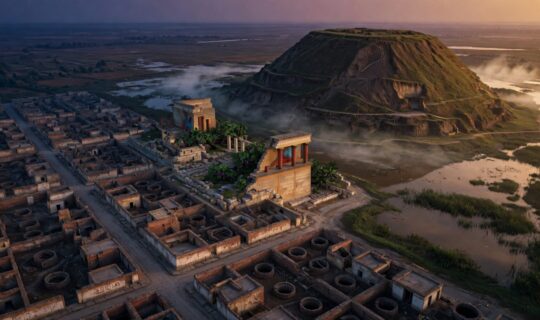
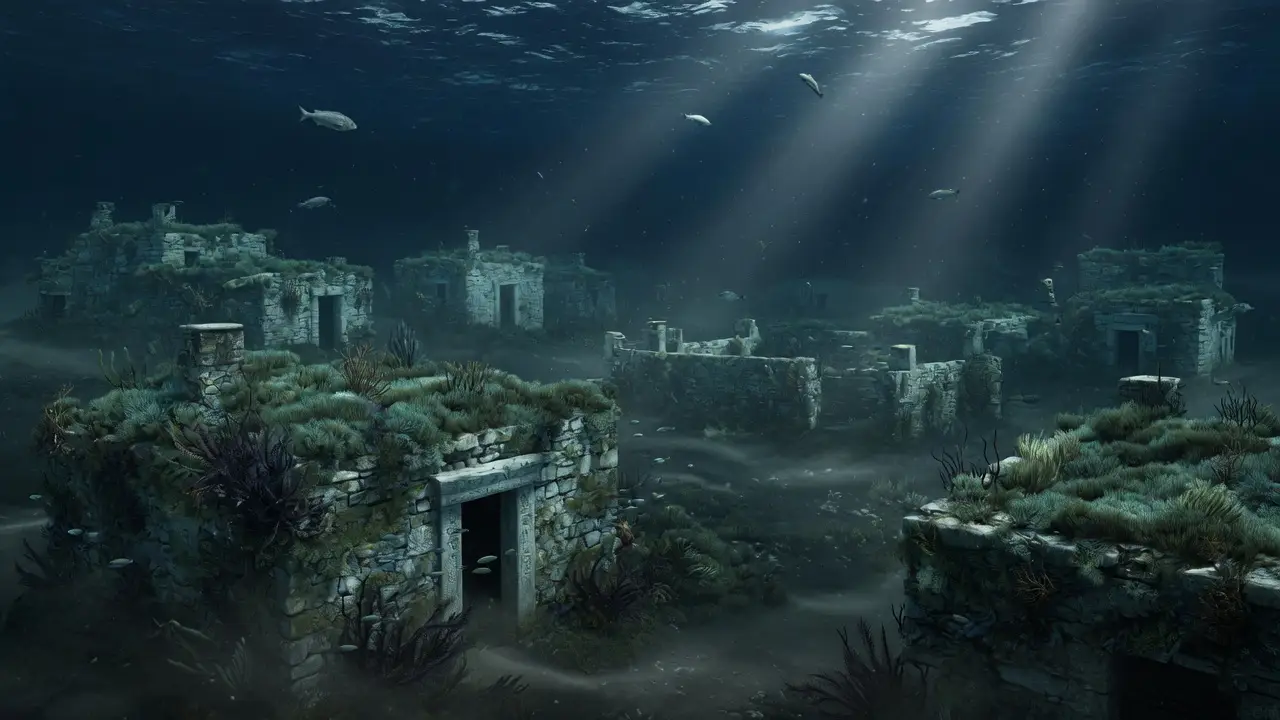
Around 11,700 years ago, the last ice age ended. This was not a slow thaw. In geological terms, it was abrupt. Ice sheets that had locked up enormous volumes of water began melting with a speed that reshaped coastlines across the planet. Sea levels rose by roughly 120 meters over several thousand years. That is not a metaphor. That is a fact etched into ocean floor sediment and coastal geology. Entire landmasses disappeared. The North Sea basin, once a vast inhabited plain connecting Britain to mainland Europe, went underwater. The Persian Gulf filled from a freshwater lake into a saltwater sea. The Black Sea, according to compelling geological evidence put forward by oceanographers William Ryan and Walter Pitman in 1997, may have experienced a catastrophic inundation around 5600 BCE when Mediterranean waters broke through the Bosphorus and flooded a much smaller freshwater lake basin with extraordinary violence.
Ryan and Pitman’s Black Sea hypothesis remains debated, but the geological evidence for rapid coastal flooding across the ancient world is not. Human populations living along coastlines, in river deltas, on fertile flood plains, would have experienced these events as the literal end of their world. Their gods were angry. The water was rising. Everything they knew was gone.
And then someone survived to tell the story.
The Memory Encoded in the Telling
Here is where it gets genuinely strange. Indigenous Australian oral traditions, which researchers now recognize as some of the oldest continuous knowledge systems on earth, contain dozens of stories describing coastal flooding events. Legends in which familiar landmarks, once dry land, sank beneath the sea. For decades, anthropologists treated these as spiritual allegories. Then geologists began mapping the actual inundation history of Australia’s coastline after the last ice age. They found, again and again, that Aboriginal flood stories corresponded with shocking precision to real, datable coastline changes that occurred between 7,000 and 18,000 years ago. These were not metaphors. These were eyewitness accounts, somehow preserved across hundreds of generations of oral transmission.
A 2020 study published in the journal Australian Geographer analyzed 21 such stories and found that 14 of them described specific bays, inlets, and geographic features that were indeed submerged at the relevant geological periods. The researchers called it “the world’s oldest memory.” That phrase lands differently once you sit with it. Oral cultures were preserving accurate geographical information across thousands of years with no writing, no maps, no institutional infrastructure. Only the story. Only the telling, and the re-telling, and the insistence that this happened, this was real, remember it.
Why the Details Match
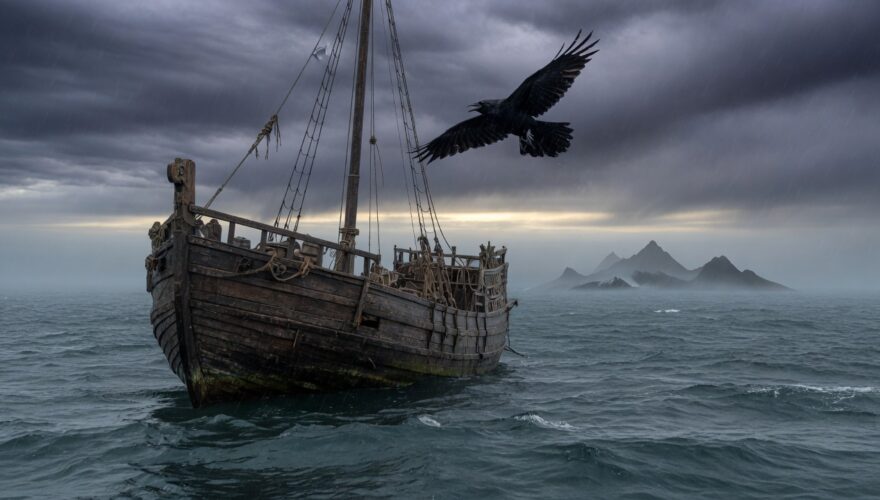
The birds bother scholars the most. Across unrelated flood traditions, separated by oceans and millennia, the survivor releases birds to find land. In the Babylonian account, Utnapishtim releases a dove, a swallow, and a raven in succession. In Genesis, Noah releases a raven and then a dove. In certain Hindu variants of the Manu story, a similar motif appears. This is not a coincidence of metaphor. This is specific procedural knowledge. If you are adrift on water and need to locate dry land, you release a bird and watch which direction it flies. You do not release it once. You wait. You try again. This is the practical knowledge of people who spent time on boats, watching coastlines disappear, problem-solving their survival.
The detail survived because it was true. It worked. And when the story was passed down and eventually shaped into theology and myth, the detail went with it, embedded in the narrative the way a fossil is embedded in stone. Strip away the divine punishment, strip away the chosen righteous man, strip away the covenant and the rainbow, and what remains is a survival manual written in story form by people who actually did this.
The Uncomfortable Possibility
Mythology has spent centuries being condescended to. The assumption, baked into the European Enlightenment and only partially dislodged since, is that myth is what primitive people invented to explain things they could not understand. Thunder gods for lightning. Flood gods for floods. A supernatural security blanket pulled over the terrifying randomness of the natural world.
But the evidence now points somewhere more unsettling. Some myths are not explanations for events. They are memories of events. Compressed, dramatized, spiritualized across retellings, yes, but at the core: something happened. The water came. Someone survived. They told the story. And the story, because it was the most important story anyone in that community had ever heard, because it was literally the story of how everyone alive descended from the people who did not die, that story did not get forgotten.
It got sacred.
When an event is catastrophic enough, when it kills nearly everyone and reshapes the physical world, the survivors do not file it under history. They file it under god. Under divine judgment. Under the story that explains why the world is the way it is. That transformation from memory to myth is not a corruption of truth. It is how preliterate cultures protected truth. They wrapped it in the most durable container they had: meaning.
So, What About Now?
We are living through a period of accelerating sea level rise. The IPCC projects that hundreds of millions of people living in coastal zones face displacement within this century. Low-lying island nations are already negotiating the terms of their disappearance. And across the world, in languages and cultures that the dominant civilization barely notices, there are communities watching water encroach on land their ancestors have occupied for thousands of years, carrying oral traditions that describe, with eerie precision, what happens when the sea takes the shore.
We dismiss myths at our own risk. Not because they are literally true in their supernatural architecture, but because they sometimes encode something harder and more durable than divine narrative. They encode lived experience. Human memory. The specific, brutal, practical knowledge of what it looks like when the world ends and someone has to decide how to survive it.
Every major religion has a flood myth because somewhere, at some point, there was a flood. And someone lived. And they never let anyone forget it.