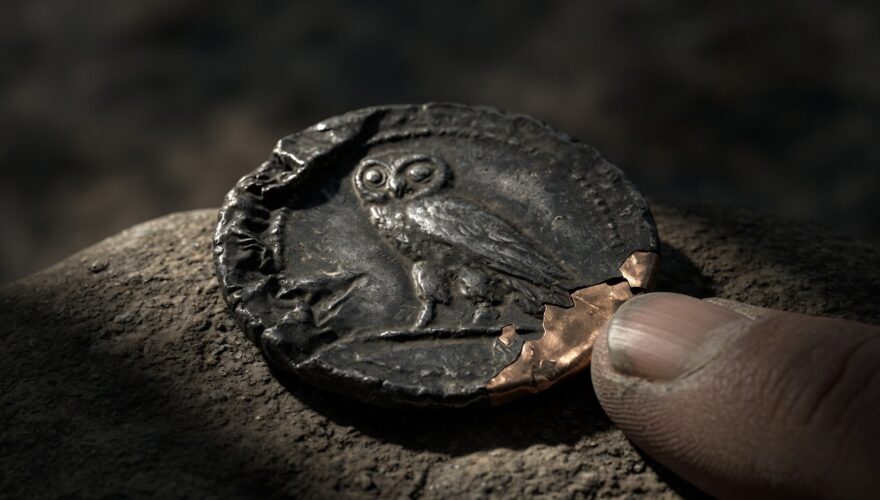
Long before modern fraud detection, ancient counterfeiters plated bronze with silver, cast fake coins in molds, and destabilized markets from Athens to Rome. This is the story of the ancient war on fake money, how it was made, how it was caught, and how it shook empires.
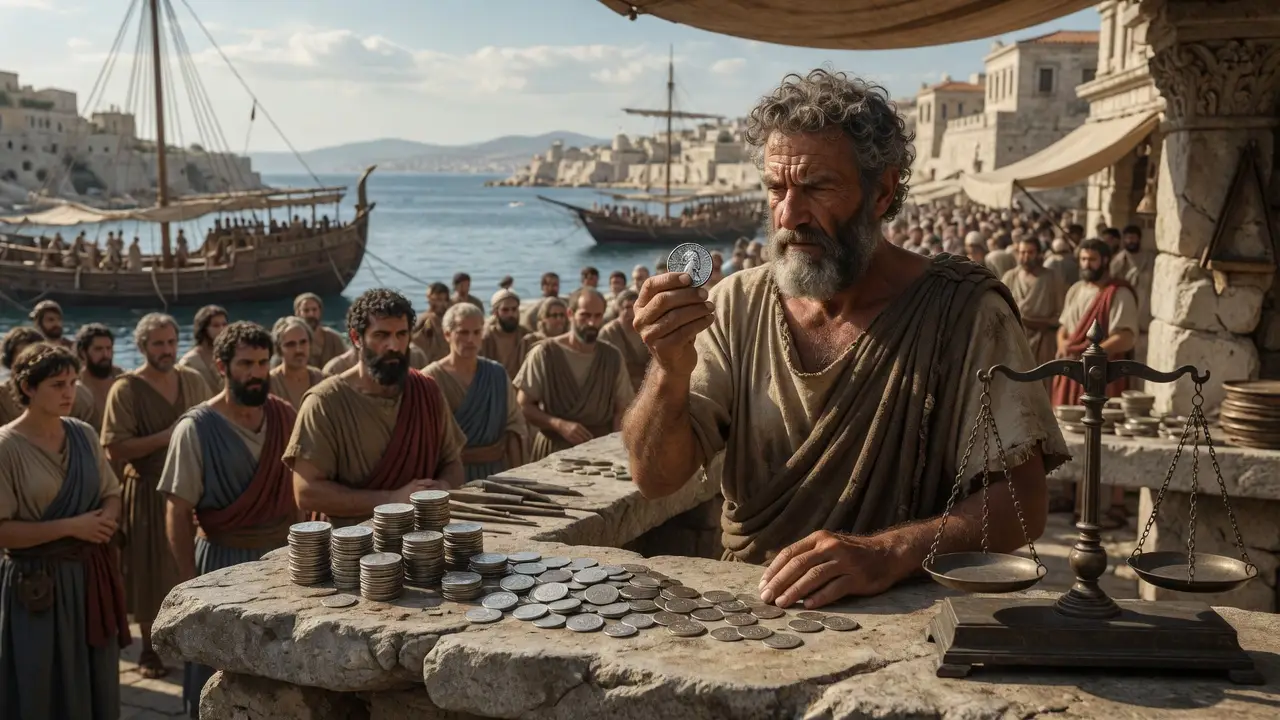
The merchant held the coin up to the light, turned it slowly, then pressed his thumbnail into its edge. The silver bent. Real silver doesn’t bend like that. He looked up at the man across the stall, and the man was already gone, swallowed into the noise of Piraeus harbor. The coin was a fake. An exquisitely made, utterly worthless fake.
This scene played out ten thousand times across the ancient world. Not as isolated incidents, but as a chronic, organized assault on the one thing that held commerce together: trust in money. Governments crumbled over it. Men were tortured, burned, and crucified because of it. And the methods counterfeiters used were so sophisticated that some of them wouldn’t look out of place in a modern forgery operation.
The war on fake money is not a modern invention. It is as old as money itself.
- 1 When Money Was Born, So Was the Urge to Fake It
- 2 The Tricks of Ancient Counterfeiters
- 3 Athens and the Battle Over the Owls
- 4 How People Detected Fake Coins
- 5 Rome Treated Counterfeiting Like a Crime Against Power
- 6 Counterfeit Money as Economic Warfare
- 7 The Craftsmen in the Shadows
- 8 A Fraud That Shook Empires
- 9 The Weight of Trust
When Money Was Born, So Was the Urge to Fake It
Coinage emerged in Lydia, in western Anatolia, sometime around 600 BCE. The Lydians struck electrum coins from a naturally occurring gold-silver alloy, and the idea spread fast. Within a century, the Greek city-states had adopted it, the Persians had refined it, and trade across the Mediterranean depended on it.
But the moment a coin had recognized value, it had a target on its back.
The earliest counterfeiters didn’t need a complex operation. They needed patience, skill, and access to cheap base metals. Bronze, lead, and copper were abundant. Silver and gold were not. The gap between those two realities was where the crime lived.
The Tricks of Ancient Counterfeiters
The most common technique was plating. A counterfeiter would take a core of lead or bronze, shape it to the right size and weight, and then coat it in a thin wash of silver or gold. Done well, the result looked identical to a genuine coin. The surface gleamed. The relief detail was clean. A merchant handling dozens of coins a day, in poor light, under pressure, could miss it entirely.
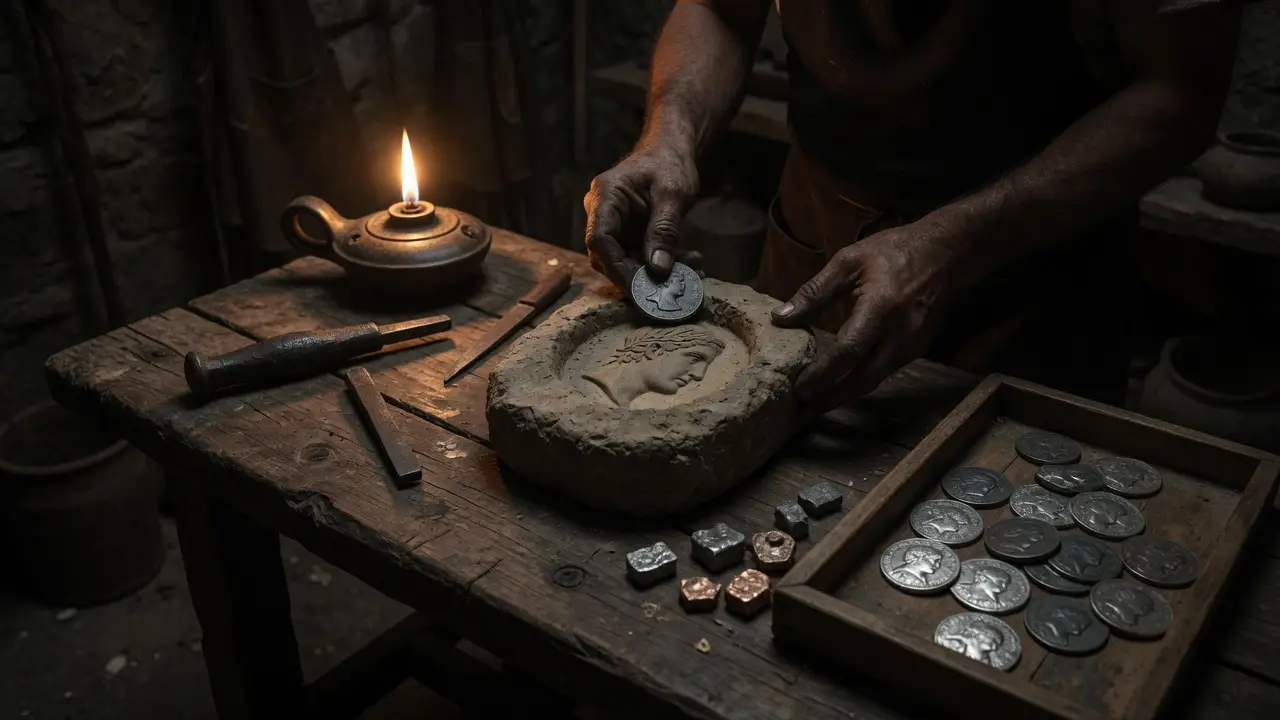
Casting was another method. Legitimate coins were struck, meaning a blank was placed between two engraved dies and hammered. Struck coins had a particular surface quality, a slight flow in the metal, tiny stress marks from the impact. Cast coins, made by pouring molten metal into a mold taken from a real coin, lacked all of that. But again, in a busy market, the difference was easy to miss.
Join The Archive Briefing
Weekly dispatches. The history they didn't teach you — sourced, subverted, delivered to your inbox.
“A counterfeit coin injures not the man who receives it alone, but all who come after him.”
Adapted from Roman legal principle in Ulpian’s Digest (Digest 48.10)
Clipping was simpler and more brazen. A person would shave tiny amounts of silver from the edges of genuine coins, accumulate the clippings, and eventually have enough raw material to sell or reuse. The coin still looked real. It was just lighter than it should have been. Over time, clipped coins became visibly smaller than unclipped ones, which is one reason ancient mints began adding edge lettering and rim decorations to their coins: not as decoration, but as a tamper alarm.
The fourth method was alteration: taking a low-value coin and modifying it to pass as a higher denomination. This required genuine engraving skill. Some ancient forgers were, by any measure, gifted craftsmen working in the wrong profession.
Athens and the Battle Over the Owls
No ancient coin was more trusted, more copied, or more contested than the Athenian tetradrachm. On one side, the helmeted head of Athena. On the other, an owl, an olive branch, and the letters AOE for Athens. Traders from Egypt to the Black Sea accepted them without hesitation. The Athenian owl was, in practical terms, the US dollar of the ancient Mediterranean.
That reputation created a problem. Because the owl was accepted everywhere, forgers everywhere wanted to make them.
Some imitations were semi-official: cities in Persia, Arabia, and Egypt struck their own “Athenian-style” coins because local merchants wouldn’t accept anything else. These weren’t quite forgeries in the criminal sense, more like regional adaptations. But others were outright criminal productions designed to deceive. Plated owls began circulating, particularly around Piraeus, the port of Athens, where foreign ships unloaded foreign money daily and the flow of coins was too fast for careful scrutiny.
“Let the silver coin be tested by the public tester according to this law.”
Athenian Coinage Decree inscription, c. 375 BCE
Athens fought back with legislation. A law attributed to the late fourth century BCE established official coin-testers, called dokimastai, at the agora and at Piraeus. Their job was to examine coins presented in transactions and reject fakes. An inscription found at the agora, dating to around 375-374 BCE, records the exact procedure: if a coin was found to be counterfeit, it was to be cut and handed over to the goddess, probably dedicated at a sanctuary to remove it from circulation without simply throwing it away, which would have allowed it to resurface.
The Athenians were not sentimental about this. A merchant who knowingly passed counterfeit coins faced serious legal consequences. A slave who operated a counterfeiting operation faced death.
How People Detected Fake Coins
Ancient coin-testing was a sensory craft. Experienced traders and money-changers developed intuitions that took years to build, and they used every available sense.
Weight was the first test. A real coin had a known weight. A plated coin, with a lead or bronze core, would often be heavier than it should be, since base metals are denser than silver. A good scale, calibrated with genuine coins, caught many fakes immediately.
Color was the second. Silver has a specific, cool brightness. A plated coin, especially one with a copper or bronze core beginning to show through worn edges, would have off-tones: a slight redness, a yellowish cast, a dull patch where the plating had thinned.
Whoever shall counterfeit, wash, or scrape the public money, shall be liable under this law.”
Lex Cornelia de Falsis, Rome, c. 80 BCE
Sound was the third, and perhaps the most interesting. When struck against a hard surface, genuine silver produces a clear, sustained ring. Base metals produce a dull thud. Money-changers would drop coins onto stone counters, or tap them against each other, and listen. A good ear could catch a plated coin that looked perfect.
Touch came next. Silver has a particular thermal conductivity and surface feel that experienced hands recognized. Some ancient sources describe traders biting coins, though this was probably less common than popularly imagined. Biting actually works poorly for detecting plated coins, since the plating itself resists the teeth.
The most definitive test was the cut. A knife or chisel applied to the edge of a suspect coin would reveal the interior. Silver all the way through, or bronze beneath the surface. This destroyed the coin’s beauty but settled the question absolutely. Many genuine ancient coins survive today with cut marks on them: the scars of suspicion, proof that somebody, somewhere, wasn’t willing to take the risk.
Rome Treated Counterfeiting Like a Crime Against Power
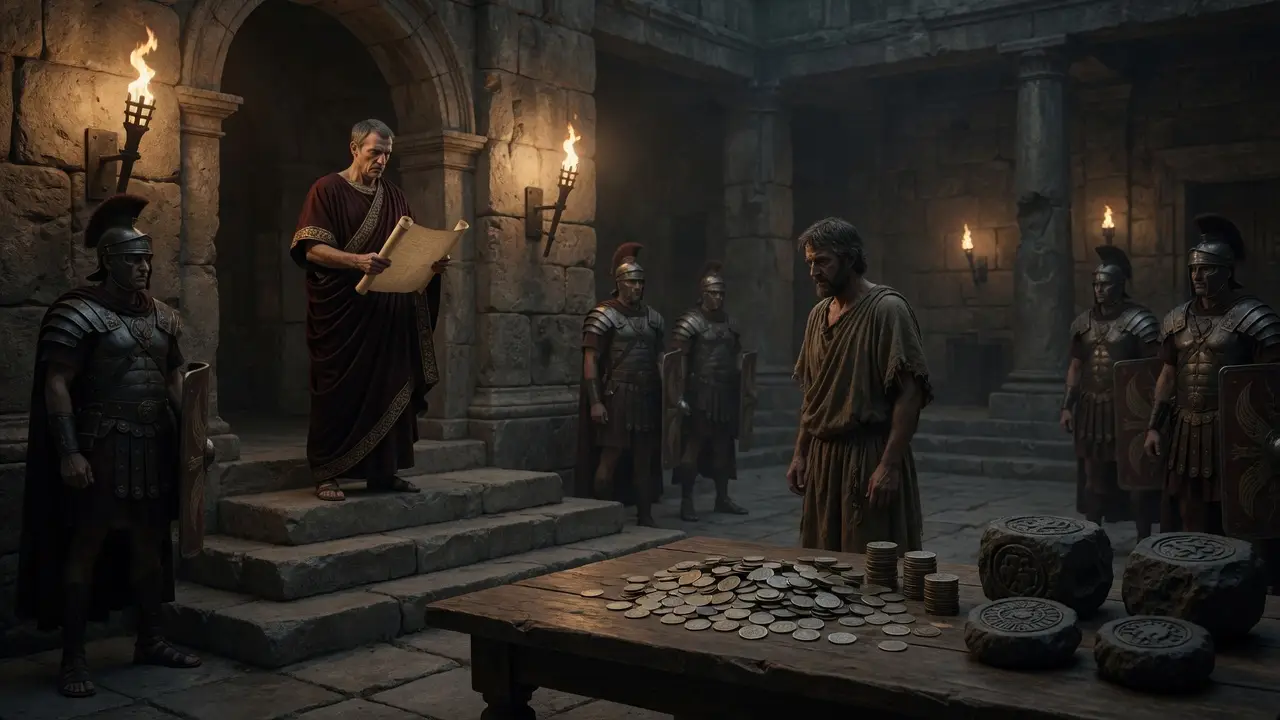
The Romans codified what the Greeks had handled informally. Under the Lex Cornelia de Falsis, passed under Sulla around 80 BCE and extended by later emperors, counterfeiting was treated not merely as fraud but as a crime against the state. The logic was explicit: the emperor’s face was on every coin. To fake that coin was to mock the emperor’s authority, to undermine the divine legitimacy stamped into the metal.
Penalties reflected that framing. Free men convicted of counterfeiting faced deportation to an island or condemnation to the mines, which was effectively a death sentence by exhaustion. Slaves faced execution outright. By the time of Diocletian in the late third century CE, the penalty could be burning alive.
LESSER-KNOWN DETAIL
Athens’ official coin-testers (dokimastai) were slaves or freed men, not citizens. The job was considered too degrading for freeborn Athenians, yet it was one of the most economically critical roles in the city.
Roman legal texts show exactly how seriously this was taken. The jurist Ulpian, writing in the early third century CE, listed counterfeiting alongside poisoning and forging wills as crimes against fundamental social order. Not financial crimes. Social crimes. Moral crimes.
The Romans also prosecuted the infrastructure of counterfeiting, not just individual offenders. Owning molds for casting coins was itself a criminal offense. Possessing counterfeit coins in quantity, even without proof of manufacture, could result in prosecution. The state understood what modern law enforcement understands: the network matters as much as the act.
Counterfeit Money as Economic Warfare
States also weaponized counterfeiting against each other. During the Second Punic War, Carthage flooded Roman territories with debased and counterfeit coinage to destabilize the Roman economy. It wasn’t the decisive factor in the war, but ancient sources suggest it created enough commercial disruption to matter.
Philip II of Macedon, Alexander‘s father, was accused by Greek city-states of deliberately circulating debased coins in enemy territories. The accusation may have been propaganda, but it reflected a genuine strategic logic: if your enemy’s market can’t trust its own money, you don’t need to defeat his army.
LESSER-KNOWN DETAIL
Roman mine workers condemned for counterfeiting were sometimes forced to work the very silver mines their crimes had helped exploit, an unusually ironic form of state punishment.
In the eastern Mediterranean, the Ptolemaic kingdom of Egypt ran a closed monetary system precisely to defend against this. Foreign coins were melted and reissued as Ptolemaic currency before they could circulate, which gave the state control over monetary quality and eliminated the risk of foreign counterfeits entering the local economy. It was an early, sophisticated form of monetary sovereignty.
The Craftsmen in the Shadows
Behind every wave of ancient counterfeiting was a network of skilled people: engravers who could copy coin designs, metalworkers who understood alloys, traders who moved the product without arousing suspicion.
Some counterfeiters operated at remarkable scale. Archaeological evidence from Roman Britain includes multiple sites where large numbers of cast coins were produced, with the molds found nearby still showing the impressions of genuine coins they were copied from. These weren’t opportunistic individuals. They were small industries.
One detail rarely discussed: the skill required to make a convincing plated coin was genuinely considerable. The silversmith had to know how to draw the metal thin enough to be convincing, but thick enough not to flake under handling. He had to control the color of the surface wash. He had to match the weight as closely as possible by calibrating the core material. Some ancient plated coins are so well executed that modern numismatists have needed X-ray fluorescence equipment to confirm they were fakes. The ancient trader with his thumbnail was playing against a professional.
A Fraud That Shook Empires
By the third century CE, the Roman Empire was in monetary crisis, and counterfeiters were partly to blame, though mostly they were a symptom rather than a cause. The state itself had been debasement the silver content of the denarius for decades, trying to pay its expenses without adequate bullion. By the 260s CE, the antoninianus coin was less than five percent silver. Practically speaking, official coins had become a form of state-sanctioned counterfeiting.
LESSER-KNOWN DETAIL
A hoard found in Roman Britain (the “Frome Hoard” area and similar sites) contained molds for casting fake coins alongside genuine coins, suggesting counterfeiters sometimes operated directly within coin-using communities, not on their fringes.
This created a perverse situation: genuine counterfeit coins, made with better silver than the official ones, began circulating alongside the degraded official currency. The market trusted the fakes more than it trusted the state. Diocletian’s currency reforms in the 290s were driven in part by the need to restore confidence in official money, to make the state’s coin worth trusting again.
The ancient counterfeiter had, in a sense, won. Not because any individual forger defeated the empire, but because the logic of debased money had been normalized so thoroughly that the line between the criminal operation and the state treasury had blurred almost beyond recognition.
The Weight of Trust
Every system of money is, at its core, a shared agreement. The coin is worth something because enough people agree it is. Counterfeiting attacks that agreement directly. It doesn’t just steal money. It erodes the willingness to trust, to trade, to believe that the object in your hand is what it claims to be.
LESSER-KNOWN DETAIL
In ancient China, the punishment for counterfeiting bronze coins under the Han dynasty was death by dismemberment, suggesting the problem was global and the responses similarly extreme.
The ancient world understood this intuitively, which is why the punishments were so severe. The counterfeiter wasn’t just a thief. He was someone who poisoned the well everyone drank from.
The merchant at Piraeus, pressing his thumbnail into that coin, was doing more than checking for fraud. He was holding the line between a functioning society and a slow slide into suspicion. That’s a lot of weight for a bent coin to carry.