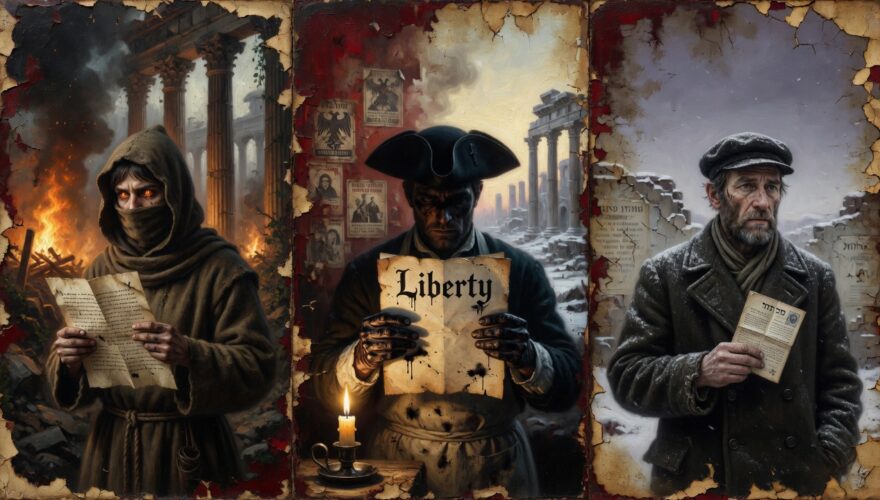
The most powerful propaganda campaigns in history were not built by empires. They were built by the persecuted. Discover how early Christians, American revolutionaries, and the Zionist movement mastered narrative control long before they held any real power, and why the playbook they created still shapes the world today.
The Room Where It Started
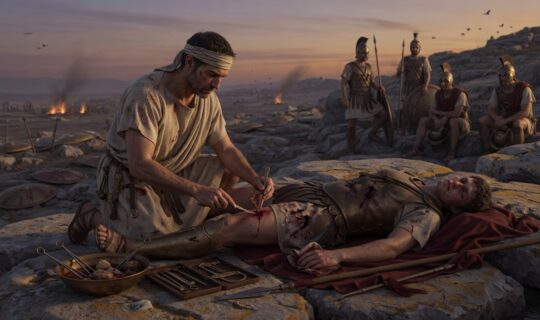
In 64 AD, Rome was burning. Not metaphorically. The city actually burned for six days, and Nero needed someone to blame. He chose the Christians, a ragged cult that most Romans barely knew existed, a group so marginal they barely registered in imperial records. He accused them of arson. He had them arrested, wrapped in animal skins, and torn apart by dogs in the arena. Some were coated in pitch and set alight to serve as garden torches.
It should have ended there.
Instead, within 250 years, Christianity became the official religion of the Roman Empire. The same empire that had tried to exterminate it.
That is not a miracle story. That is a propaganda story. And it is one of the most effective ever told.
Power Is Not a Prerequisite for Narrative Control
Most people assume propaganda is something the powerful do to the weak. Governments manufacture consent. Empires rewrite history. The strong tell the story, and the rest of us believe it.
But history keeps disrupting that assumption. Some of the most sophisticated, most durable narrative campaigns in human history were built by people who had nothing: no armies, no printing presses, no palaces. What they had was a story, a grievance, and the discipline to repeat both without stopping.
Three movements in particular stand out. Three groups who were marginalized, persecuted, scattered, or dismissed, and who weaponized that vulnerability so effectively that the world eventually reorganized itself around their version of events. The early Christians. The American revolutionaries. The Zionist movement.
None of them started with power. All of them started with narrative.
Join The Archive Briefing
Weekly dispatches. The history they didn't teach you — sourced, subverted, delivered to your inbox.
The Christian Martyrdom Loop
The Romans were excellent administrators but terrible at understanding what made certain ideas stick. They assumed that killing the leaders of a movement would kill the movement. It had worked before. It did not work here.
The early Christians had discovered something the Romans would never fully grasp: a martyr is more powerful than a soldier. A soldier can be defeated. A martyr cannot be argued with. His death becomes the argument.
When Polycarp, the bishop of Smyrna, was burned alive around 155 AD, something unusual happened. The Roman crowd apparently went quiet as he prayed. Witnesses claimed the flames curved around him. The story spread. It spread fast. Within years, accounts of Christian executions were being circulated across the empire not as cautionary tales, but as advertisements.
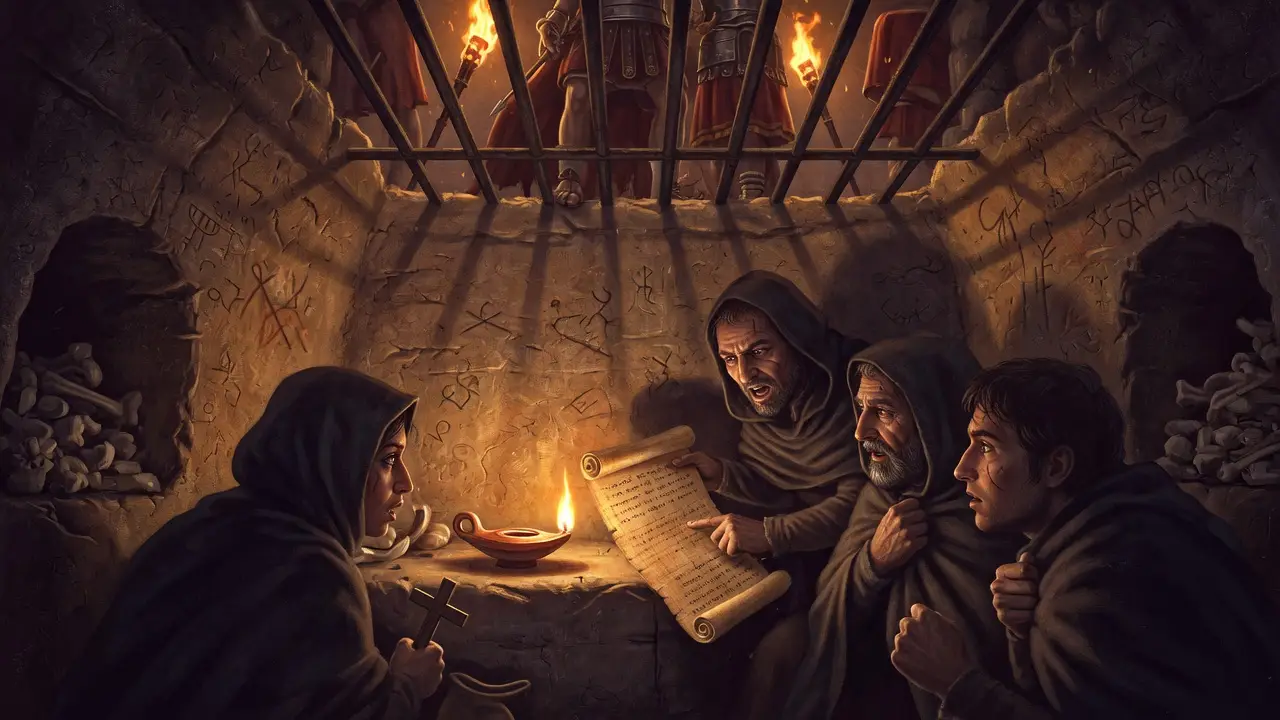
This was deliberate. Early Christian communities kept meticulous records called acta martyrum, the acts of the martyrs. These were not grief documents. They were propaganda tools dressed in the language of faith. They framed execution as triumph, suffering as proof of divine favor, and the Roman state as a moral authority so corrupt it destroyed what it could not comprehend.
The lesser-known detail here is that the Romans actually tried to suppress these documents. They confiscated Christian texts. They demanded Christians hand over their sacred writings, earning those who complied the Latin label traditores, literally “those who hand over.” That word, in corrupted form, is where we get the word traitor. Rome inadvertently gave the English language one of its most charged words while trying to erase a story it could not control.
The story kept growing anyway.
“The blood of the martyrs is the seed of the church.”
Tertullian, c. 200 AD
By the time Constantine legalized Christianity in 313 AD, the empire was not converting to a foreign religion. It was absorbing a narrative that had been quietly colonizing Roman minds for three centuries.
The Revolution That Was Sold Before It Was Fought
In 1765, the British Parliament passed the Stamp Act, a tax measure affecting printed materials in the American colonies. It was not a brutal law. Compared to what European peasants lived under, it was barely an inconvenience. Benjamin Franklin, then in London, initially expected the colonists would simply comply.
He was wrong. And the reason he was wrong was already being built, block by block, in the print shops of Boston.
Samuel Adams understood something that most political operators of his era did not: a revolution needs an audience before it needs an army. Adams was a mediocre businessman and a brilliant propagandist. He organized a network called the Sons of Liberty and used it like a communications infrastructure, circulating pamphlets, letters, and newspapers across the colonies at a time when coordinated messaging across thirteen separate territories was extraordinarily difficult.
Adams framed every British tax measure not as a policy disagreement but as a moral atrocity. He was not describing reality. He was manufacturing one. The phrase he and his allies hammered into colonial consciousness, “taxation without representation,” was technically accurate but strategically deployed. It transformed a fiscal dispute into a question of fundamental human dignity.
The lesser-known detail: Adams orchestrated the Boston Massacre narrative with surgical precision. When British soldiers fired into a crowd in March 1770, killing five people, Adams had the story in print within days. Paul Revere’s famous engraving of the event, which showed disciplined British soldiers firing in formation into a peaceful crowd, was almost entirely false. The crowd had been aggressive. The soldiers had been terrified. One victim, Crispus Attucks, was depicted as white in the engraving, likely because Adams judged that a Black man’s death would fail to move the colonial audience he was targeting.
None of that nuance reached the printing presses. The Massacre narrative spread through the colonies as Adams had designed it: clean, outrageous, and simple enough to repeat at a dinner table.
“It does not require a majority to prevail, but rather an irate, tireless minority keen to set brushfires in people’s minds.”
Samuel Adams
Thomas Paine then did something Adams could not: he wrote for the unpersuaded. His 1776 pamphlet Common Sense sold 500,000 copies in a colonial population of 2.5 million. He did not write for intellectuals. He wrote in plain sentences with Anglo-Saxon words, for people who had never thought of independence as anything other than a fantasy. He made it feel inevitable. That is the hardest thing in propaganda: making a radical idea feel obvious.
By the time British muskets were pointed at colonial farmers in Lexington, the propaganda had already won the psychological war. The colonists were not fighting a tax policy. They were fighting tyranny. Paine and Adams had made sure of that.
The Zionist Text That Moved History
In 1896, a Viennese journalist named Theodor Herzl published a pamphlet called Der Judenstaat, The Jewish State. It was 86 pages. It proposed the establishment of a Jewish homeland as a political solution to antisemitism.
Herzl was not the first person to suggest this. There had been proto-Zionist thinkers for decades before him. But Herzl grasped something his predecessors had not: the idea needed to be legible to non-Jews, not just to the diaspora. It needed to be a political argument, not a religious one. It needed to speak the language of European nationalism, which was the dominant political grammar of the 1890s.
He then did what effective propagandists always do: he institutionalized the narrative. In 1897, he organized the First Zionist Congress in Basel, Switzerland. At the closing of that congress, he wrote in his diary with stunning confidence: “At Basel I founded the Jewish State. If I said this out loud today, I would be greeted by universal laughter. In five years perhaps, and certainly in fifty years, everyone will perceive it.”
He was off by one year. The State of Israel was declared in 1948, fifty-one years later.
What made Zionist propaganda distinctive was its dual audience management. Internally, it spoke to Jewish communities scattered across Russia, Eastern Europe, and the Middle East in the language of return, dignity, and biblical covenant. Externally, it spoke to European powers in the language of colonial settlement, civilization-building, and geopolitical stability.
The Balfour Declaration of 1917, a letter from the British Foreign Secretary expressing support for a Jewish homeland in Palestine, was the result of years of sustained lobbying by Chaim Weizmann. Weizmann was a chemist, but he understood politics as chemistry: the right elements, combined under the right pressure, in the right order. He was in London during the First World War, and he made himself useful. When Britain needed a synthetic version of acetone for explosives production, Weizmann solved the problem. He asked for nothing in return at the time. That restraint was itself a strategic act. The debt was noted.
“We must expropriate gently the private property on the estates assigned to us. We shall try to spirit the penniless population across the border by procuring employment for it in the transit countries, while denying it employment in our country.”
Theodor Herzl, in a private diary entry, 1895
The movement also pioneered what might be called emotional archaeology: excavating historical trauma and presenting it as a continuous, living wound. The memory of the Inquisition, the pogroms of Tsarist Russia, the long history of European antisemitism, all of it was woven into a single narrative of a people who had no choice but to act. By the time the Holocaust provided catastrophic confirmation of those fears, the narrative architecture was already in place.

The Pattern Beneath the Pattern
Look across these three movements and the same mechanism appears. First, there is the construction of identity through suffering: we are defined by what has been done to us. Second, there is the moral inversion: the powerful are recast as barbaric, and the weak as righteous. Third, there is the institutionalization of the message, through texts, assemblies, newspapers, congresses, so the narrative outlives any individual voice.
“These are the times that try men’s souls.”
Thomas Paine, The Crisis, December 1776
And fourth, critically, there is what might be called the patience of the powerless. None of these movements expected to win quickly. Tertullian wrote for an audience he knew might be executed. Samuel Adams organized for a decade before a single shot was fired. Herzl died in 1904, never seeing Israel established. They were not building for the moment. They were building for the century.
What This Means in Today’s World
Every political movement today, left or right, secular or religious, claims victimhood as its foundation. That is not coincidence. It is strategy, inherited from these movements, whether consciously or not. The framing of persecution grants moral authority. It recruits the sympathetic. It immunizes the message against criticism, because attacking a victim always carries risk.
The danger is that this mechanism has no inherent moral content. It can carry truth or deception equally well. The early Christians were genuinely persecuted. The American colonists were genuinely taxed without representation. The Zionist case for a homeland was forged in genuine historical trauma. But the tools they developed, the martyrdom narrative, the atrocity account, the institutional repetition of grievance, those tools are neutral. They are available to anyone.
“I am a Christian; and if you inquire my name, it is what you have heard; but if the family I belong to, it is Christianity.”
Polycarp of Smyrna, before his execution, c. 155 AD
Understanding how these campaigns worked is not cynicism. It is the minimum requirement for navigating a world where narrative is the primary battlefield.
The powerless did not wait for power to tell their story. They told it first. And in doing so, they made power follow.