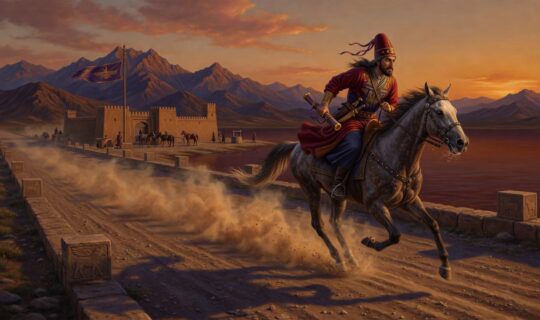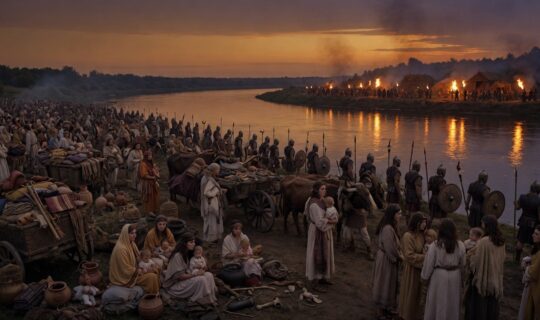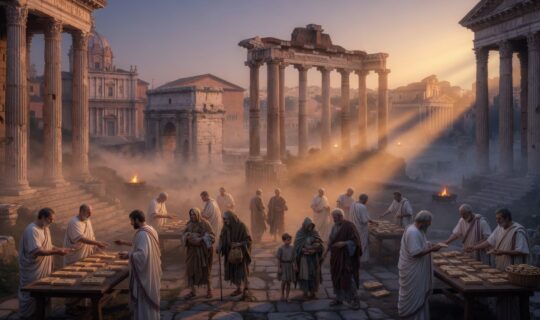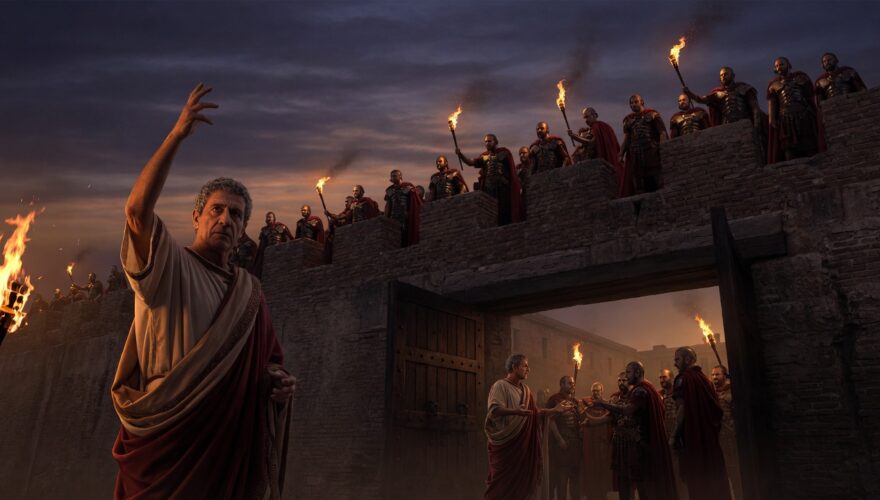
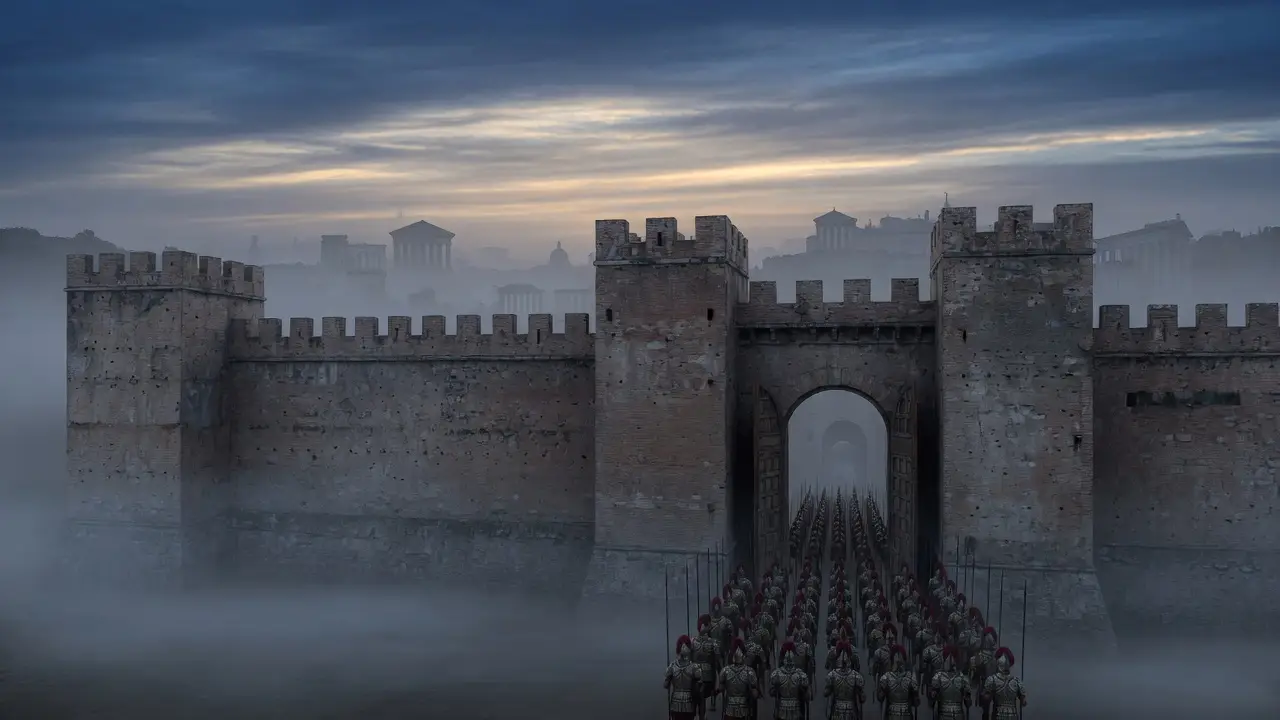
Two men stood on opposite sides of a fortress wall, shouting numbers at each other like bidders at a livestock sale. One stood inside, already among the soldiers. The other stood in the mud outside the gate, arm raised, fingers spread so the men on the ramparts could count along as he topped the last offer. Between them, they were haggling over the one thing in the ancient world that was never supposed to be for sale: the throne of Rome.
It had been empty for less than a day. The previous occupant was still cooling on the floor of his own palace, his head already gone, carried off on the point of a spear. The men doing the selling, and setting the price, were the emperor’s own bodyguard. Within a few hours, one of the two bidders would win, the gates would swing open, and Rome would have a new master, purchased in cash, per soldier, like a shipment of grain.
Historians still argue about how literally to take the word “auction.” Nobody argues about the outcome. On March 28, 193 AD, the Praetorian Guard murdered an emperor who’d ruled for less than three months, then sold his job to the highest bidder. It wasn’t the first time Rome’s own soldiers had installed a ruler by force. It was the moment they stopped pretending it was anything else.
The Bodyguards Who Learned Their Own Strength
Augustus never wanted a private army camped inside Rome. When he created the Praetorian cohorts in 27 BC, he scattered them on purpose, a few units near the palace, the rest tucked into towns around Italy, so no single commander could look out a window and count an army of his own. Romans had feared exactly this for centuries: armed men loyal to one man, standing inside the sacred boundary of the city. Augustus understood that fear better than anyone. He’d used it to end the Republic.
His caution lasted less than fifty years. Around 23 AD, the ambitious prefect Sejanus convinced Emperor Tiberius to gather every scattered cohort into a single fortress, the Castra Praetoria, a walled camp just outside the city’s edge. It looked like administrative tidiness. It was actually one of the worst security decisions an emperor ever signed off on. For the first time, several thousand armed men lived together, trained together, and talked together, a few minutes’ walk from the Senate and the palace.
The historian Edward Gibbon, writing centuries later, put his finger on exactly why that mattered: housing the guards that close to the seat of power taught them to recognize their own strength, and the weakness of everyone around them.
“Just as if it had been in some market or auction-room.”
Cassius Dio, Roman History, describing the bidding at the Praetorian camp
They didn’t waste the lesson. In 41 AD, a tribune cut down the emperor Caligula in a palace corridor, and in the chaos that followed, a group of Praetorians found his terrified uncle Claudius hiding behind a curtain, dragged him out, and declared him emperor on the spot in exchange for a fortune in cash. That afternoon, the Guard had made and unmade an emperor before dinner. Over the centuries that followed, the Guard, or its commanding prefect, had a hand in the deaths of more than a dozen emperors. Rome had built the single most dangerous employee in its own history and kept him on permanent payroll.
A Reformer Among Wolves
By December of 192 AD, the throne belonged to Commodus, son of the philosopher-emperor Marcus Aurelius and nothing like him. Commodus had spent his reign fighting as a gladiator in the arena, renaming Rome after himself, and drawing up an execution list that eventually included his own mistress. When Marcia found her name on it, she didn’t wait around to find out if he meant it. On the night of December 31st, she laced his wine with poison. He vomited it back up. So his old wrestling coach, a man named Narcissus, finished the job with his hands in the emperor’s own bathtub.
Join The Archive Briefing
Weekly dispatches. The history they didn't teach you — sourced, subverted, delivered to your inbox.
Rome needed someone respectable to fill the vacancy fast, and Laetus, the Praetorian prefect who’d helped arrange Commodus’s death, settled on Pertinax. He was an unusual pick for the purple: the son of a freed slave from Liguria, a former schoolteacher turned soldier, who’d spent decades climbing the ranks on competence rather than birth. The Senate, worn down by years of Commodus’s paranoia, welcomed him with visible relief.
Pertinax tried to fix everything at once. He sold off Commodus’s menagerie of exotic animals, his gladiatorial gear, his gilded furniture, even his favorites, just to scrape together the donative he’d promised the Guard for their loyalty. He balanced the treasury. He trimmed the gladiatorial games the public loved. And critically, he tried to drag the Praetorian Guard back toward something resembling discipline, after years of Commodus letting them do more or less whatever they wanted.
“But what evil have I done? Whom have I killed?”
Didius Julianus’s reported last words, recorded by Cassius Dio
It cost him almost immediately. Weeks into his reign, while he was away at Ostia inspecting the grain supply, a Praetorian plot against his life surfaced. He pardoned the soldier at the center of it once it became clear the man had been used, and executed the others involved. It should have been a warning shot. Instead, it barely registered.
Eighty-Six Days
By late March, the goodwill had curdled into something closer to mutiny. The Guard missed Commodus more than anyone in Rome wanted to admit out loud. They missed his indulgence, his loose discipline, the sense that their privileges were untouchable. Pertinax had given them none of that. Only order. And order, to men who’d grown used to license, felt like punishment.
On March 28th, somewhere between two and three hundred Praetorians marched on the palace. Nobody had planned it as a coup. It was closer to a riot that discovered its own momentum along the way. Pertinax’s own household guards didn’t lift a hand to stop them. Laetus, the very prefect who’d installed Pertinax months earlier, did nothing either, and may have quietly encouraged it.
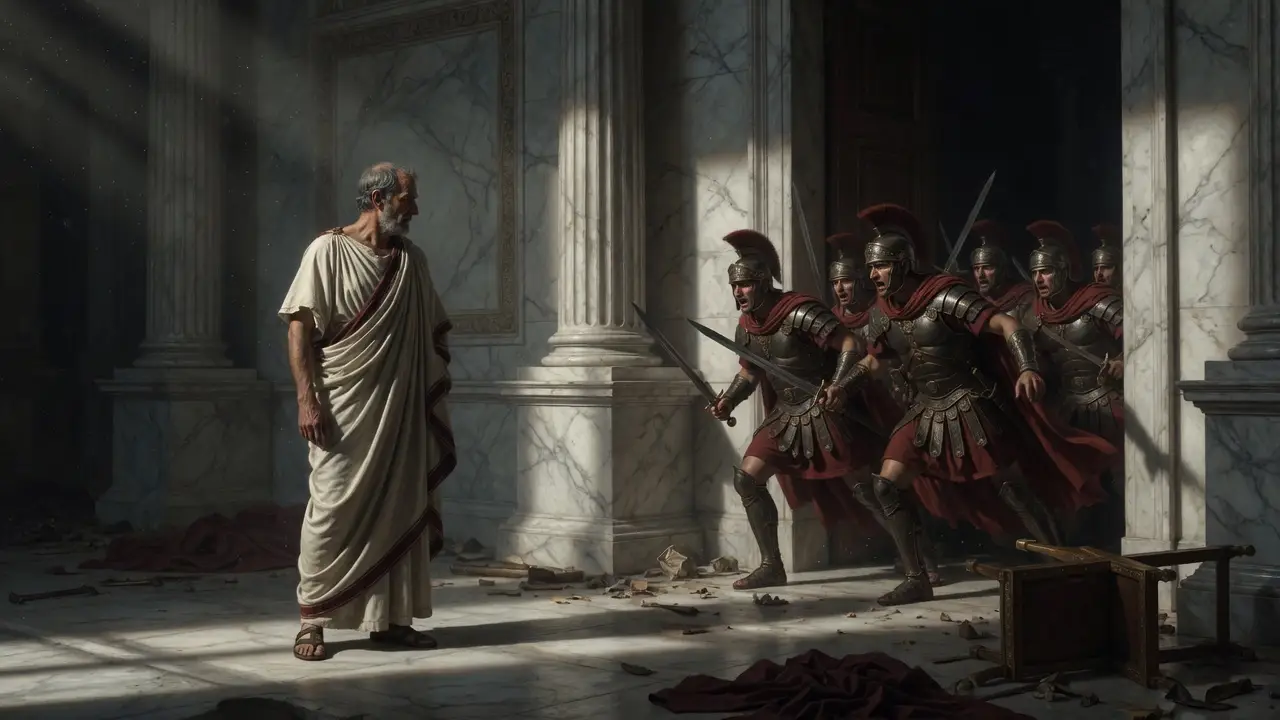
Pertinax could have run. He didn’t. According to Cassius Dio, a senator living in Rome at the time who later wrote the fullest surviving account of these events, Pertinax walked out to meet the armed men who’d come to kill him and tried, astonishingly, to talk them down. It didn’t work. He was cut down under a storm of blades, and one soldier severed his head and carried it back to camp on the tip of a spear, a grotesque trophy for men who’d sworn to die defending him only three months before.
Dio, who’d known the man personally, admired his composure and mourned the uselessness of it. Courage doesn’t count for much against a few hundred men who’ve already made up their minds.
An Empire on the Block
Here is where Roman history takes its strangest turn. The Guard had just murdered their emperor with no plan for what came next, and within hours, that gap became an opportunity.
Titus Flavius Sulpicianus, prefect of the city and, in a detail almost too bitter to invent, Pertinax’s own father-in-law, had been sent to the camp that same day to calm the soldiers down. Once he realized the throne was sitting empty, he stayed and started negotiating for it himself.
Word of the vacancy reached a wealthy senator named Didius Julianus in the middle of a late-night dinner party. By most accounts, he’d had a fair amount to drink. His wife, his daughter, and his dinner guests all reportedly pushed the same idea: go to the camp, and don’t be shy with money. He had plenty of it sitting in a treasure room at home, and this looked like the one night of his life when spending it might buy him everything.
“An empire which had not been acquired by merit, but purchased by money.”
Edward Gibbon, The Decline and Fall of the Roman Empire, on Julianus’s reign
He arrived to find the gates barred and Sulpicianus already inside making his case. So Julianus planted himself at the foot of the rampart and started shouting up at the walls. What followed, in Dio’s own words, felt “just as if it had been in some market or auction-room.” Soldiers ran messages back and forth between the two men on opposite sides of the wall, relaying each new figure like runners at a cattle sale. Sulpicianus, holding the advantage of already being inside, pushed the price to 20,000 sesterces a man, roughly eight years’ wages in a single afternoon.
Julianus, panicking at the thought of losing, didn’t nudge the number. He jumped it by five thousand at once, shouting the new total and holding up his fingers so the men on the wall could count along.
It worked. Somewhere around eight to ten thousand Praetorians were watching that day, which meant Julianus had just verbally committed to something in the neighborhood of two hundred million sesterces, money he did not actually have sitting in that treasure room. It didn’t matter in the moment. The gates swung open. The soldiers pulled down their standards, put Commodus’s image back on them for good measure, and marched their new emperor toward the Senate, surrounded by enough spears that nobody in the chamber felt much room to argue.
A Purchase He Couldn’t Afford
Julianus’s reign began exactly as badly as it started. Within days he devalued the currency, undoing Pertinax’s careful work on the coinage, because the treasury he’d inherited couldn’t cover what his mouth had promised at that wall. He never did pay the Guard everything he owed them.
Outside the palace, Rome delivered its verdict without much subtlety. Crowds jeered him in the streets and shouted for anyone, any general, any name, to come take the throne back by force. Three men answered within weeks: Clodius Albinus in Britain, Pescennius Niger in Syria, and Septimius Severus, governing Pannonia along the Danube. All three commanded loyal legions. All three found the idea of an emperor bought at auction unbearable, and all three, not entirely coincidentally, wanted the job for themselves.
LESSER-KNOWN DETAIL
The soldiers who elevated Julianus forced him to also adopt the name Commodus and put the dead tyrant’s image back on their standards. They missed the emperor they may have helped kill more than they respected the one who’d tried to fix things.
Severus moved first and moved fastest. His troops proclaimed him emperor in early April, and he marched them straight for Italy before either rival could organize. Julianus tried negotiating, even offering to split the empire down the middle. Severus never bothered replying. Italian towns began switching sides ahead of his advance, and the same Praetorians who’d sold him the throne two months earlier now scrambled to save their own necks, handing over Pertinax’s actual killers in exchange for pardons.
The Senate, reading the wind correctly, voted to depose Julianus, declared Severus emperor, and granted Pertinax the divine honors he never lived to enjoy. Soldiers sent to arrest Julianus found him utterly alone, deserted by the guards, the prefects, and the flatterers who’d crowded around him two months before. Only his son-in-law stayed. According to Dio, his final words were a question: “But what evil have I done? Whom have I killed?” He seemed to believe, right up until the blade fell, that his hands were clean because he hadn’t swung the sword himself. He’d simply paid for it afterward. He’d been emperor for sixty-six days.
The Trap Severus Set
Severus entered Rome without a fight in June of 193 AD, and he hadn’t forgotten who’d killed Pertinax, sold his throne, and set off this entire chain reaction.
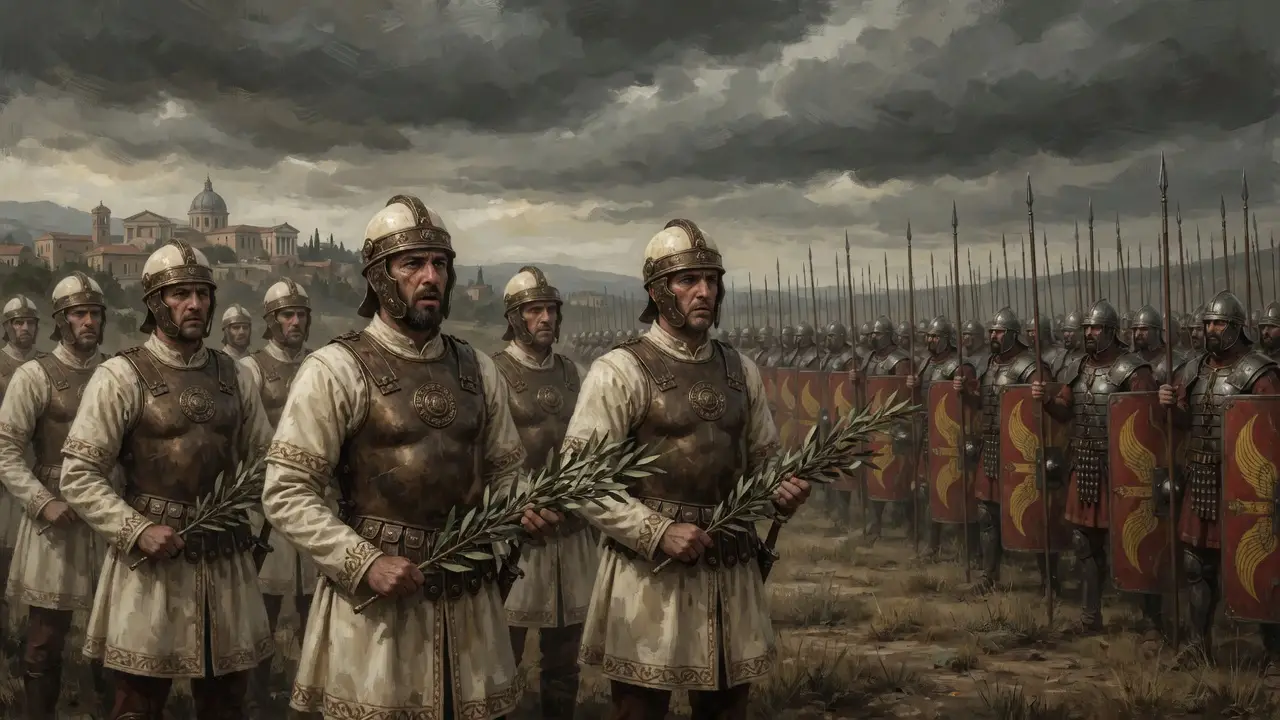
He summoned the Praetorian Guard to an assembly outside the city, framed as a ceremony of loyalty. He told them to leave their weapons behind and come in formal dress, carrying olive branches, a soldier’s traditional gesture of peace. They obeyed. It’s a strange kind of trust for men who’d recently sold an empire and murdered two emperors inside of a few months. His own legions surrounded them the moment they arrived. There was no fight. There didn’t need to be one.
He stripped the Guard of its armor and its standards on the spot, dissolved the unit that had sat at the center of Roman power for over a century and a half, and banned every former member from coming within a hundred miles of the city on pain of death. Then he built a new Guard from his own veterans along the Danube, men who owed their new privileges to him personally and had watched, from a safe distance, exactly what happens to a Guard that forgets its place.
LESSER-KNOWN DETAIL
Julianus’s winning bid, multiplied across roughly eight to ten thousand guardsmen, came out to something like 200 million sesterces. He never had that kind of money. It existed only as a number he shouted over a wall.
It was tidy political theater, decisive and nearly bloodless. It also solved nothing permanently. The new Guard eventually learned the same lesson the old one had. A future prefect named Macrinus would arrange the murder of Emperor Caracalla in 217. Another mutiny would kill Elagabalus in 222. It took more than a century, and a defeat at the Milvian Bridge in 312 AD, before Emperor Constantine finally disbanded the Guard for good and tore down the walls of the Castra Praetoria, the very fortress that had made all of it possible in the first place.
The Auction Never Really Closed
It’s tempting to read 193 AD as an isolated scandal, one ugly afternoon in eight centuries of Roman history. That undersells what actually happened. Rome had built an institution whose entire job was protecting the person at the top, and that institution had quietly figured out that protection and ownership aren’t the same thing. Once loyalty carries a price tag, someone eventually asks what the market will bear. The Guard didn’t invent that logic. They just said it out loud, in cash, in front of witnesses, at a wall.
LESSER-KNOWN DETAIL
This wasn’t the Guard’s first coronation-for-cash. In 41 AD, they killed Caligula and installed his terrified uncle Claudius, found hiding behind a curtain in the palace, for a matching cash bribe.
The uncomfortable part isn’t that Roman soldiers were unusually greedy. It’s that any organization built to guard power, whether it carries spears or sits on a corporate board or holds the keys to a modern government, eventually faces the same quiet temptation: the people meant to protect the system realize they could simply take it instead, or sell their protection to whoever pays best. Rome never solved that problem. It kept rebuilding the same trap under a new name and hoping the next set of guards would turn out differently.
They rarely did. An empire doesn’t usually fall because an enemy finally breaks down its gates. It falls because the men standing at the gates start wondering what the position is worth, and somebody, eventually, tells them.