The invention of writing had nothing to do with poetry, prophecy, or power. The world’s most transformative technology was created by accountants tracking grain and debt in ancient Mesopotamia, and that changes everything we think we know about civilization.
The World’s Oldest To-Do List
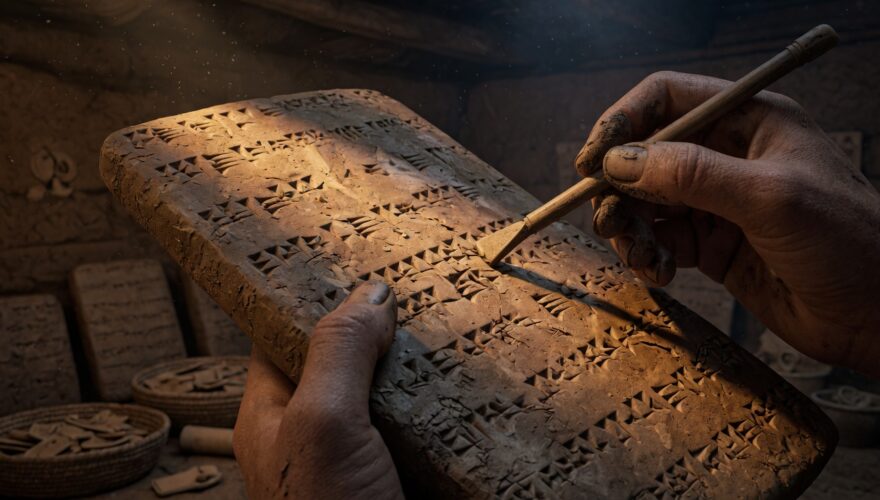
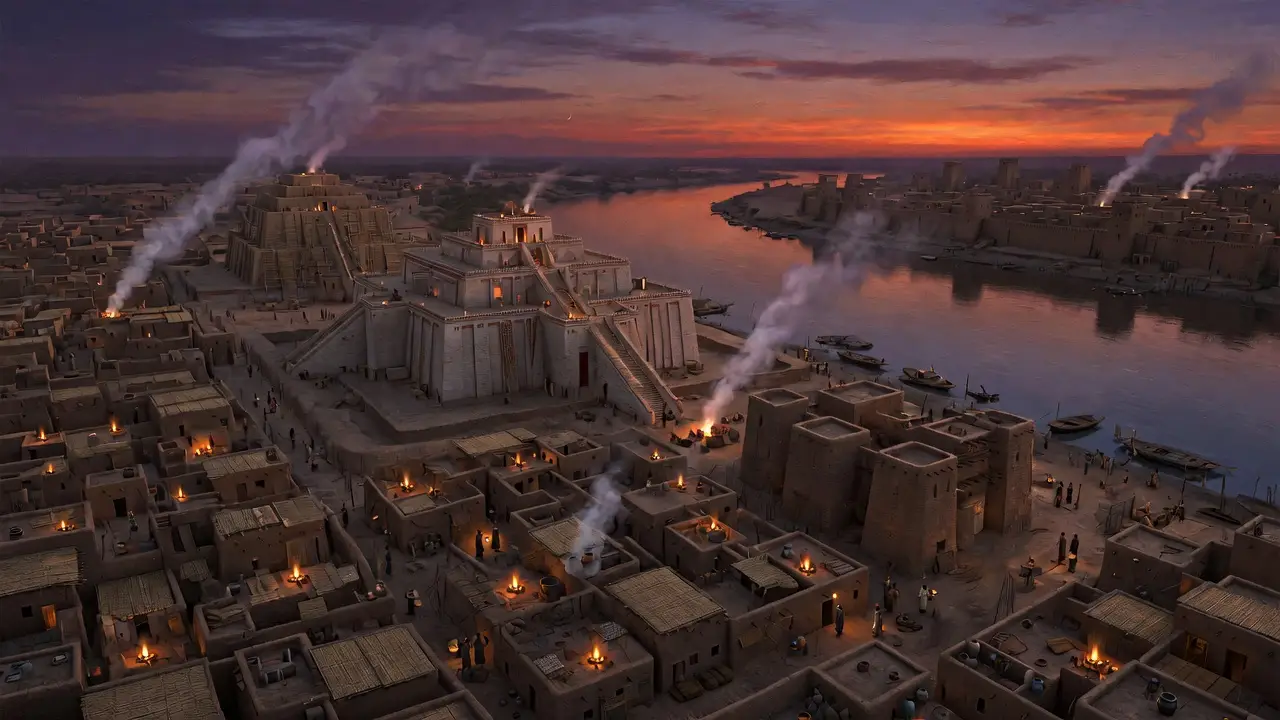
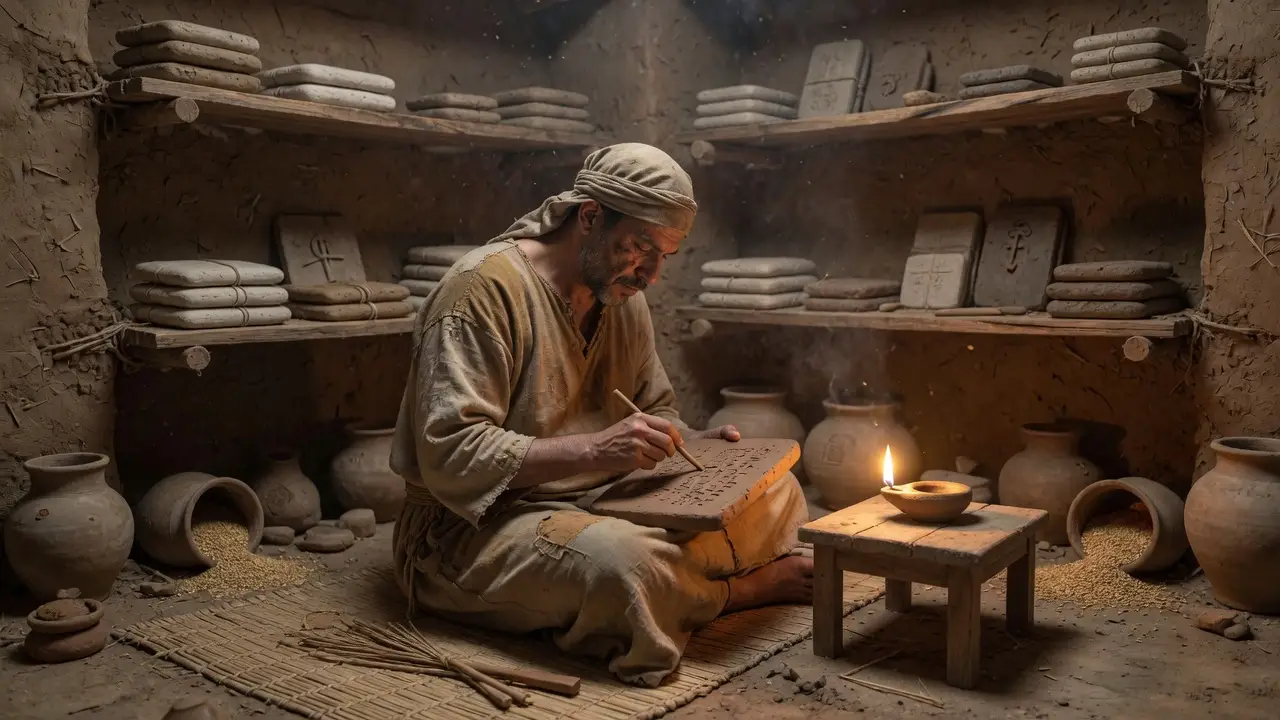
The year is approximately 3100 BCE. In the city of Uruk, the largest urban settlement on earth at the time, a teeming, noisy place of perhaps 50,000 people crammed along the banks of the Euphrates, a man named Kushim sits in a storage room and presses a reed into a lump of wet clay.
He is not writing a poem. He is not recording the words of a king. He is not preserving a vision from the gods.
He is doing inventory.
The marks he makes on that clay tablet, held today in the Schøyen Collection in Oslo, translate, roughly, to this: “29,086 measures of barley. 37 months. Kushim.” A delivery note. A grain ledger. A bureaucratic memo from the dawn of recorded history.
Kushim is almost certainly the oldest named individual in the history of the world. The first human being whose identity was preserved across millennia. And he was an accountant.
This is the story that gets left out of civilization’s origin myth. Writing, the technology that makes history itself possible was not the invention of a philosopher or a prophet. It was invented by people who needed to keep track of stuff.
A City That Outgrew Its Own Memory
To understand why writing emerged when and where it did, you have to understand what Uruk had become by the fourth millennium BCE.
It was, by ancient standards, a metropolis. A trading hub. A center of temple administration where enormous quantities of grain, wool, livestock, and oil moved through warehouses run by an increasingly complex priestly bureaucracy. Farmers paid taxes. Workers received rations. Merchants settled debts. The temple administered it all.
Join The Archive Briefing
Weekly dispatches. The history they didn't teach you — sourced, subverted, delivered to your inbox.
“A scribe who does not know Sumerian, what kind of scribe is he?”
Sumerian Proverb (c. 2000 BCE)
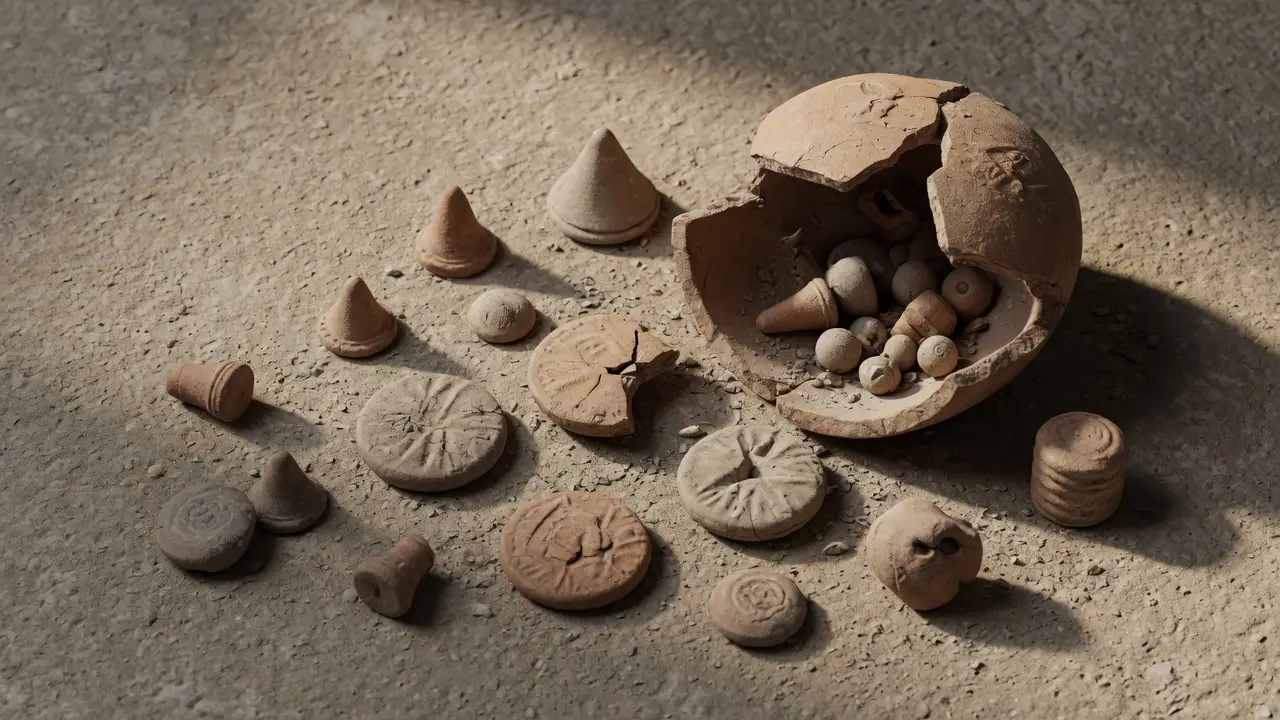
For thousands of years before writing, this kind of accounting ran on a system of small clay tokens — simple geometric shapes that stood for specific commodities. A cone meant a small measure of grain. A sphere meant a large one. A cylinder might represent an animal. These tokens were stored in hollow clay envelopes called bullae, sealed, and passed between parties as a form of record-keeping.
It worked. Until it didn’t.
As Uruk’s economy grew more complex, as trade routes extended further, as the range of goods diversified, as transactions multiplied, the token system buckled. You couldn’t track barley, wool, fish, pots, labor days, and debt obligations with a handful of clay shapes and hope everyone remembered what meant what.
Someone, somewhere, made a logical leap: instead of storing tokens inside a clay envelope, press their shapes into the outside of the clay. Instead of a physical object representing a quantity, make a mark that represents the object. The envelope became unnecessary. The mark became the record.
Writing was born not from inspiration, but from administrative desperation.
The Accountant’s Art
The earliest writing system, proto-cuneiform, the ancestor of what would eventually become Sumerian cuneiform was deliberately, almost aggressively limited. It could record numbers. It could record a fixed inventory of nouns: commodities, names, places. It had no verbs. No grammar. No way to express time, causation, or feeling.
It was not designed to tell stories. It was designed to prevent arguments about who owed what to whom.
The tablets from this period are strikingly uniform. Scholars have catalogued tens of thousands of them, and the overwhelming majority deal with the same narrow set of subjects: grain rations for workers, livestock counts, deliveries of raw materials, textile production outputs, beer allocations. (Beer appears constantly. The Sumerians ran on it, it was the standard wage for a large portion of the workforce, safer to drink than water, and produced in industrial quantities by temple breweries.)
“Do not pass judgment when you drink beer.”
From the Instructions of Shuruppak (c. 2600 BCE, one of the oldest known literary texts)
One tablet records the daily beer rations for workers constructing a temple wall. Another tracks the wool output from a flock of sheep over a full year. A third catalogs the number of fish delivered to a processing facility over 28 consecutive days.
The picture that emerges is not civilization’s poetic awakening. It is a spreadsheet. A very, very old spreadsheet.
The Slow Invasion of Language
Here is what is genuinely remarkable: for roughly five hundred years after its invention, writing in Mesopotamia remained entirely transactional. No one attempted to record speech. No one tried to write a sentence. The technology existed purely as an accounting tool, and the people using it apparently saw no reason to push further.
Then something changed.
Scribes began running into a specific problem: names. If you’re tracking grain deliveries, you need to record who made them. You can draw a picture of grain easily enough. But how do you write a person’s name? How do you write the name “Kushim,” which doesn’t correspond to any physical object?
The solution they hit upon was the rebus principle: use a picture not for what it shows, but for the sound of what it shows. In English, this would be like drawing a picture of a bee and an ankle to spell “Beowulf.” In Sumerian, scribes began repurposing logograms for their phonetic value. Signs that once meant specific things began to also represent syllables.
LESSER-KNOWN DETAILS
Kushim may not have been a person’s name at all. Some scholars believe “Kushim” refers to an office or position title rather than an individual,which would mean the oldest named human in history might actually be a job title. The uncertainty itself is worth mentioning.
This was the critical fracture point. The moment writing escaped the ledger and became capable of representing language, any language, any thought, any idea was not a sudden revolution. It was a slow, bureaucratic drift. Accountants needed to write names. Writing names required sound. Sound opened everything.
Within a few centuries, the same system that tracked barley and beer was being used to record law codes, mythological epics, hymns, medical texts, and astronomical observations. The Epic of Gilgamesh, arguably the oldest surviving work of literature was written in a script whose entire architecture was built around grain deliveries.
Egypt’s Parallel Discovery
Mesopotamia wasn’t alone. Around the same time, possibly slightly later, possibly independently, possibly with some indirect contact, Egypt developed its own writing system. And its origins followed the same pattern almost exactly.
The earliest Egyptian hieroglyphs appear not on temple walls but on small ivory and bone labels attached to grave goods, essentially ancient luggage tags for the tombs of early rulers at Abydos. They record names, numbers, and the origins of goods. They are, once again, administrative.
The romantic image of hieroglyphs as a sacred script of the gods, medu netjer, “words of god,” as the Egyptians called them, came later. The system was divine in retrospect. At birth, it was a bookkeeping tool dressed in pictures.
One of the earliest hieroglyphic inscriptions records the amount of oil and linen delivered to a tomb. Another catalogs the geographical origin of various luxury goods. Even in Egypt, where writing would eventually achieve some of the most visually spectacular forms in human history, it started with someone tracking shipments.
What the Clay Tablets Got Right
There’s a temptation to read the accountants’ role in writing’s invention as something diminishing, as if the technology’s transactional origins somehow reduce its later grandeur. But that reading gets it backwards.
The fact that writing was invented to solve a real, grinding, practical problem is precisely why it was so durable. Abstract inventions get abandoned when the culture shifts. Technologies born from necessity embed themselves in the infrastructure of daily life and refuse to die.
LESSER-KNOWN DETAILS
Scribes were among the most powerful people in ancient Mesopotamia, not soldiers, not priests, but the men (and occasionally women) who controlled the flow of written information. A king who couldn’t read was entirely dependent on his scribes to tell him what his documents said.
Writing survived because every merchant, every farmer, every temple administrator needed it to function. By the time anyone tried to write a poem, writing already had thousands of years of institutional momentum behind it. It wasn’t a luxury or an experiment. It was load-bearing.
The scribes who spent their careers recording grain yields and debt obligations were doing something they would never have described as historically significant. They were solving a problem in front of them. And in doing so, they gave every poet, historian, prophet, and philosopher who came after them a medium in which to exist.
The Weight of a Reed
Kushim’s tablet sits in a collection in Oslo. It is small enough to hold in one hand. The marks on it are shallow, almost casual, the work of someone who pressed the same shapes into clay thousands of times and thought nothing of it.
No one knows what Kushim looked like, what language he spoke at home, whether he had children, or what became of him. He is a name attached to a number, preserved entirely by accident, because the clay he wrote on happened to survive while everything else about him turned to dust.
LESSER-KNOWN DETAILS
The Sumerians wrote in two directions before standardizing. Early proto-cuneiform was written in columns from right to left and top to bottom. The script rotated 90 degrees sometime around 3000 BCE, and scholars aren’t entirely sure why.
He didn’t know he was inventing anything. He was doing his job.
That might be the most human thing about the whole story: civilization’s most consequential technology was created by someone who almost certainly never thought about civilization at all. He thought about barley. He thought about thirty-seven months of deliveries and whether the numbers matched.
They did. He wrote it down. And here we are.