
Napoleon’s two exiles weren’t just the result of lost battles. This is the story of how Europe’s most powerful banking houses, the Rothschilds, the Barings, the Hopes spent fifteen years undermining a man who had the audacity to build a financial system they couldn’t control. The military defeats were real. But the war behind the war was fought in counting houses, not on battlefields.
The bankers who moved money faster than armies could move men understood something terrifying: if Napoleon succeeded in breaking state dependence on private lenders, the old order of Europe might never recover.
This is the story of the emperor who conquered nations, challenged kings, and tried to take control of money itself. And it may explain why the most dangerous battle Napoleon ever fought was not at Waterloo, but against the people who controlled Europe’s purse strings.
The Man Who Knew Before the Generals Did
The battle wasn’t over when Nathan Mayer Rothschild learned the outcome of Waterloo. His courier network, faster and more efficient than anything Wellington’s army could deploy, had already carried the news across the Channel. While London still buzzed with rumors and Parliament braced for the worst, Rothschild stood on the floor of the Stock Exchange, face unreadable, and began selling. Other traders, watching the most connected financier in Europe unload his positions, panicked and followed. Consol prices collapsed.
Then, quietly, Rothschild bought everything back at the bottom.
By the time official dispatches confirmed Bonaparte’s defeat, the Rothschild family had multiplied their already staggering fortune many times over. It was the greatest single trade in the history of European finance, and it wasn’t an accident. It was the harvest of a decade-long strategy to ensure that one particular man never got his hands on the architecture of continental money.
Napoleon Bonaparte wasn’t brought down solely by Russian winters or the Duke of Wellington’s infantry. He was brought down because he had a plan for European finance that terrified the most powerful banking houses on earth, and they had both the resources and the patience to wait him out.
A Different Kind of Revolution
By 1800, France was financially ruined. The Revolution had destroyed public credit, emptied the treasury, and produced a currency so worthless that soldiers sometimes went unpaid for months. The Directory that preceded Napoleon was less a government than a slow collapse held together by inertia.
When Bonaparte seized power through the coup of 18 Brumaire, most observers assumed he would do what conquerors had always done: find a wealthy patron, negotiate loans from the established banking houses, and govern on borrowed credit at punishing interest rates. It was the European way. Monarchs had been doing it for centuries, and the great banking families, the Hopes of Amsterdam, the Barings of London, the early Rothschilds of Frankfurt had grown fat on the arrangement.
Join The Archive Briefing
Weekly dispatches. The history they didn't teach you — sourced, subverted, delivered to your inbox.
Napoleon did something unexpected. He studied the problem like a military campaign and concluded that French dependence on private lenders was a structural weakness as dangerous as any enemy army.
“There are only two powers in the world: the sword and the spirit. In the long run, the sword is always defeated by the spirit.”
Napoleon Bonaparte
In 1800, he co-founded the Banque de France. In 1803, he reorganized it to give the state meaningful control over credit and money supply. He banned compound interest in certain commercial arrangements, attacked usurious lending practices, and built a financial system designed explicitly to reduce the government’s exposure to private creditors. His Civil Code restructured contract law across territories he controlled, establishing legal frameworks that favored productive commerce over speculative finance.
“When a government is dependent upon bankers for money,” Napoleon reportedly said, “they and not the leaders of the government control the situation.”
He intended to change that equation permanently.
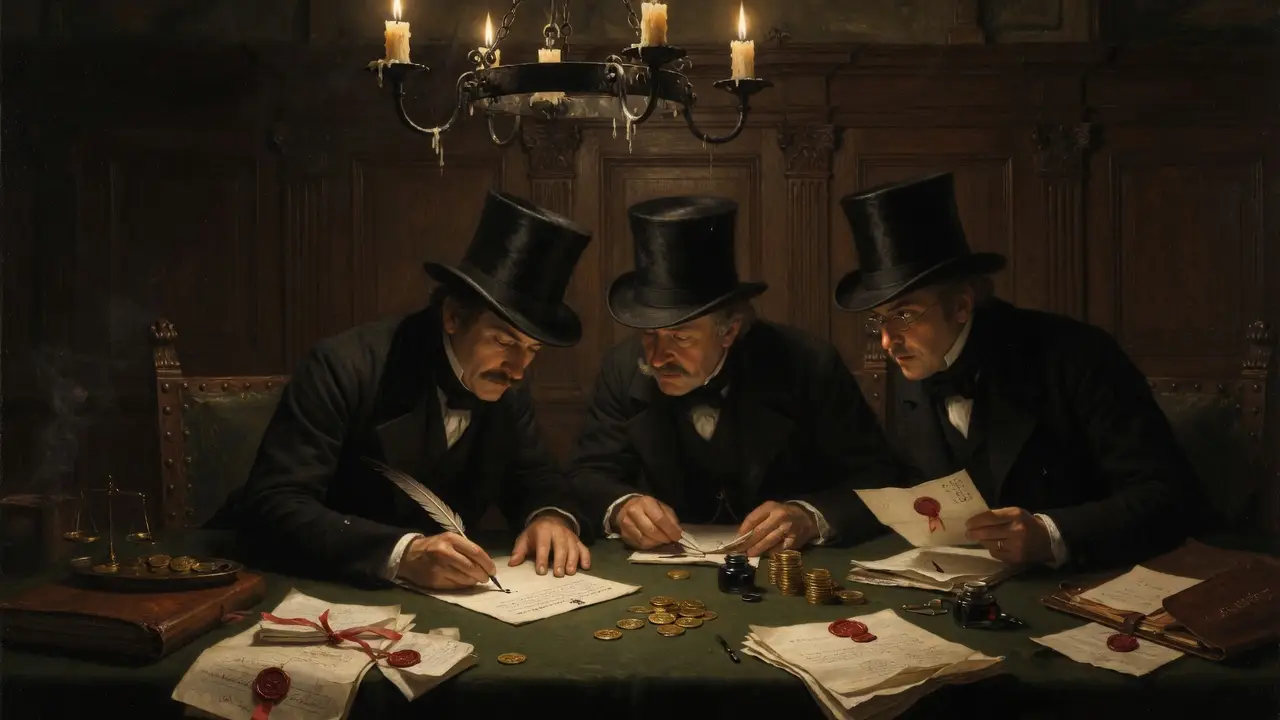
What the Counting Houses Saw Coming
The banking houses of Europe understood immediately what Napoleon was building. An independent French financial system, backed by state power and structured to minimize private debt, wasn’t just a French problem. France was the largest continental economy. If Bonaparte succeeded, the model would spread. The kingdoms and principalities that made up the patchwork of Europe were all, to varying degrees, clients of the same network of private lenders. A French example of sovereign financial independence was contagious.
The British government, perpetually at war with France, needed financing on an almost incomprehensible scale. The Rothschilds had already begun their ascent from Frankfurt coin dealers to the dominant force in European sovereign debt. Nathan, the most aggressive of the brothers, had moved to London in 1798 and was now deeply embedded in British war finance. His brothers James and Carl moved between Paris and the allied capitals, managing a network that could move gold across blockaded borders with a reliability no government could match.
I care not what puppet is placed upon the throne of England to rule the Empire on which the sun never sets. The man that controls Britain’s money supply controls the British Empire, and I control the British money supply.”
Nathan Mayer Rothschild
Their business model depended on instability. Wars required loans. Reconstruction required loans. The periodic financial crises that swept through European states when harvests failed or armies demobilized — all of it required loans, at rates that the lenders set. Napoleon’s system, if it matured, would begin to close those windows one by one.
The Continental System, Napoleon’s attempt to blockade British trade, was partly a military measure and partly a financial one. By shutting British goods out of European markets, he was also attacking the financial networks that moved with them. The effects were felt in counting houses from Lisbon to Hamburg.
The Hundred Days and the Point of No Return
The first exile to Elba in 1814 seemed to settle the matter. The allied powers installed the Bourbon monarchy under Louis XVIII, the Congress of Vienna convened to redraw Europe’s map, and the banking houses prepared to resume business as usual. The reconstruction of post-war Europe would require enormous loans. It was, from a purely financial perspective, an excellent outcome.
Then Napoleon escaped.
His return in March 1815 sent a different kind of panic through the courts of Europe than is usually described. Yes, there was fear of renewed war. But there was also a specific financial terror: if Bonaparte could retake France and consolidate his hold, the reforms he’d interrupted might resume. The Banque de France was still structurally his creation. His legal codes still governed commerce across territories that had briefly been under French influence. Given five years of peace, he might actually finish what he’d started.
The Hundred Days were never really about whether Napoleon could win militarily. He needed a negotiated peace, not a conquest. He wrote to the allied sovereigns suggesting exactly that. The letters were ignored. More telling, they were ignored almost before the ink dried, suggesting the decision had already been made at a level where military considerations were secondary.
“They have learned nothing and forgotten nothing.”
Talleyrand (on the Congress of Vienna)
Nathan Rothschild coordinated the financing of the Seventh Coalition with a speed that remains remarkable by any standard. Gold moved through his network to Wellington’s army in quantities and at velocities that no government treasury could have managed independently. He was, in a genuine operational sense, as responsible for putting Wellington’s army in the field as any minister of war.
“I don’t care what puppet is placed upon the throne of England to rule the Empire on which the sun never sets,” Rothschild allegedly said, in a quote whose exact wording has been debated but whose sentiment historians largely accept as genuine. “The man that controls Britain’s money supply controls the British Empire, and I control the British money supply.”
He was making the same point Napoleon had made, from the other side of the ledger.

Saint Helena: Where Dangerous Ideas Go to Die
Elba had been a mistake. It was close enough to the continent that escape was possible, and Napoleon still had enough prestige to rally support. Saint Helena, the volcanic British island in the South Atlantic, was chosen with a care that went beyond mere punishment. It was 1,200 miles from the nearest coastline. No one escaped from Saint Helena.
Napoleon spent his final six years there dictating his memoirs and shaping what would become the Napoleonic legend. He was acutely aware, in those final years, of what had actually undone him. His recollections returned repeatedly not to Waterloo or Moscow but to the question of money, credit, and the independence of states from private financiers.
LESSER-KNOWN DETAILS
Napoleon’s letters to allied sovereigns during the Hundred Days proposing peace negotiations were never formally answered, though they were received. The silence was diplomatic but deliberate.
“The hand that gives is above the hand that takes,” he observed late in his exile. “Money has no motherland; financiers are without patriotism and without decency; their sole object is gain.”
The Congress of Vienna, meanwhile, had reconstructed Europe in ways that would benefit the established banking order for generations. The Rothschilds emerged from the Napoleonic Wars as the dominant financial force on the continent, with brothers positioned in London, Paris, Frankfurt, Vienna, and Naples. The Hope family of Amsterdam, who had managed French state finances during Napoleon’s period and shifted their allegiances fluidly between regimes, retained their position. The Barings cemented their status as the premier house for British sovereign debt.
The financial architecture of post-Napoleonic Europe was, in essence, privately administered. Governments borrowed from these houses on terms these houses largely set. It was the system Napoleon had spent fifteen years trying to dismantle.
What the Textbooks Leave Out
There is a lesser-known detail from Napoleon’s financial administration that rarely makes it into popular histories: he personally supervised the Banque de France’s early operations with unusual intensity, attending board meetings that most heads of state would have delegated entirely. He understood credit mechanics with a precision unusual for a military man, and the system he built remained structurally sound even under the strains of continuous warfare, which itself tells a story about its design.
There is also the matter of the Ouvrard affair. Gabriel-Julien Ouvrard, a French financier of spectacular wealth and flexible loyalties, had financed French military operations and simultaneously maintained relationships with British banking interests. Napoleon eventually had him imprisoned, not for treason in the conventional sense but for exactly the kind of private financial manipulation that the Banque de France was meant to prevent. The episode illustrates how Napoleon understood the distinction between war as geopolitics and war as financial operation.
“If I had succeeded, I would have died the greatest man the world had ever seen. Having failed, I am accounted a monster.”
Napoleon at Saint Helena (recorded by General Gourgaud)
And then there is the Bourbon Restoration’s first act of financial policy: the immediate renegotiation of French state debt on terms that restored private banking houses to their traditional position as intermediaries. It happened within weeks of Napoleon’s first abdication. Whatever else Louis XVIII represented, he represented a return to the old credit relationships, and the speed of that return suggests it was a condition of the restoration, not a coincidence.
The Long Shadow
Napoleon’s financial ideas didn’t die on Saint Helena. They resurfaced in the debates of the nineteenth century about central banking, sovereign credit, and the proper relationship between states and private money. The arguments he made, and the system he briefly built, influenced later thinkers who grappled with the same tension between democratic governance and financial power.
LESSER-KNOWN DETAILS
The Banque de France, co-founded by Napoleon in 1800, remains structurally intact today with modifications. Its founding charter was essentially his creation.
Every modern debate about central bank independence, sovereign debt restructuring, or the political influence of financial institutions carries, somewhere in its genealogy, the unresolved questions that Bonaparte posed and that the banking houses of Europe answered by exiling him twice.
The man who conquered most of Europe couldn’t conquer the money.
And that, more than any battle, is why his story keeps refusing to end.