From the Roman legions who were paid in it, to the French peasants who were imprisoned for smuggling it, to Gandhi’s defiant walk to the sea, salt shaped empires, funded revolutions, and proved that controlling a basic necessity is the oldest form of power. This is the full, dark history of white gold.
In the spring of 1930, a 60-year-old man in a white shawl walked 240 miles across India under a burning sun. He was not an army general. He carried no weapons. He led no cavalry charge. He was walking to the sea to pick up salt.
The British Empire, the most powerful political force on earth at that moment watched this slow march with growing unease. They had reason to be afraid. That man was Mahatma Gandhi, and he understood something the empire had perhaps forgotten about itself: the most dangerous act of rebellion is not always the loudest one.
Sometimes, it is the simplest one. Salt. That white crystalline substance you shake over your dinner without a second thought had, for most of human history, the power to make kings rich, break the backs of the poor, and ignite revolutions. This is that story.
Before Refrigerators, There Was Salt
Strip away modern technology and ask yourself: how do you keep food from rotting? In a world without refrigeration, the answer, for thousands of years, was salt. It drew moisture out of meat and fish, denied bacteria the conditions they needed to thrive, and turned what would have been a perishable meal into something that could survive months of travel, war, or winter.
Salt did not merely season food. It was the original preservation technology. Every army marched on it. Every navy depended on it. Every city that wanted to feed itself through a hard winter hoarded it.
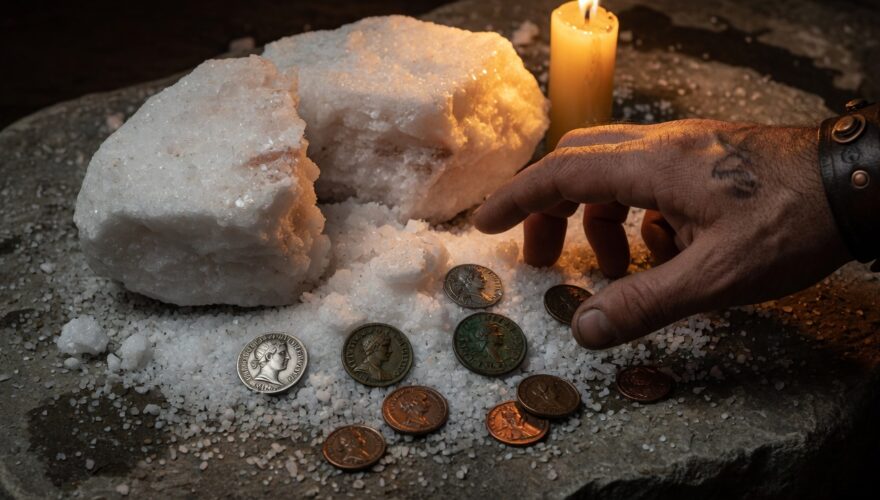
The Roman legions received part of their pay in salt — that is, after all, where we get the word “salary,” from the Latin salarium. For most of human civilization, to control the salt supply was to control life itself.
The Geography of Power
Salt does not exist everywhere in equal measure. It pools in specific places, coastal flats, underground deposits, dried lake beds and that geographic reality meant whoever sat atop a salt source held extraordinary leverage over everyone else.
The ancient Chinese state recognized this early. As far back as the 7th century BC, the philosopher-statesman Guan Zhong advised the Duke Huan of Qi to nationalize salt production. His argument was elegant in its brutality: every person needs salt to survive, so tax it and you tax the entire population without them being able to refuse or escape.
You cannot grow salt in a garden. You cannot substitute something else. It is one of the few commodities in history where demand is genuinely inelastic.
The Chinese salt monopoly that followed this advice endured, in various forms, for over two thousand years. At its height, salt revenues funded imperial armies, palace construction, and the vast bureaucratic machinery of successive dynasties. Historians estimate that at certain points in Chinese history, salt taxes accounted for more than half of total government revenue.
Join The Archive Briefing
Weekly dispatches. The history they didn't teach you — sourced, subverted, delivered to your inbox.
The sea is the source of salt, and salt is the source of wealth.”
Guan Zhong, 7th century BC Chinese statesman
Meanwhile, in Venice, merchants grew rich beyond imagination by controlling the salt trade routes of the Mediterranean. The city-state that would eventually become one of the most powerful in Europe built its early fortune not on art or banking, but on salt.
Venetian ships moved salt from Adriatic deposits to markets across the known world, and the profits funded everything else. Venice once went to war with Genoa specifically over salt trade routes. The War of Chioggia, fought in the late 14th century, was ostensibly about sea power and commercial dominance, but at its core it was a salt war. Venice won. And Venice grew.

The Tax That Broke France
If you want to understand how a mineral can topple a monarchy, look at France in the decades before 1789.
The gabelle, France’s salt tax, was one of the most reviled institutions in European history, not merely because it was expensive, but because of the grotesque inequality with which it was applied. Different regions of France paid wildly different rates. Some provinces were exempt entirely. Nobles and clergy paid nothing. The burden fell, as it almost always does in corrupt tax systems, on those least able to bear it.
But the gabelle had an even more sinister feature. In many parts of France, citizens were legally required to purchase a minimum annual quota of salt from the crown’s official monopoly sellers, the greniers a sel. This was not voluntary. Families who could not afford their quota were still legally obligated to buy it. Failure to comply was a criminal offense.
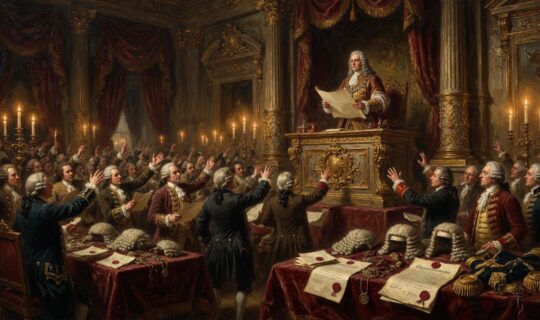
The French salt police, and yes, there were salt police, were called the gabelous. They had the power to enter homes, inspect kitchens and cellars, and arrest anyone suspected of using unsanctioned salt. Smuggling salt was punishable by forced labor in the royal galleys. At least three thousand people per year were imprisoned for salt crimes in 18th-century France.
“The gabelle is a tax on the necessities of life, collected from the poor with a harshness unknown to any other levy.”
Arthur Young, English agricultural writer, Travels in France, 1787-1789
When the Revolution came in 1789, the abolition of the gabelle was one of the first acts of the new government. The crowds that stormed the Bastille were not just angry about bread. They were angry about salt.
Soldiers, Armies, and the Salt Line
The relationship between salt and military power is older than most nations. Roman soldiers were partially paid in salt or given a salt allowance, the salarium, because keeping an army fed and preserved in the field was a logistical problem that salt uniquely solved. Dried and salted meat could travel. Fresh meat could not. The difference between a well-salted army and an unsalted one, on a six-month campaign, was the difference between a fighting force and a dying one.
During the American Civil War, the Union made deliberate, strategic attacks on Confederate salt works, particularly the massive operations at Saltville, Virginia. The reasoning was direct: destroy the South’s ability to preserve food, and you destroy its army’s capacity to fight. Salt works were treated as military targets of the highest priority.
Less well known is the role of salt in the American Revolution itself. The British blockade of American ports was not only aimed at cutting off gunpowder and weapons. It was aimed at cutting off salt.
Washington’s army at Valley Forge in the winter of 1777- 1778 was not just suffering from cold and hunger in the conventional sense. They were suffering from the near-total collapse of their food preservation system. Meat rotted. Soldiers starved. Salt, or the lack of it, nearly ended the revolution before it could succeed.
“We have no salt, and the army is in a most deplorable condition for want of it.”
General George Washington, letter to the Continental Congress, 1777

Gandhi’s Walk and the Empire’s Weakness
The British Empire’s salt monopoly in India was a masterwork of colonial extraction. Indian salt had been traded freely for centuries before British rule. Under the East India Company and later the Crown, that changed entirely. Salt production was regulated, taxed, and eventually monopolized. Indians were forbidden from collecting or producing salt independently, even from the sea that washed their own coastline. They were forced to buy it, at inflated prices, from British-controlled sources.
By 1930, the salt tax represented a disproportionate share of the income of India’s poorest citizens. It was not the largest tax in the colonial system, but it was the most intimate one. Everyone needed salt. Everyone felt it. Gandhi’s genius was recognizing that this was the perfect point of leverage. He did not attack the entire imperial system at once. He walked to the sea and picked up a handful of salt.
That single act, technically illegal under British law, was simultaneously a defiance of colonial authority and an act every Indian could understand and replicate immediately.
Within weeks, millions across India were making their own salt, marching to the sea, defying the law in the most peaceful and unglamorous way imaginable. The British response: mass arrests, beatings of nonviolent protesters, international press coverage of the brutality, did more to undermine the moral authority of the empire than any guerrilla campaign could have.
The Salt March did not immediately end British rule in India. But it cracked the psychological foundation of the empire. It demonstrated, in terms the entire world could grasp, that an empire built on the taxation of basic human necessities was not a civilizing force. It was an extraction machine.
“It is the most extraordinary revolution in history. A man has gone to pick up salt by the seashore, that, at this moment, is shaking the British Empire.”
Henri Barbusse, French writer and journalist, 1930
Things You Were Never Told
The city of Salzburg, one of Austria’s most beautiful, literally means “Salt Castle.” The city was built around and funded by the salt trade from the nearby Hallstatt mines, which have been mined continuously since at least 1200 BC, making them among the oldest salt mines in the world.
In Hallstatt itself, archaeologists discovered the preserved body of a prehistoric miner in the 19th century, perfectly mummified by the salt in which he had been buried since roughly 1000 BC. His clothes, tools, and even his last meal were intact. Salt had preserved him better than any Egyptian embalmer.
In medieval West Africa, the salt trade was so lucrative that Malian caravans traded gold for salt ounce-for-ounce. In the Saharan interior, salt was literally worth its weight in gold. The Timbuktu empire built much of its extraordinary wealth on controlling the routes between gold-producing southern regions and salt-producing northern ones.
The phrase “not worth his salt”, meaning someone is incompetent or unreliable, comes directly from the Roman practice of paying soldiers in salt. If a soldier was not worth his salt, he was not earning his pay.
In the Ethiopian highlands, blocks of salt called “amole” were used as currency well into the 20th century. The uniformity and durability of salt made it an ideal monetary instrument in regions without access to metal coinage.

The Weight of Small Things
There is something almost absurd, in retrospect, about how much blood was spilled over something you can buy in a grocery store for thirty cents. But that absurdity is the point.
Salt was not valuable because it was rare in absolute terms. It was valuable because it was essential, and because the people who controlled essential things have always found ways to extract maximum profit from those who had no alternative. The history of salt is, in that sense, the history of power itself: who has it, how they keep it, and what ordinary people eventually do when the weight of it becomes too much to bear.
Every salt revolt, every salt war, every salt march was fundamentally the same story. A government or empire decided that a basic human necessity was an opportunity for revenue. It built a system to enforce that extraction. It made the system more intrusive and punitive over time. And eventually, something snapped.
The French peasant who smuggled salt across a provincial border and faced the galleys for it. The Indian villager who walked to the sea with Gandhi. The American revolutionary soldier freezing at Valley Forge because his meat had no preservative. They were all caught in the same mechanism, centuries apart.
The Lesson in the Grain
Today, in most of the world, salt is so cheap it barely registers as an expense. The monopolies are gone. The salt police are gone. The gabelle is gone. We won, in that sense.
But the logic that created those systems never went away. Governments still identify the things people cannot live without and find ways to tax them, control them, or profit from them. The commodity changes. The mechanism does not.
That is why Gandhi’s march still carries weight that goes far beyond Indian independence. It was a reminder that when a government taxes necessity itself, when it turns survival into a revenue stream, it has already lost the moral argument. The only question remaining is how long people will tolerate it before someone decides to walk to
the sea.
Salt built empires. Salt broke them too.