How the printing press triggered a century of religious war, mass hysteria, and political violence before it sparked the Enlightenment. The story of the most dangerous technology in European history and what it reveals about information without infrastructure.
The Machine That Broke the World First
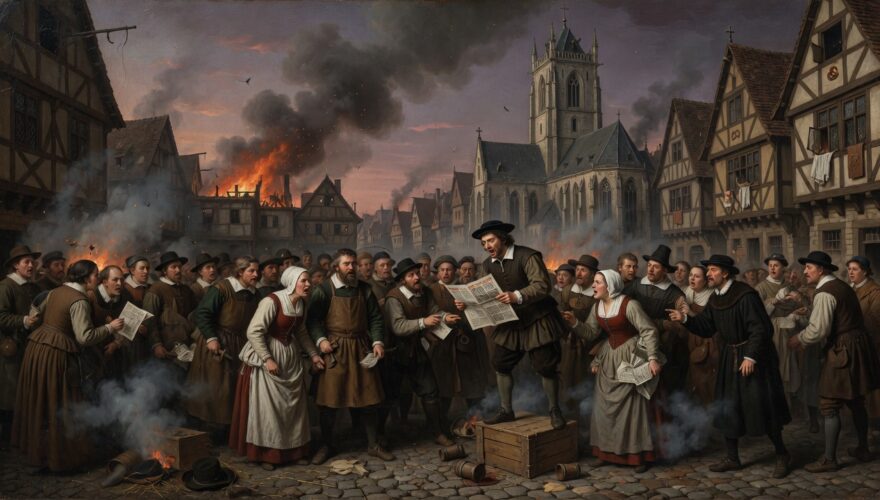
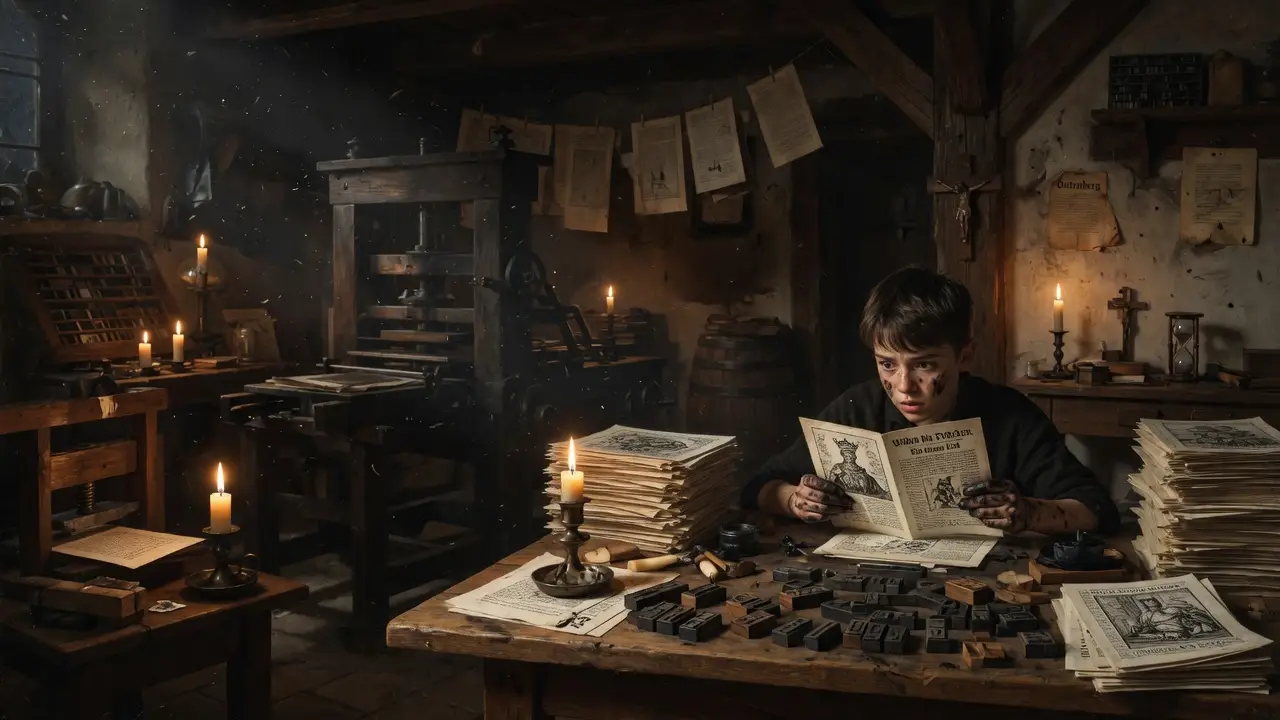
In the winter of 1521, a German peasant named Hans walked into a local tavern and heard something that would have been impossible ten years earlier. A man at the bar was reading aloud from a pamphlet. Not scripture. Not a royal decree. A man’s opinion. Printed. Copied. Distributed. Forty pages, sharp as a blade, accusing the Pope of being the Antichrist.
Hans couldn’t read. But he could listen. And so could everyone else in that room.
Within months, similar scenes were playing out across Germany, France, Switzerland, and the Low Countries. Ideas that previously took decades to travel now moved in weeks. And not all of those ideas were enlightened. Many of them were incendiary. Within a generation, Central Europe would be drowning in blood over the contents of documents that Gutenberg’s press had made impossible to suppress.
We tell the story of the printing press as a triumph. It was. But first, it was a catastrophe.
A Weapon Looking for a War
Johann Gutenberg finished his press around 1440 in Mainz. Within fifty years, there were over a thousand printing shops across Europe, producing roughly eight million books. To put that in perspective: in all the centuries prior, European scribes had produced perhaps a few hundred thousand manuscripts total.
The gatekeepers of knowledge, the Church, the universities, the royal courts, had spent a thousand years controlling what was written, who could read it, and who had access to both. That entire system collapsed in roughly half a century. Nothing replaced it.
“I did not plan or wish for this to go so far… the fault lies with those who have made use of these writings beyond what was proper.”
Martin Luther (1520), on the pamphlet wars
That’s the part people forget. There was no new infrastructure. No framework for verifying what was true. No established way of deciding whose printed words deserved trust. Just an avalanche of text hitting a population that was largely illiterate, deeply superstitious, and primed by centuries of religious tension.
The press didn’t create Europe’s fault lines. It just handed everyone a torch and told them to go find them.
Join The Archive Briefing
Weekly dispatches. The history they didn't teach you — sourced, subverted, delivered to your inbox.
Luther’s Match
On October 31, 1517, Martin Luther nailed his Ninety-Five Theses to the door of the Wittenberg Castle Church. It was a standard academic challenge, the kind of thing theologians did. He expected a debate among scholars.
What he got instead was a printing explosion.
Within two weeks, copies of the Theses had spread across Germany. Within two months, they had reached England and Italy. Luther hadn’t planned this. He reportedly said he would have spoken “more softly and carefully” had he known what was coming. But the press didn’t care about his intentions. It reproduced his words exactly as written and sent them into a world with no mechanism to contextualize them.
“From this swarm of new books, the world is plagued with a new kind of pest.”
Erasmus of Rotterdam (c. 1525), on the chaos of print
The Catholic Church responded with its own printed documents, condemning Luther. Luther’s followers printed counter-responses. Satirical woodcuts mocking the Pope circulated alongside actual theological arguments. Readers with no training in doctrine couldn’t easily distinguish between a serious reformer and a radical apocalyptic street preacher. In print, they all looked the same.
Between 1518 and 1525, Luther alone produced roughly five hundred publications. His opponents produced hundreds more. By the time serious theological dialogue might have contained things, the fire had already jumped the firebreak.
The German Peasants’ War of 1524 killed an estimated one hundred thousand people. Many of the rural men who took up arms believed they were acting on Luther’s own words, misread, stripped of nuance, and filtered through dozens of pamphlet authors who had their own agendas. Luther was horrified. He published a response condemning the peasant uprising with brutal language. That pamphlet spread just as fast.
The Witch Hunts and the Power of Printed Panic
The Reformation wars are the most well-known chapter of this story. They aren’t the only one.
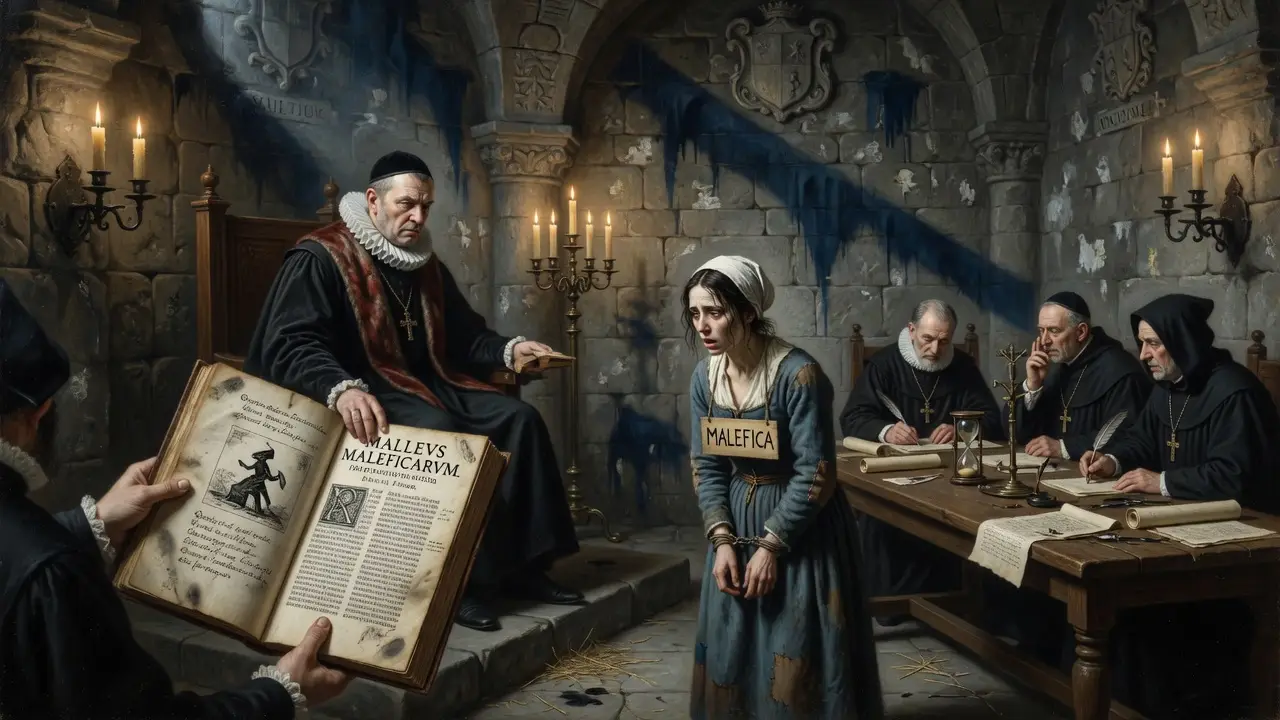
In 1487, two Dominican friars named Heinrich Kramer and Jacob Sprenger published a book called the Malleus Maleficarum, or “The Hammer of Witches.” It was, in essence, a manual for identifying, prosecuting, and executing witches. Scholars had written about witchcraft before. But those manuscripts had lived in monastery libraries, accessible to almost no one.
The Malleus got printed.
“The printing press, gunpowder, and the compass these three have changed the appearance and state of the whole world.”
Francis Bacon (1620), Novum Organum
By 1520, it had gone through fourteen editions. By 1600, around thirty. It became the second-best-selling book in Europe after the Bible. Judges carried it into courtrooms. Inquisitors quoted from it during interrogations. It provided a procedural framework for conducting witch trials at a time when local magistrates had no other standardized legal guidance.
Historians estimate that between 1450 and 1750, roughly forty to sixty thousand people were executed for witchcraft across Europe. The curve of those executions tracks almost precisely with the spread of the printing press and the proliferation of witch-hunting literature.
The press didn’t invent the fear of witches. But it industrialized it.
What Ran Faster Than Truth
One of the stranger lesser-known stories from this era involves a pamphlet published in Germany in 1493, just a few decades after Gutenberg. It claimed that a race of monsters was living in the newly discovered lands across the Atlantic: men with their faces on their chests, dog-headed beings, people who fed on human flesh.
Christopher Columbus had just returned from his first voyage. Actual information about the Americas was scarce and slow. The pamphlet moved faster. It circulated across Europe and shaped public understanding of indigenous peoples for decades, feeding narratives that would later be used to justify conquest and enslavement.
LESSER-KNOWN DETAILS
Gutenberg himself died nearly broke. His primary financier, Johann Fust, sued him and took the press. The man who changed the world couldn’t profit from it.
No one fact-checked the monsters. There was no mechanism to do so.
This is the pattern that repeats across the entire first century of print: the sensational outruns the accurate, the simple outruns the complex, and the emotionally charged outruns the considered. Sound familiar?
The Moment It Started to Turn
The turning point didn’t come from a single event. It came slowly, through exhaustion.
After a century of religious war, plague, witch trials, and political revolution fed in part by uncontrolled information, European society began building new scaffolding around the press. Slowly, universities updated their curricula to account for a world where anyone could publish. Legal systems developed libel frameworks. The scientific community invented peer review, not as an academic nicety, but as a survival mechanism against an ocean of printed misinformation about medicine, astronomy, and natural philosophy.
Literacy rates climbed. As more people could read for themselves, the single voice reading aloud in the tavern lost some of its power. Critical distance became possible where before there had been only reception.
LESSER-KNOWN DETAILS
Many of the most inflammatory pamphlets of the Reformation were printed anonymously, not because the authors feared God, but because they feared prosecution. Anonymity in media is as old as the press itself.
By the mid-1600s, the first newspapers emerged, flawed and partisan, but at least attempting something like regular, verifiable reporting. Francis Bacon argued for systematic evidence. René Descartes published his method of radical doubt. These weren’t just philosophical exercises. They were responses to a world that had nearly torn itself apart because it had no agreed-upon way of deciding what was true.
The Enlightenment, often credited as the great gift of the printing press, was actually the long, painful recovery from the press’s first century.
What Gutenberg Actually Gave Us
The printing press ultimately delivered everything we credit it with: the democratization of knowledge, the Scientific Revolution, the rise of literacy, the foundations of modern democracy. None of that is wrong.
But that story is incomplete without the other half. The first century of print produced more religious wars, mass hysteria, and political violence than the previous five combined. It amplified every existing prejudice, handed megaphones to demagogues, flattened nuance into slogans, and spread panic at a speed that institutions couldn’t match.
The technology was neutral. The world it landed in was not.
LESSER-KNOWN DETAILS
The Catholic Church’s response, the Index Librorum Prohibitorum (the Index of Forbidden Books), was itself a printed document. They used the press to ban the press.
There’s a reason historians use the phrase “the press as a cause” when discussing the Reformation, the witch trials, and the Thirty Years’ War. Not the only cause. But a cause. A force multiplier for everything already brewing beneath the surface.
What saved Europe wasn’t the press itself. It was the slow, grinding work of building systems capable of living with the press: literacy, critical thinking, legal frameworks, scientific method, journalism. Infrastructure. The kind of infrastructure that takes generations to build and can be dismantled shockingly fast.
The Question Gutenberg Couldn’t Answer
Hans, the illiterate German peasant in that tavern, eventually died in the upheaval that followed. Whether he fought in the Peasants’ War, was caught up in religious persecution, or simply lived and died in the chaos of the era, history doesn’t record his name or his fate. He’s a composite of ten thousand men like him, men who encountered the press not as liberation but as confusion, weaponized in someone else’s hands.
The printing press gave Europe the tools to eventually build a better world. But the tools arrived long before the wisdom to use them.