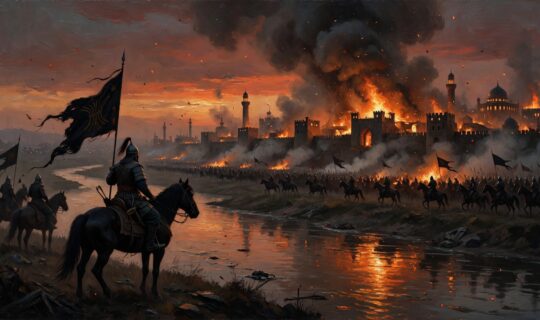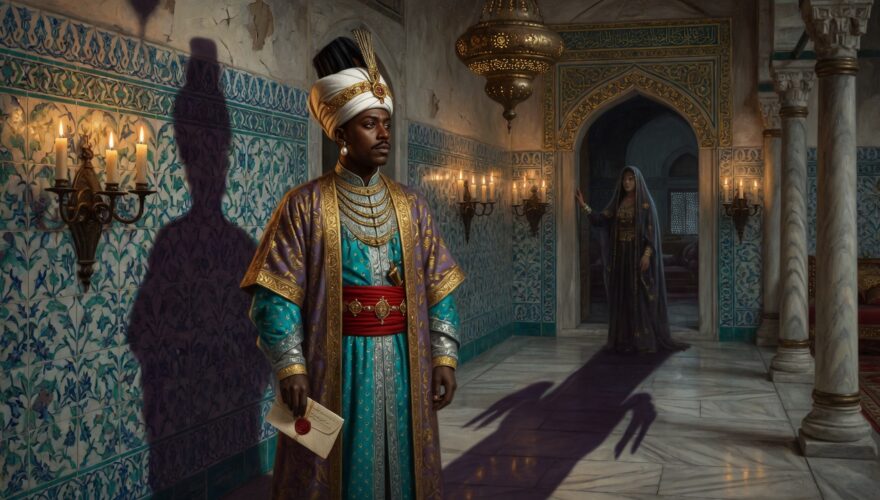
Eunuchs were created to be controlled. Stripped of family lines, heirs, and traditional claims to power, they were meant to serve rulers without becoming rivals. In theory, they were the perfect servants: loyal, dependent, and politically harmless. But history has a habit of turning cruel systems against their creators. The men designed to have no dynasty of their own became masters of dynasties built by others.
A Knife, a Throne, and a Calculated Bet
The year is 968 AD. In the vast bureaucratic labyrinth of the Byzantine imperial palace, a man named Basil Lekapenos sits at the center of everything. He controls the treasury. He appoints generals. He whispers into the emperor’s ear and watches rivals disappear. He has held this position for decades, surviving the reigns of multiple emperors the way a spider survives storms — by staying very still and knowing exactly where every thread of the web leads.
He is also a eunuch. And that is precisely why he is trusted with all of it.
This was not an accident, and it was not a kindness. It was a cold calculation made by dynasties across three continents over more than a thousand years: a man who cannot father children cannot found a rival dynasty. Give him power, and he has nowhere to take it except back to you.
What those dynasties got, however, was not always what they bargained for.
The Logic of the Cut
To understand how castrated men came to run some of history’s most powerful empires, you have to understand what terrified rulers more than foreign armies: their own courts.
Every general who won a battle was a potential usurper. Every nobleman who accumulated wealth had sons who might one day want the throne. The palace was not a safe place. It was a slow-motion civil war dressed in silk.
“He who controls the inner court controls the empire.”
Common saying among Tang Dynasty officials, recorded in court documents
Eunuchs solved a specific problem. They could be educated, trusted with sensitive information, and placed in proximity to the emperor and his family, including the women’s quarters, without the usual threats that came with male ambition. They couldn’t inherit. They couldn’t build family empires. They were, in theory, permanently loyal because they were permanently dependent.
In practice? Some of them became the most dangerous men in history.
Join The Archive Briefing
Weekly dispatches. The history they didn't teach you — sourced, subverted, delivered to your inbox.
China: When the Knife Goes Too Deep
The Chinese imperial court produced eunuchs of staggering influence, none more consequential than Zheng He and none more terrifying than Wei Zhongxian.
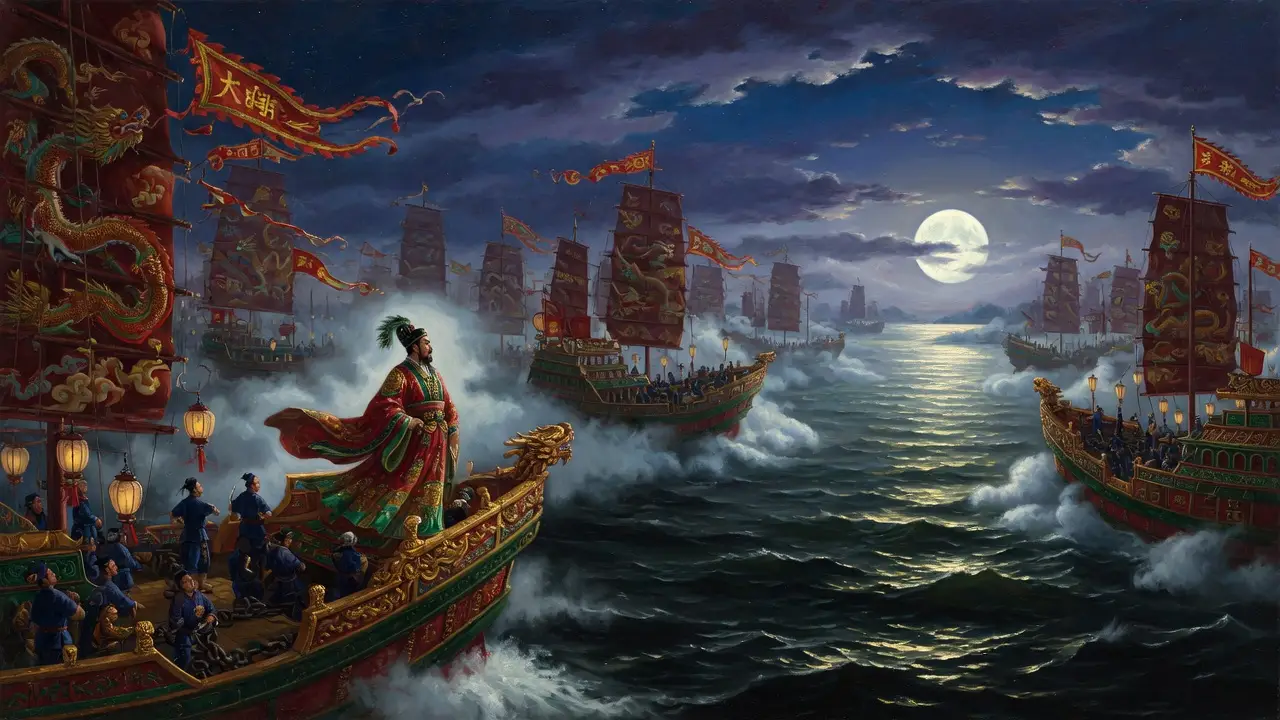
Zheng He is the famous one. A Muslim from Yunnan, castrated after being captured as a boy during a military campaign, he rose through the Ming court to become Admiral of the Treasure Fleet. Between 1405 and 1433, he commanded armadas that dwarfed anything Europe would produce for another century. Sixty-two massive treasure ships. Over 27,000 men. Seven voyages across Southeast Asia, India, the Persian Gulf, and the east coast of Africa. He was not a shadow figure. He was the face of Chinese imperial ambition, sailing under the dragon banner of the Yongle Emperor with a mandate to show the world what the Middle Kingdom was.
But Zheng He was the exception in the eunuch story. The rule was Wei Zhongxian.
Wei Zhongxian entered the palace as a middle-aged man who had voluntarily castrated himself to escape gambling debts. Let that sit. He was functionally illiterate. He had no scholarly credentials, no military background, no noble lineage. What he had was an instinct for survival that bordered on supernatural and a relationship with the Tianqi Emperor that functioned, in the words of historians, less like servant and master and more like a man and his shadow.
By 1624, Wei Zhongxian controlled the secret police, the military, the civil appointments, and the court’s moral climate. Officials who refused to submit built shrines to him in their provinces while he was still alive. He was referred to in official documents as “the Nine Thousand Years”, a deliberate echo of the emperor’s title of “Ten Thousand Years.” He was, for all practical purposes, the Emperor of China. One man short of a title.
“They were neither men nor women, but something in between and precisely for that reason, they could go everywhere and know everything.”
Procopius, Byzantine historian, describing eunuchs in the imperial court
When the Tianqi Emperor died in 1627, his successor took three months to destroy Wei Zhongxian entirely. The new emperor, Chongzhen, was seventeen years old. It took him three months to dismantle what Wei had spent a decade building. Wei committed suicide before he could be executed, but the damage he left behind, a bureaucracy gutted, a military hollowed out, a state apparatus built around one man’s paranoia, contributed directly to the collapse of the Ming Dynasty seventeen years later.
One eunuch. One dynasty. Gone.
Byzantium: The Man Who Was More Emperor Than the Emperor
Basil Lekapenos, the man in our opening, was the illegitimate son of Emperor Romanos I, castrated as a child to remove him from the line of succession. A cruel irony: the operation meant to neutralize him became the thing that positioned him for real power.
He served as parakoimomenos, the emperor’s chamberlain, literally “the one who sleeps beside”, under three different emperors spanning forty years. He managed the Byzantine bureaucracy with the efficiency of a man who understood that systems outlast personalities. While emperors came and went, Basil remained. He accumulated land, wealth, political allies, and information, especially information.
“The eunuch is a shadow with teeth.”
Persian court proverb, recorded in Safavid administrative manuals
When Emperor John I Tzimiskes died in 976, likely poisoned, Basil was the dominant political force in Constantinople. He governed the empire during the minority of Basil II, the boy who would eventually become one of Byzantium’s greatest rulers. The young emperor grew up watching his namesake operate, and what he saw was an education in how power actually works.
When Basil II finally moved to strip the older man of his wealth in 985, the confiscated estates were staggering. Basil Lekapenos, the man who could never be emperor, had quietly become the richest private individual in the Byzantine world.
The historian Leo the Deacon wrote of court eunuchs with barely concealed disgust, calling them “a third kind of human being.” But that third kind of human being was running the empire while Leo was busy writing about it.
The Ottoman Machine: Kösem, Süleyman, and the Harem’s Iron Hand
The Ottoman system elevated eunuch power to institutional architecture.
The Kapi Agha controlled access to the sultan. The Kislar Agha, the Chief Black Eunuch, ran the imperial harem, which was not as European imagination preferred to picture it, a pleasure palace. The harem was the administrative heart of the Ottoman succession system. Mothers of princes, valide sultans, women of extraordinary political sophistication competed and maneuvered within those walls, and the Kislar Agha was their gatekeeper, their messenger, their enforcer, and sometimes their ally.
During the seventeenth century, as a succession of weak sultans blurred the lines between power and ceremony, the Kislar Agha became one of the most powerful figures in the empire. He controlled correspondence between the harem and the outside world. He managed the wealth of the female members of the dynasty. He decided who got access to the sultan.
Information is power. The Kislar Agha had all of it.
One telling detail that rarely makes it into standard histories: African eunuchs serving in the Ottoman harem were frequently given Islamic educations of considerable depth. Some became respected scholars. The position of Kislar Agha came with enough income and influence that men competed fiercely to place favorites in the role. The “powerless” slave administrator was, in practice, holding one end of a rope that controlled the entire imperial household.
The Cut That Couldn’t Contain Them
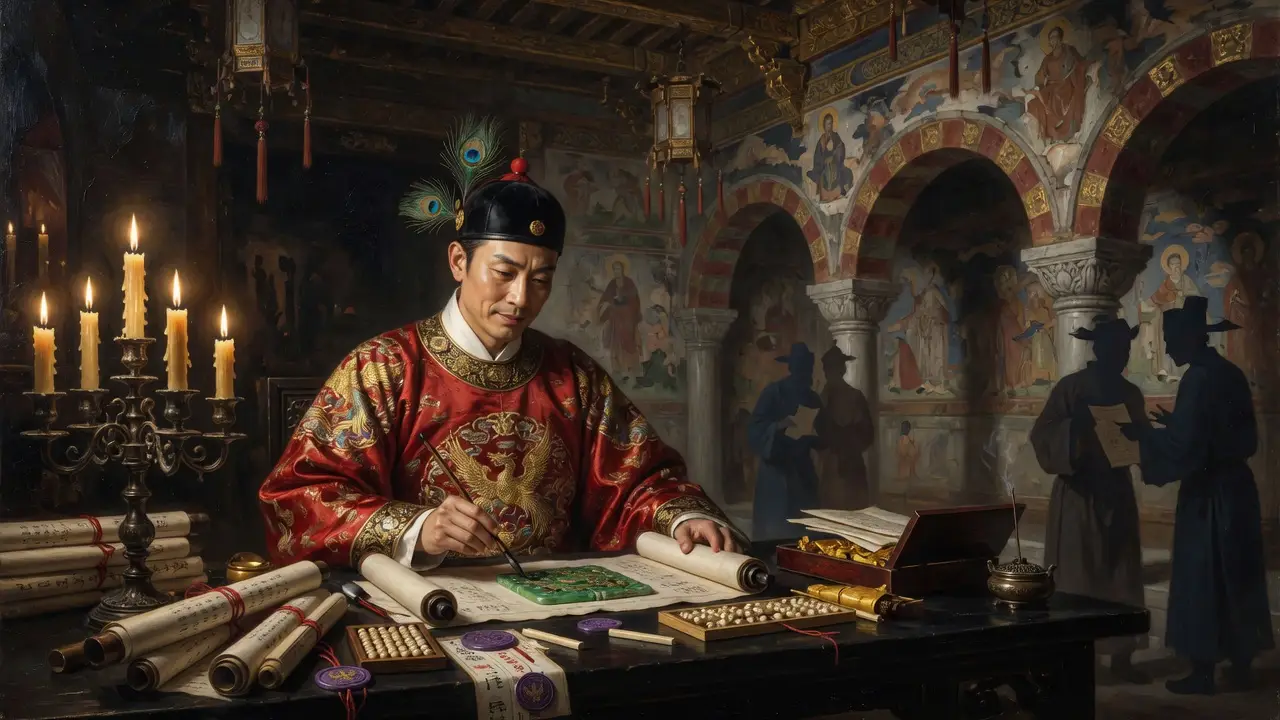
The rulers who created this system believed they had found a perfect mechanism: grant power to men incapable of using it against you. What they consistently failed to account for was that power doesn’t care about biology.
A eunuch with access to the treasury and the emperor’s ear had something more durable than a son: he had information, institutional knowledge, and the patience of a man who had already survived the worst thing that could be done to him. The ambition of eunuchs did not disappear. It rerouted. It expressed itself through adopted sons, political networks, factional alliances, and the slow accumulation of wealth. It expressed itself in legacy, in buildings, in patronage, in the survival of ideas.
Zheng He’s voyages were eventually shut down by Confucian bureaucrats who resented the influence of court eunuchs. The records of his expeditions were deliberately destroyed. A faction of scholars burned the logs of the greatest naval enterprise in pre-modern history because they hated the men who had made it possible. That is how seriously the eunuch question was taken.
The power was real. The threat was real. And the calculation that created them was, in the end, just another miscalculation wearing the costume of pragmatism.
The Part of This Story That Lives in Every Institution
The eunuch system was not a historical aberration. It was a solution to a problem that has never gone away: how do you grant someone enough power to be useful without giving them enough power to be dangerous?
Modern institutions run on the same logic, dressed in different clothes. The chief of staff who knows everything and owns nothing. The advisor who has no constituency of his own. The technocrat who is effective precisely because he cannot be elected. We don’t castrate anyone. We use contracts, NDAs, term limits, and the careful construction of roles designed to be powerful but not threatening.
The emperors of Byzantium, China, and the Ottoman Empire were not barbarians who mutilated servants for sport. They were administrators trying to solve the oldest problem in governance. That they used a brutal method does not make the problem or the logic, any less recognizable.
It just makes us grateful for the paperwork.
They Were the Empire
History remembers the emperors. The ones who commissioned the treasure fleets, who held the throne, who signed the decrees. But the Byzantine Empire that lasted a thousand years was administered, in significant part, by men who were never supposed to matter. The Ming court that sent ships to Africa and Arabia was steered by a castrated boy from Yunnan who became the greatest explorer of his age. The Ottoman palace that shaped the Middle East for six centuries was filtered through men who controlled every door.
They were given nothing and took everything they could reach.
That is not a footnote. That is the story.