Norse traders moved more human cargo across Europe and into the Islamic world than any other group of the era. The longships carried people, not just plunder. Men, women, and children became currency. They were sold, exchanged, transported, and used to fund the same Viking expansion that later generations would turn into myth.
The raids made the headlines of history. But the slave trade may have been the engine that kept the Viking world moving.
The Cargo No One Wanted to Be
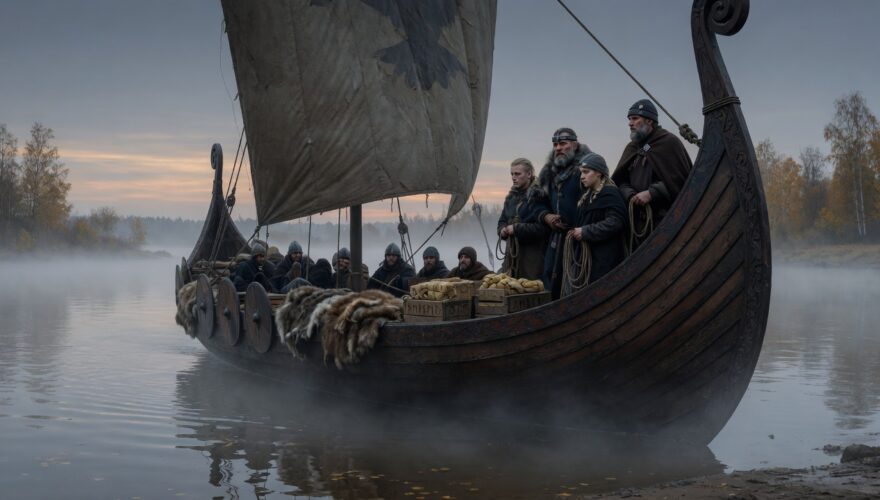
The boy had a name once. By the time the longship reached the Volga, nobody used it. He was cargo now, catalogued alongside furs and amber and walrus ivory, his value assessed by the muscle across his shoulders and the fear in his eyes. The Norse merchant who purchased him in Dublin would sell him again in Bulgar, and someone else would move him south toward Baghdad, where the Abbasid Caliphate had an insatiable appetite for foreign bodies to serve its courts, its households, its harems, and its armies.
This was the Viking Age in full operation. Not the one with the horned helmets and burning monasteries, but the one that actually made Norse civilization wealthy. The raids were theater. The slave trade was the business.
What the Museums Leave Out
The popular image of the Norse warrior is a man who takes things by force and disappears into the fog. It is romantic and cinematic and incomplete. By the ninth century, the Norse had built one of the most sophisticated human trafficking networks the medieval world had ever seen, stretching from the Irish coastline to the Byzantine court, from Scandinavia’s frozen edges to the slave markets of Samarra.
LESSER-KNOWN DETAILS
The Norse established a dedicated slave market on the island of Île de Groix off the Brittany coast, used specifically to process captives from raids on the Frankish coast before transporting them south.
Historians estimate that during the Viking Age’s peak, tens of thousands of people were moved through these networks every decade. Some scholars place the number of enslaved individuals passing through Norse-controlled trade routes in the hundreds of thousands across the full span of the era. To put that in context: the Norse were, for roughly two centuries, the primary suppliers of enslaved people to the Islamic world, a market that paid extraordinarily well and asked very few questions.
The Norse word for a slave was thrall. To be “enthralled” still lives in the English language, long after the institution that coined it collapsed.
How the Network Was Built
It did not begin with grand strategy. It began with opportunity.
When Norse raiders hit the monastery at Lindisfarne in 793, they were not following a business plan. But they quickly learned what sold. Monks were educated, sometimes multilingual, and fetched higher prices. Young women were premium cargo. Healthy men went to agricultural estates or, if lucky, ended up as household servants rather than field labor. Children were easiest to transport and easiest to break into compliance.
Join The Archive Briefing
Weekly dispatches. The history they didn't teach you — sourced, subverted, delivered to your inbox.
LESSER-KNOWN DETAILS
Norse law had a specific legal category called the “freedman,” a former thrall who was free but still owed obligations to their former owner’s family for up to three generations.
The Irish coast became a primary hunting ground. Dublin, established by the Norse around 841, functioned simultaneously as a port city and a clearinghouse for enslaved people. Raids on coastal settlements would funnel captives back through Dublin, where they would be sorted, traded, and re-exported. Frankish chronicles of the period describe Norse ships leaving Irish ports so heavy with human cargo that they rode low in the water.
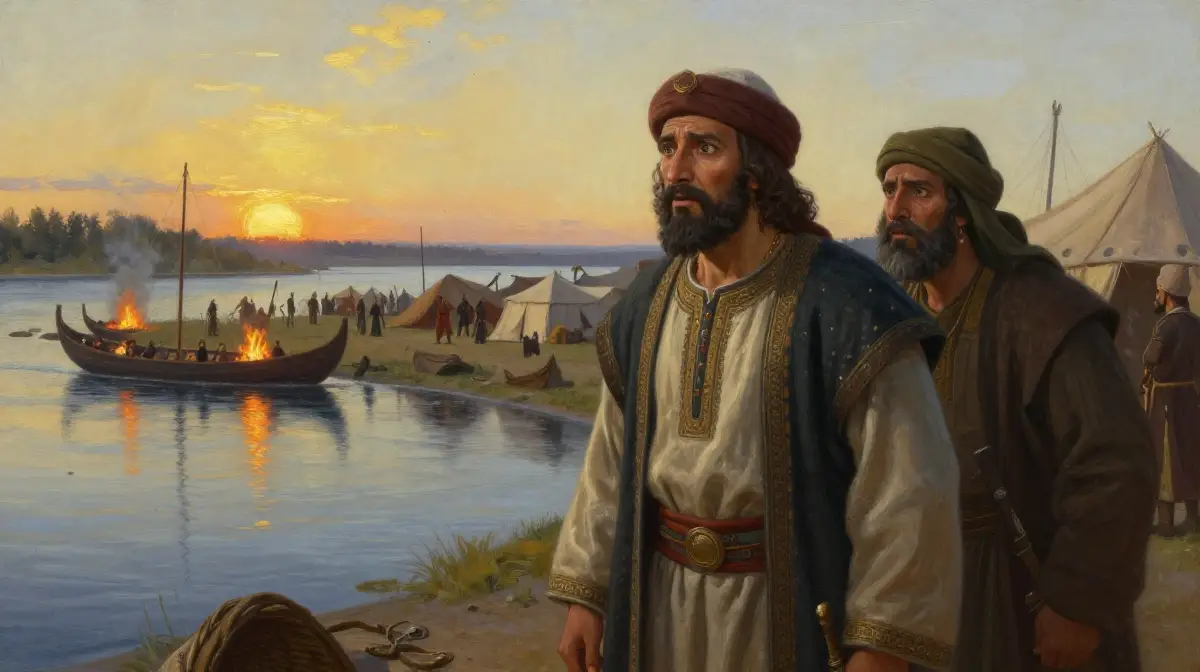
“I have never seen more perfect physical specimens, tall as date palms, blond and ruddy; they wear neither tunics nor kaftans, but the men among them wear a garment which covers one side of the body and leaves a hand free.”
Ahmad ibn Fadlan (921 AD), Arab diplomat and traveler, on witnessing a Rus funeral on the Volga
From the west, the routes went south to Al-Andalus and across the Mediterranean. From the east, the Rus, the Norse settlers who gave Russia its name, built a parallel corridor down the great river systems, the Dnieper and the Volga, toward the Caspian Sea and the Islamic markets beyond. Byzantine Constantinople sat at the intersection, hungry for both slaves and trade goods, content to facilitate both.
The Merchants of the Rus
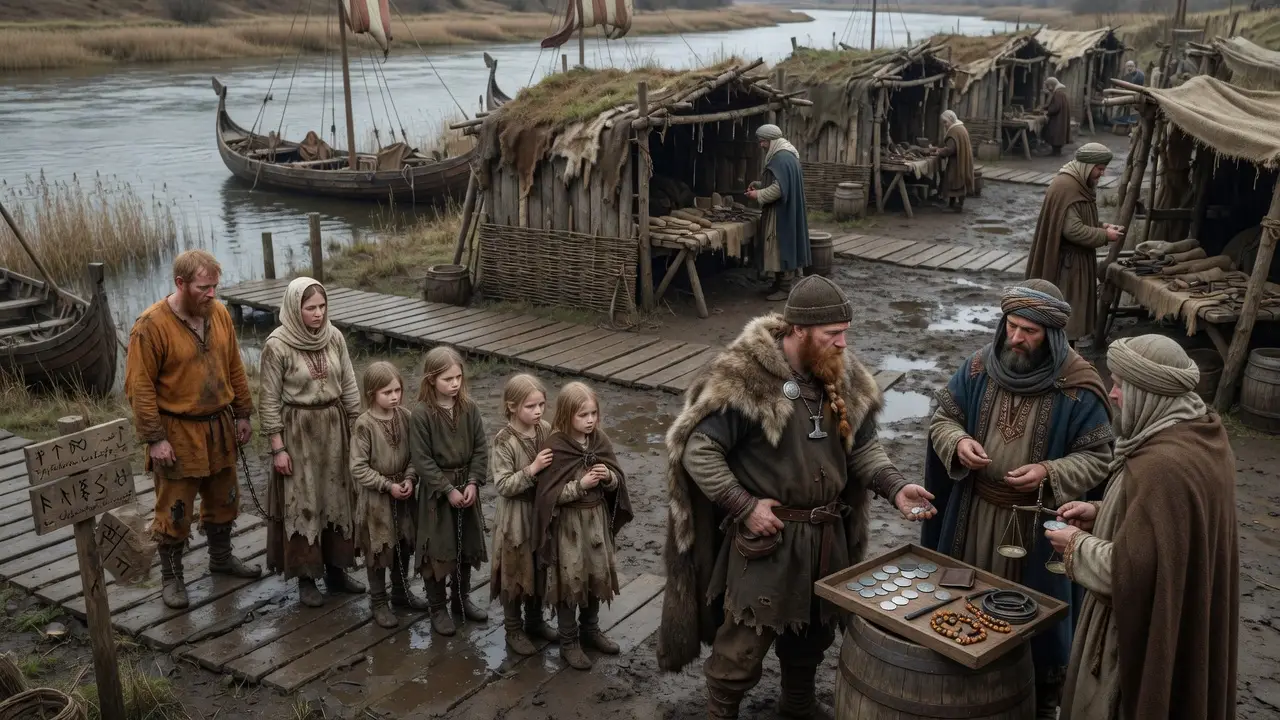
What the Rus built along the eastern rivers was not a raid but an empire of commerce, and it ran on human beings.
Arab traveler Ahmad ibn Fadlan encountered a Rus trading party on the Volga in 921 and left one of the most startling accounts of the medieval world. He described Norse merchants traveling with enslaved women as personal attendants and sexual property, openly bought and sold alongside sable pelts and silver dirhams. Ibn Fadlan was a sophisticated man from a sophisticated civilization, and he was still visibly disturbed. “They are the filthiest of God’s creatures,” he wrote, not as a racial judgment but as a reaction to behavior he found barbaric even by his era’s standards. He described their rituals, their indifference to hygiene, and their complete comfort with a level of human exploitation that shocked a traveler from a world that also kept slaves.
LESSER-KNOWN DETAILS
The term “slave” comes from “Slav” because so many Eastern European Slavic people passed through Norse trade routes that their ethnic name became synonymous with the condition they were sold into.
The Rus were not savages. They were businessmen. Their trading posts along the river routes became permanent settlements, some of which grew into cities. Kyiv, Novgorod, Smolensk: these places began, in significant part, as way stations on a slave corridor. The silver that flooded back into Scandinavia from these eastern routes, Islamic dirhams by the millions, funded the longships, the jewelry, the burial mounds, the entire material culture we associate with the Viking Age.
Take away the slave trade, and the Norse golden age does not look like a golden age.
The Price of a Person
Markets set prices, and the records that survive tell us a great deal about how the Norse and their trading partners valued human beings.
In tenth-century Iceland, the legal code assigned monetary value to thralls for purposes of compensation. A slave was worth roughly half the weregild of a free farmer. In Dublin’s markets, prices fluctuated based on supply, health, and perceived origin. A Frankish captive might command more than an Irish one, simply because Frankish literacy rates were higher and literate slaves were useful. In the Islamic south, young Slavic women commanded extraordinary prices, enough that the word “Slav” itself became so associated with enslaved people that it eventually gave European languages the word “slave.”
“Howth was plundered by the heathens, and they carried off a great number of women into captivity.”
The Annals of Ulster (821 AD), Irish monastic chronicle
The Norse were not the only people doing this. The Arab world, the Byzantines, the Franks, and the Anglo-Saxons all kept slaves. What made the Norse exceptional was their role as the middlemen, the logistical backbone of a continent-spanning trade that connected supply in the northwest with demand in the southeast. They were the infrastructure.
When the System Started to Crack
The trade did not end because of moral awakening. It ended because the economics shifted.
Christianization of Scandinavia, which proceeded unevenly through the tenth and eleventh centuries, brought with it a theological objection to enslaving fellow Christians. This was not an absolute prohibition, but it added friction. A Norse lord who raided an Irish village in 900 had no religious hesitation. A Norse lord who had been baptized raiding a village of baptized Christians in 1050 had, at minimum, a theological complication to manage.
“They bring sable, squirrel, and other furs, as well as swords, from the far north to the Sea of Rum… They sell male and female slaves.”
Ibn Khordadbeh (ca. 870 AD), Arab geographer, describing Rus traders
The Islamic silver economy also began to contract. The Abbasid Caliphate’s slow fragmentation reduced the purchasing power of the eastern markets. The river routes became less profitable. The Norse trading empire that had enriched Scandinavia for two centuries began to look less like an opportunity and more like a liability.
Slavery itself did not vanish. It transformed, slowly, into serfdom, a different form of bondage that tied people to land rather than to chains, and which the church found far easier to tolerate. The moral evolution was modest. The structural change was significant.
The Footprint That Remains
The genetic evidence has been the most recent revelation. Studies of Irish, Scottish, and Icelandic DNA show significant Norse markers throughout populations, but also show the movement of people from the British Isles, from Eastern Europe, from across the former slave routes, embedded in populations thousands of miles from where those ancestors were born. The slave trade did not just move people temporarily. It moved them permanently, erasing their names and scattering their descendants across continents.
Kyiv’s founding mythology does not celebrate its origins as a waystation for human cargo. The romantic image of Dublin as a Viking city rarely mentions that its economy ran on enslaved people for over a century. Icelandic sagas reference thralls casually, in passing, the way you might mention a tool used and put away.
The Norse did not invent slavery. They did not invent the slave trade. What they did was industrialize it, optimize it, and make it efficient enough to fund a civilization. That distinction matters because the Viking Age is still romanticized in ways that other slave-trading cultures are not. The longship is a symbol of adventure. What it was also carrying deserves the same attention.
The Boy on the Volga
We do not know what happened to the boy from the opening of this story. We do not know his name, his mother’s name, or where exactly the raid that took him happened. That absence is itself the point. The historical record preserves the names of the merchants, the prices at major markets, the political alliances between the Rus and the Byzantines. It preserves almost nothing of the people who were traded.
“The city is full of the idolatrous rites of the Slavs, and trade in female slaves is most common there.”
Adam of Bremen (ca. 1075 AD), German chronicler, on Hedeby, the Norse trading city
The Viking Age was real and complex and genuinely remarkable. But the wealth that built it, the silver that paid for the ships, the furs, the amber, the elaborate burials, a significant portion of that came from selling people who had no say in the matter.
History has a habit of remembering the people holding the ropes. The ones tied to them take longer to find.