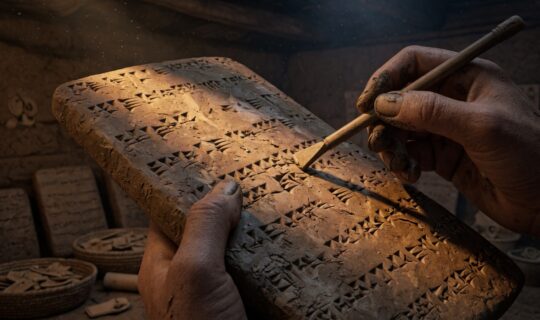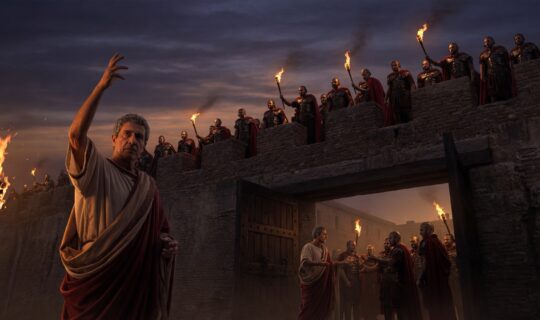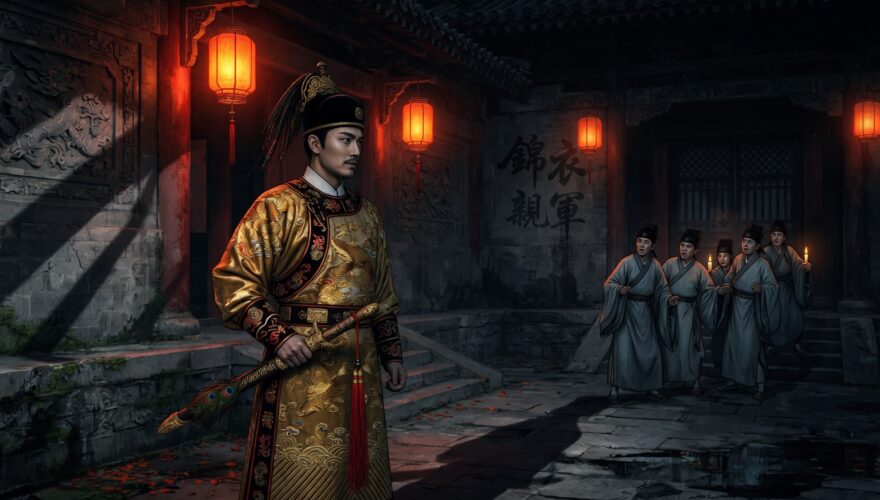
In ancient China, emperors did not merely kill rivals. They buried scholars alive, erased entire noble families, built surveillance states, and ordered purges so vast they swallowed tens of thousands at a time. Dynasties rose with promises of order, only to discover that fear could govern faster than justice.
This is not a story about one tyrant. It is a story about empires that built civilization with one hand and buried the cost with the other.
The Ground Was Still Wet
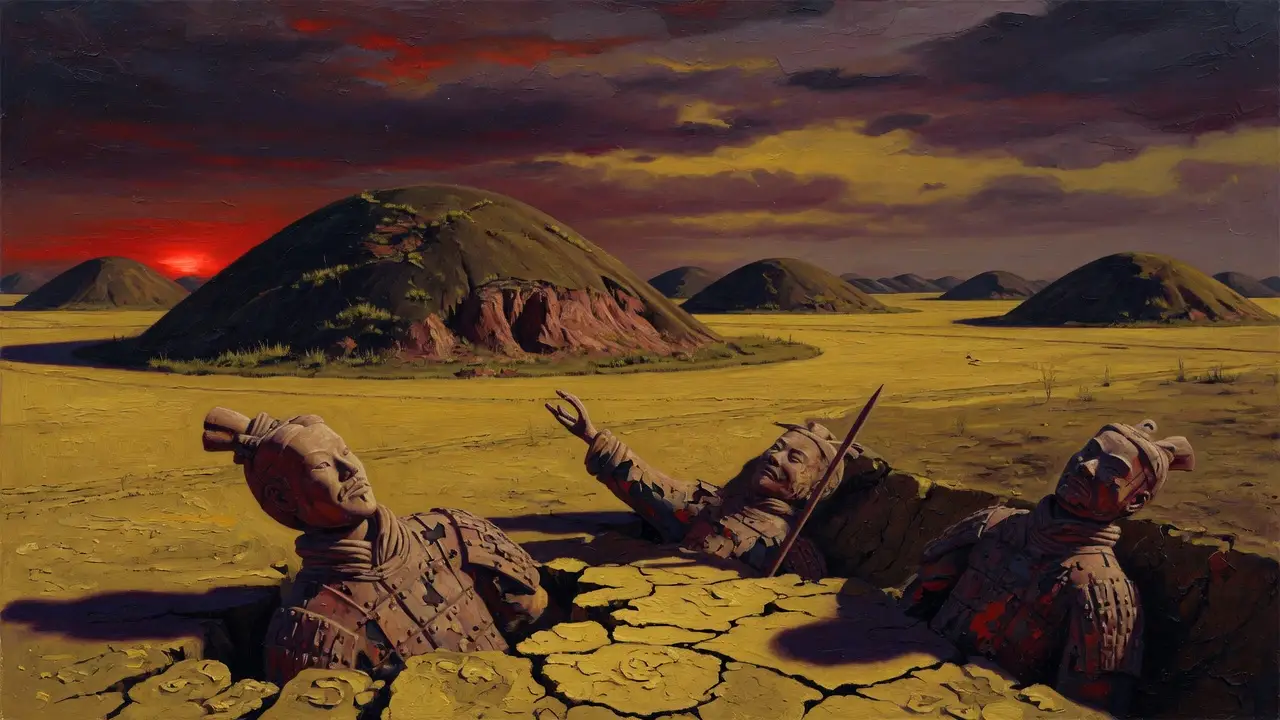
In 210 BCE, somewhere beneath the fields of modern-day Shaanxi province, workers were still pressing soil over the bodies. Not one body. Not a hundred. Estimates range from several hundred to over a thousand living people sealed alive inside the tomb complex of China’s first emperor, Qin Shi Huang. Concubines who had never borne him children. Craftsmen who knew the location of every trap, every mechanism, every river of mercury flowing through the burial chambers. They knew too much. So they went in, and they did not come out.
Western schoolchildren learn about Nero. About Caligula. About the horrors of the Roman Colosseum. But the scale of what happened in China across two thousand years of dynastic rule dwarfs most of what Europe produced in the same centuries, and almost none of it makes it into the standard curriculum. The purges were larger. The body counts were higher. The bureaucratic machinery of state violence was more sophisticated, more deliberate, and in some cases, more coldly efficient than anything the Roman Senate ever dreamed up.
This is not ancient history as a curiosity. It is a story about what power does when it has no ceiling.
The Dynasty That Built Everything by Destroying Everyone
The Qin Dynasty lasted fifteen years. Fifteen. In that window, it unified a fractured continent, standardized weights and measurements, built the first version of the Great Wall, and executed or enslaved millions of people in the process.
Qin Shi Huang was not a madman in the way Hollywood imagines tyrants. He was methodical. His advisor Li Si helped him design a state that ran on fear as efficiently as it ran on grain. The Legalist philosophy underpinning Qin rule was blunt: human beings are inherently selfish, and only the threat of severe punishment keeps society functional. This was not a fringe view. It was government policy.
“Those who use the past to criticize the present should be put to death along with their families.”
Li Si, Chief Advisor to Qin Shi Huang, on the Burning of the Books (213 BCE)
The Burning of the Books in 213 BCE gets mentioned occasionally in Western surveys of Chinese history, usually as a footnote about censorship. What gets left out is what happened the following year. Qin Shi Huang, increasingly paranoid after failed assassination attempts and convinced that Confucian scholars were undermining his authority, had somewhere between 460 and 700 scholars buried alive. The precise number is debated. The method is not. They were put in pits and covered with earth while still breathing.
The emperor called it necessary. His son inherited a state so tightly wound around terror that within three years of Qin Shi Huang’s death, it collapsed entirely under the weight of its own accumulated rage.
Join The Archive Briefing
Weekly dispatches. The history they didn't teach you — sourced, subverted, delivered to your inbox.
What the Han Inherited and What They Kept
The Han Dynasty that followed is generally framed as a golden age, and in many respects it was. Confucianism returned. Trade expanded. The Silk Road began to take shape. But the Han also inherited the Qin’s appetite for mass reprisal, and they used it.
Emperor Wu of Han, who ruled for over fifty years in the second and first centuries BCE, is celebrated as one of China’s greatest emperors. He expanded the empire dramatically, pushed back the Xiongnu confederation in the north, and patronized arts and scholarship. He also executed his own ministers with remarkable frequency. His reign saw multiple purges of court officials accused, sometimes credibly and sometimes not, of practicing black magic against him.
LESSER-KNOWN DETAILS
The mercury rivers in Qin Shi Huang’s tomb are real. Modern soil surveys have detected abnormally high mercury concentrations around the mausoleum site, lending credibility to Sima Qian’s claim that mechanical rivers of liquid mercury were built inside. The tomb has never been fully excavated.
The witchcraft trials of 91 BCE stand largely unknown outside specialist circles. They are called the Gu Witch Hunt, and they consumed the imperial court for years. Starting from a single accusation, the investigations spread outward in concentric circles of suspicion. People accused their neighbors to save themselves. Officials denounced rivals. The crown prince was implicated. In the chaos that followed, the prince raised an army in a desperate act of self-preservation, lost, and committed suicide. His mother and thousands of people connected to the accusations were killed. Entire noble families were wiped from the historical record.
It bears repeating: this happened a century before the birth of Christ, in a civilization that was already ancient.
The Ming and the Art of the Purge
If the Qin perfected blunt violence, the Ming Dynasty refined it into something almost bureaucratic in its precision.
Zhu Yuanzhang, who founded the Ming Dynasty in 1368, was a peasant who had survived famine, plague, and the collapse of the Yuan Dynasty. He was also, by most historical accounts, profoundly and permanently suspicious of everyone around him. His reign produced two of the largest political purges in pre-modern human history.
Of ten houses, nine stand empty. Fields are overgrown. The bones of the unburied lie across the roads.”
A Tang Dynasty memorial on the An Lushan Rebellion aftermath
The Hu Weiyong case began in 1380 when Zhu accused his own prime minister of plotting treason. Hu was executed. Then his associates were investigated. Then their associates. Over the following decade, an estimated 30,000 people were killed in the aftershocks of a single accusation. Not rebels. Not soldiers. Bureaucrats, scholars, minor officials, family members of family members. The scale of the purge was so extreme that Zhu abolished the position of prime minister entirely afterward, consolidating all executive power directly in the emperor’s hands.
He was not finished. The Lan Yu case in 1393 produced another wave of executions estimated at 15,000 people. General Lan Yu, a decorated military commander, was accused of planning a coup. Whether the plot was real has been debated for centuries. What is certain is that the wave of arrests that followed consumed a substantial fraction of the Ming military’s senior leadership.
LESSER-KNOWN DETAILS
The Yangzhou survivor account was banned for over 200 years. The Qing government classified it as seditious. It resurfaced in the early twentieth century during a surge of Han nationalist sentiment and became politically explosive almost immediately.
Together, the two purges may have killed close to 100,000 people across their full extent. For comparison, the Spanish Inquisition, often invoked as the benchmark of institutional religious terror, is estimated to have executed between 3,000 and 5,000 people over three and a half centuries.
The numbers are not close.
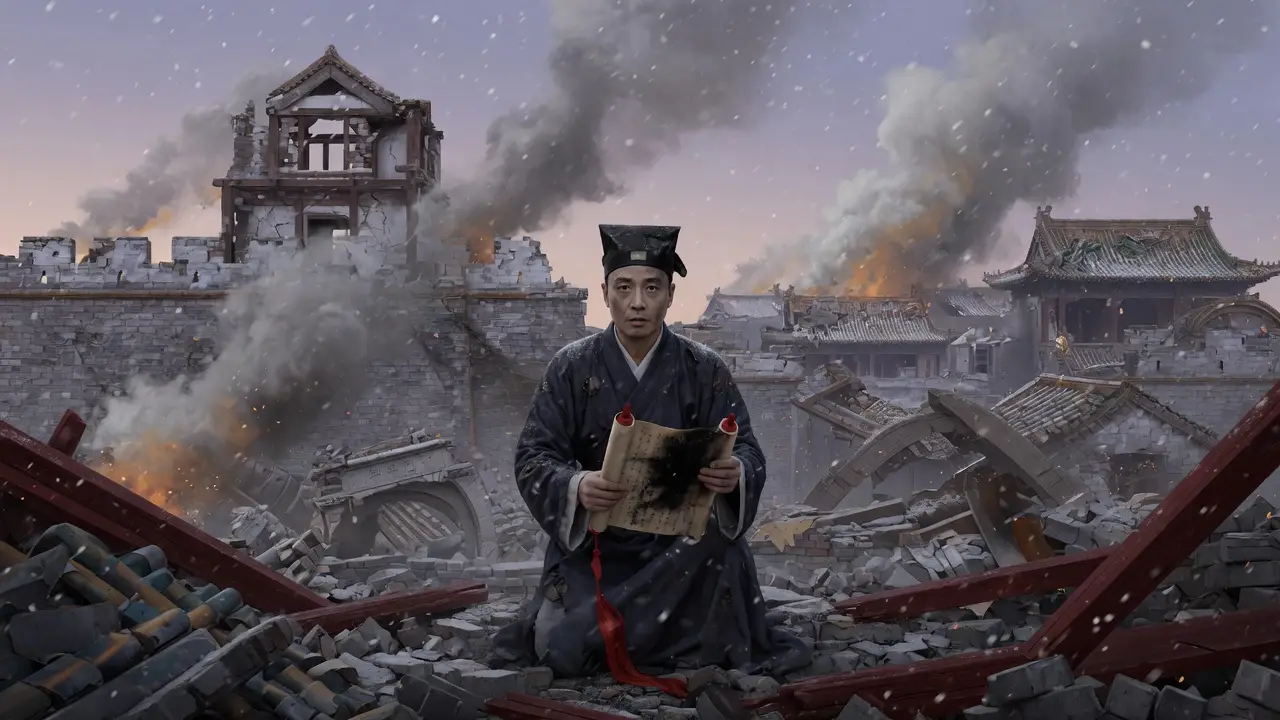
The Instruments of Control
What made Chinese dynastic violence so systematically devastating was not cruelty for its own sake. It was the infrastructure.
The Ming operated the Jinyiwei, a secret police force established by Zhu Yuanzhang in 1368. These were not informal informants. They were a parallel legal system with their own courts, their own prisons, and their own methods of interrogation. They reported directly to the emperor, bypassed the regular judiciary entirely, and could arrest, try, and execute anyone, including other government officials, without standard legal review.
“The slaughter went on for ten days. I heard nothing but the sound of crying, and then nothing at all.”
Survivor account from the Yangzhou massacre, Ji Liuqi’s records
The Jinyiwei maintained files. They built networks of informants inside the imperial court and across the provinces. They were expanded in the fifteenth century by the addition of the Dongchang, the Eastern Depot, another secret agency that eventually monitored the Jinyiwei themselves. At its height, the Ming surveillance apparatus had no real equivalent in the contemporary world.
Europeans in the same period had inquisitions and star chambers. China had something more modern in its architecture: a layered, institutional surveillance state operating at continental scale.
A Continent Drowning in Its Own History
By the time the Ming fell to the Qing in 1644, the accumulated weight of dynastic violence across Chinese history represented something that Western historiography has never fully reckoned with. The An Lushan Rebellion of the Tang Dynasty in the eighth century CE may have killed between 13 and 36 million people, according to census comparisons from before and after the conflict. To put that in context: the entire population of Europe at the time was approximately 25 to 30 million.
One rebellion. In one dynasty. Potentially more deaths than the entire population of the European continent.
The Mongol conquest of northern China in the thirteenth century reduced the population of some regions by sixty to seventy percent. Cities that had held hundreds of thousands of people were left with thousands. The scholar and statesman Ye Shi wrote of riding through regions where the only sound was wind.
“I started from the humblest origins. I have seen what chaos does to a country. I will not permit it again.”
Zhu Yuanzhang (Ming Taizu), on his purges
These events shaped Chinese political philosophy in ways that still echo. The concept of the Mandate of Heaven, which held that a dynasty’s right to rule was contingent on its virtue and competence, was in part a cultural response to the existential experience of watching entire civilizations be dismantled and rebuilt within a single lifetime. It was not abstract theology. It was a survival mechanism written into the political DNA of a civilization.
The Echo That Doesn’t Fade
The Ming-Qing transition of the seventeenth century produced massacres so systematic they have entire academic subfields dedicated to documenting them. The Yang Zhou massacre of 1645, carried out by Qing forces against a city that resisted submission, killed somewhere between tens of thousands and hundreds of thousands of people in ten days. A survivor account, the Yangzhou Shiri Ji, or Ten Days at Yangzhou, circulated in manuscript form for over two centuries before being published. The Qing government suppressed it. The document survived anyway.
LESSER-KNOWN DETAILS
Zhu Yuanzhang reportedly read every piece of government correspondence personally. Court records suggest he reviewed hundreds of memorials daily in his later years, sleeping only a few hours a night. His paranoia was, in a way, a product of his own refusal to delegate power.
History has a way of surviving suppression. Not always intact, not always in time to matter, but it survives.
What the full span of Chinese dynastic violence tells us is not that Chinese civilization was uniquely monstrous. It tells us something about the nature of unchecked central power operating at a scale that most of human history has never encountered. The Roman Empire at its height governed around 70 million people. The Han Dynasty governed roughly the same number at roughly the same time, with comparable administrative reach and comparable capacity for coordinated violence.
The difference is that Rome gets the textbooks, the films, the television series, and the cultural shorthand for ancient empire. China gets a chapter, sometimes two, and then the curriculum moves on.
That gap is not a minor oversight in education. It is a distortion in how the modern world understands the past, and by extension, how it understands the present.
The ground beneath Shaanxi is still full of people who knew too much.