Forget the conspiracy noise. These shadow networks left fingerprints on wars, governments, and the modern world itself.
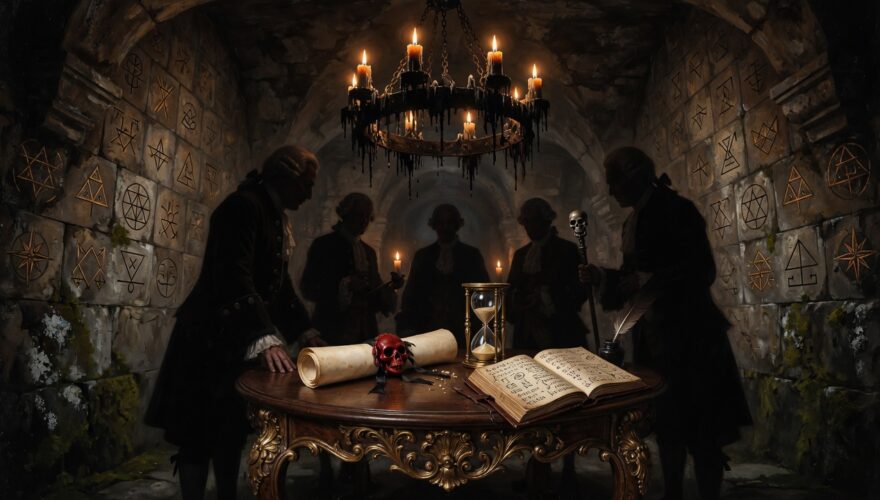
On the night of May 1, 1776, a Bavarian law professor lit a candle in his study in Ingolstadt, drew his curtains against the German dark, and founded an organization he believed would change the world. His name was Adam Weishaupt. His organization had five members. Within a decade, it had penetrated the courts of Europe, horrified the Catholic Church, and sparked a moral panic so intense that governments across the continent declared it a criminal conspiracy. Then, officially, it vanished. What happened next is the story of how real power actually works: not in parliaments or public squares, but in sealed rooms, between men who trust one another completely and answer to no one else.
We have spent two centuries drowning in myths about secret societies. Shadowy cabals pulling every lever of history, lizard people, ancient bloodlines, illuminated dollar bills. It is seductive nonsense, and it does real damage: it distracts us from the documented, verifiable, genuinely unsettling truth that networks of powerful men have repeatedly operated in the shadows and shaped the world the rest of us inhabit. The societies in this piece are not conspiracy theory. They are history. They left paper trails, court records, congressional testimony, and bodies.
The Bavarian Illuminati: The Real One
Weishaupt was not a mystic. He was a rationalist and a radical, shaped by the Enlightenment and furious at the grip of the Jesuits on European universities. His Ordo Illuminatorum, the Order of the Illuminati, was built not around ceremony or ritual but around a clear political purpose: to oppose superstition, religious authority, and the abuse of state power. Recruits were graded into nested tiers of knowledge, each level revealing more of the order’s true agenda. By the time a member reached the inner circle, he understood that Weishaupt’s goal was nothing less than a world governed by reason, without kings or priests.
The order was extraordinarily effective for its size. Weishaupt recruited through Freemasonry, embedding Illuminati cells inside lodges across Bavaria, Austria, and France. By 1784, membership had grown to somewhere between two thousand and three thousand people, including writers, reformers, courtiers, and military officers. Then the Bavarian government, tipped off by a defector, raided the order’s networks and published its seized documents. The resulting scandal was enormous. The order was banned. Weishaupt fled into exile. And a thousand years of conspiracy theory were born from the wreckage, because readers who encountered the Illuminati’s real documents, plans for a rational world order, elimination of hereditary privilege, separation of church from governance, could not believe any human being had actually written such things. The scandal became legend. The legend became myth. The myth swallowed the history whole.
LESSER-KNOWN DETAIL
Among the seized Illuminati documents was a detailed grading system for evaluating recruits based on psychological profiles. Weishaupt explicitly instructed recruiters to look for ambitious men with fragile egos, because they were easier to manage. The order was as much a study in manipulation as it was in ideology.
Skull and Bones: When the Club Runs the Country
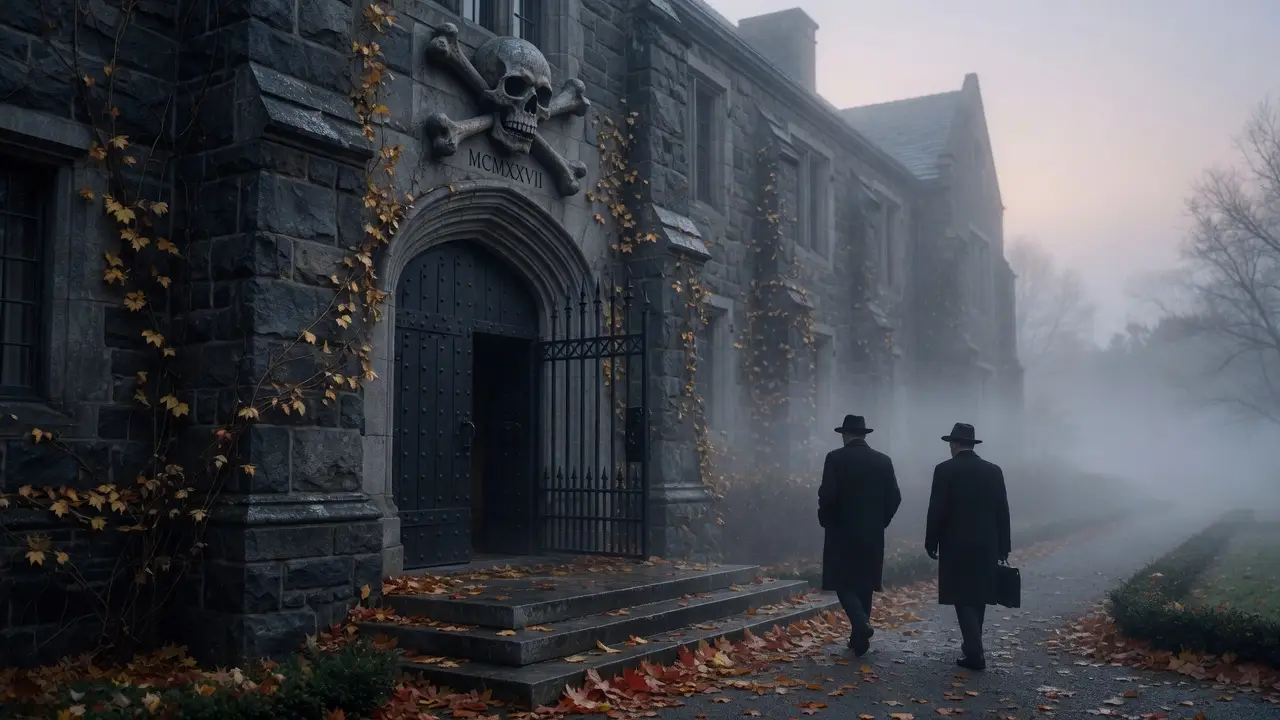
In 1832, a Yale student named William Huntington Russell came home from a year in Germany deeply impressed by the tradition of elite secret student fraternities he had encountered there. He co-founded a similar society at Yale, officially called the Brotherhood of Death, informally known as Skull and Bones. New members, called “Bonesmen,” were selected by the current senior class each year, fifteen at a time. Initiation involved rituals in a building on campus known simply as the Tomb, a windowless, brown-stone structure whose interior no non-member has ever reliably described.
For the first century of its existence, Skull and Bones was primarily a social elevator, a mechanism for binding together the sons of America’s ruling class before they dispersed into law, banking, and government. Then the twentieth century arrived, and the binding became something more operationally interesting. When the Office of Strategic Services, the wartime intelligence organization that became the CIA, needed founding personnel in the 1940s, it turned with notable consistency to men from exactly this world. William F. Buckley Jr. was a Bonesman. So were McGeorge Bundy, who shaped American foreign policy during Vietnam, and James Schlesinger, a CIA director. George H.W. Bush was a Bonesman and later led the agency himself. His son, George W. Bush, was also a Bonesman. His opponent in the 2004 presidential election, John Kerry, was equally a Bonesman. America chose its president that year from a pool of men who had both completed the same secret initiation ritual in New Haven, Connecticut.
“The consensus in elite circles was that these men knew how to keep a secret. That was the whole point.”
Ron Rosenbaum, Journalist, Esquire, 1977
What Skull and Bones actually did, beyond generating an extraordinary density of CIA directors and secretaries of state, is difficult to pin down precisely because it is, by design, a secret. What is documented is the network: the lifelong bonds, the professional patronage, the tendency of Bonesmen to hire other Bonesmen, to recommend them, to trust them in rooms where trust is the entire currency. This is not conspiracy. This is just how power reproduces itself, and Skull and Bones did it with unusual efficiency for nearly two centuries.
“America chose its president in 2004 from a pool of men who had completed the same secret initiation ritual at Yale. Neither man mentioned it.”
Join The Archive Briefing
Weekly dispatches. The history they didn't teach you — sourced, subverted, delivered to your inbox.
The Round Table: Empire Designed in Private
In 1891, the British imperialist Cecil Rhodes sat down with a small group of like-minded men in London and created what he called a “society of the elect,” dedicated to the perpetuation and expansion of the British Empire across the globe. Rhodes had already made a fortune in South African diamonds and used it to fund his political vision with a methodical, almost chilling consistency. His will famously created the Rhodes Scholarships, but the more consequential legacy was the network he seeded during his lifetime.
After Rhodes died in 1902, his associate Alfred Milner transformed the loose organization into something more structured, a tiered network of inner and outer circles that became known as the Round Table. The inner circle, sometimes called the “Kindergarten” for the young imperial administrators Milner had recruited and shaped in South Africa, operated with no public profile whatsoever. The outer circle published a journal called The Round Table, still in existence today, which functioned both as genuine intellectual output and as a respectable facade for the network behind it.
What the Round Table actually accomplished is visible in the historical record if you know where to look. Its members were instrumental in structuring the League of Nations after the First World War. They played a significant role in designing the post-war international institutions that defined the twentieth century. Crucially, they founded the Council on Foreign Relations in 1921, which became and remains the dominant foreign policy think tank in the United States. The Round Table is what it looks like when an imperial network disciplines itself to think generationally, and plans for the world its grandchildren will govern rather than the one its founders inhabit.
Propaganda Due: When the Lodge Tries to Run Italy
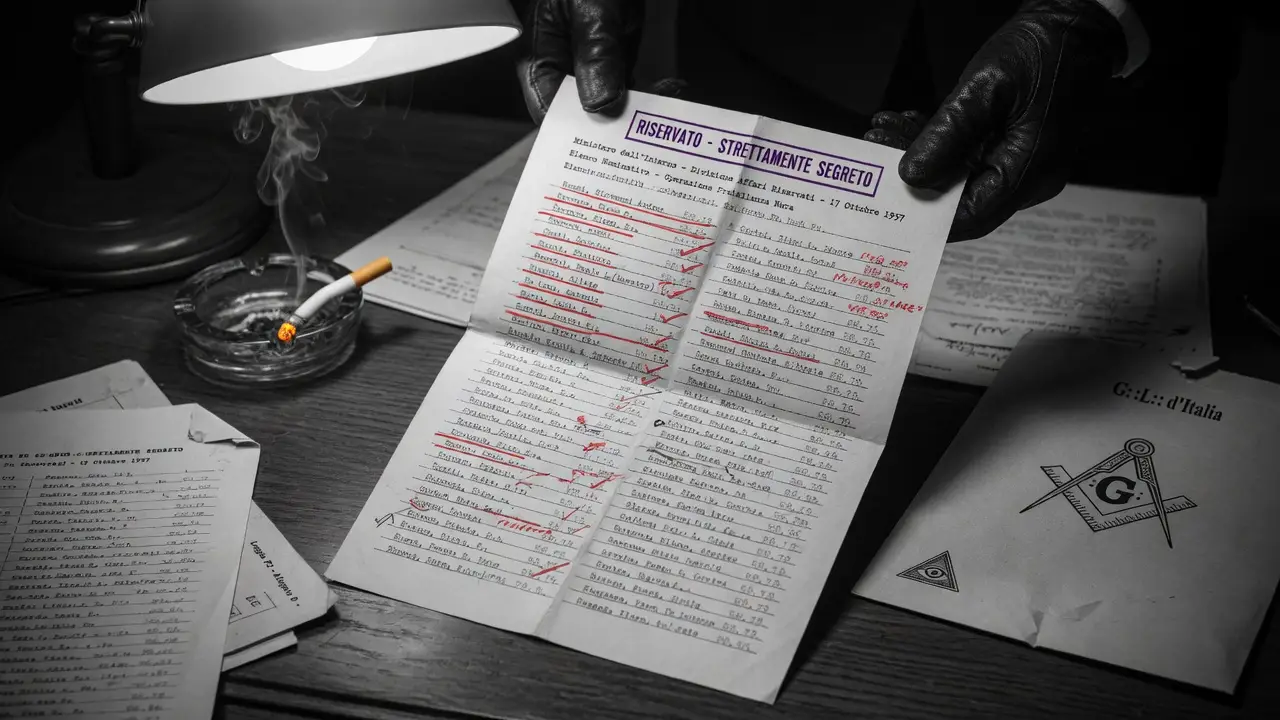
By 1981, Italy was in crisis. Red Brigade terrorists were murdering politicians and businessmen. The economy lurched between crises. The government changed hands with exhausting frequency. And then, in March of that year, police raiding the villa of a financier named Licio Gelli discovered a list. It contained nine hundred and sixty-two names. What followed was one of the most dramatic political scandals in European postwar history, because those names included three cabinet ministers, forty members of parliament, forty-three generals, eight admirals, the heads of all three Italian intelligence services, and the director of the Italian central bank.
They were all members of Propaganda Due, known as P2: a lodge of the Grand Orient of Italy, a Masonic organization, that Gelli had transformed into something the Italian parliament later described with unusual clarity as a “state within the state.” P2 did not merely connect powerful men. It coordinated them. Gelli used the lodge to place members in strategic positions across every institution of Italian life, then leveraged those placements to protect certain financial interests, block certain investigations, and redirect the flow of Italian politics away from outcomes that threatened the network’s collective interests.
THE WIDER CONNECTIONS
The P2 investigation revealed that Gelli had connections to the Argentine military junta, had facilitated the laundering of money linked to the Vatican Bank scandal that killed banker Roberto Calvi, and had possessed documents belonging to every major Italian intelligence service simultaneously. He was, in effect, his own intelligence agency.
The Italian government dissolved P2 and passed legislation banning secret associations with political aims. Gelli fled to South America but was eventually extradited, tried, and convicted of multiple offenses. Several P2-linked figures were implicated in the 1980 Bologna train station bombing that killed eighty-five people. The full truth of what P2 did and why has never been completely established, which is, in a sense, the most frightening fact of all: even after the list was found, even after years of trials and parliamentary commissions, the complete picture remained just out of reach.
The temptation, when writing about secret societies, is to reach for either of two cheap conclusions: that they control everything, or that they control nothing. Both are wrong and both are comfortable, which is usually a sign that you should avoid them.
What the Illuminati, Skull and Bones, the Round Table, and P2 actually demonstrate is something more specific and more useful. They show that formal institutions, governments, courts, parliaments, intelligence agencies, are consistently vulnerable to informal networks operating inside them. They show that trust, the deep trust that comes from shared ritual, shared secrets, shared ambition, functions as a kind of parallel governance structure that formal accountability cannot easily reach. And they show that when these networks are finally exposed, the exposure is almost always accidental: a defector, a police raid, a list found in a villa.
The question that lives after all the trials and commissions and revelations is not whether powerful people form private networks. They always have and they always will. The question is what you build, in terms of transparent institutions and genuine accountability, to ensure that those networks do not become the actual architecture of power. Most societies, at most points in history, have not built it well enough. Occasionally, they have been forced to try harder. That forcing has never come from anywhere except the moment the curtain was pulled back and ordinary people saw exactly who was behind it.
The most dangerous secret is not the one kept by a shadowy organization in a sealed room. It is the one kept by the assumption that power, by its nature, operates in the open.